

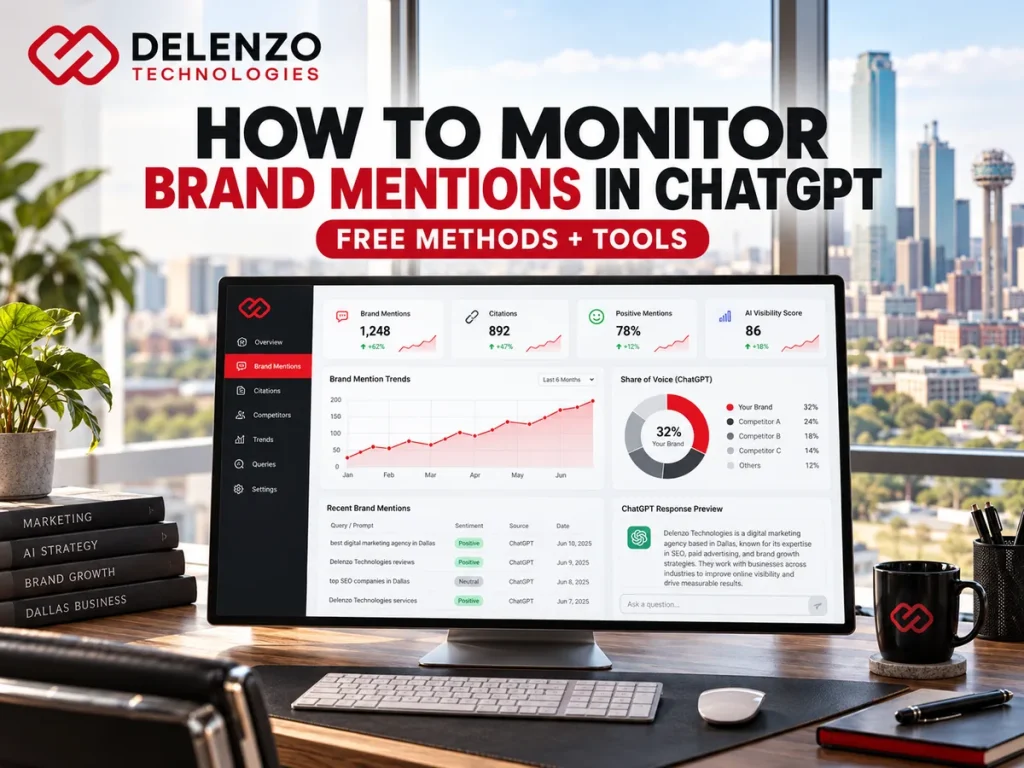
Customers now ask ChatGPT to compare companies and recommend providers. Many buying journeys start inside an AI answer. Yet ChatGPT gives brands no Search Console-style report of those answers. To know where you stand, you need a repeatable testing method. You can run the same buyer prompts on a schedule, or use a platform that does it at scale. This guide to monitoring brand mentions in ChatGPT covers both routes, plus formulas, tools, and fixes.
Quick Answer: You can monitor brand mentions in ChatGPT in two ways. Test a fixed set of buyer prompts manually for free, or use an AI visibility tool that samples answers repeatedly. Both methods track mentions, citations, and competitors over time. Consistent prompts matter more than any single answer.
What Is a Brand Mention in ChatGPT?
A brand mentioned in ChatGPT is any answer where your company name appears. Not every mention carries the same value, though. There are four types, and each tells you something different. Knowing them is the first step in learning how to see brand mentions in ChatGPT clearly.
Direct Mention
A direct mention happens when ChatGPT names your brand in an answer. For example, an answer might list Ahrefs, Semrush, and Moz as SEO platforms. It shows awareness, but not always a recommendation.
Recommendation
A recommendation is stronger than a plain mention. ChatGPT puts your brand in a shortlist, a “best” answer, or a category comparison. It matters more because the person asking is often close to buying.
Citation
A citation means ChatGPT links to or references your website as a source. A mention means your brand name appears in the answer text. The two are not the same. Your page can even be cited while a competitor is named as the answer.
Competitor Mention
A competitor mention happens when ChatGPT names rival companies and leaves yours out. This is the gap you most need to find, because it shows which buyer prompts your competitors own.
| Type | What It Means | Why It Matters |
|---|---|---|
| Direct mention | Your brand name appears | Shows basic awareness |
| Recommendation | Your brand is suggested or shortlisted | Influences buying decisions |
| Citation | Your website is linked as a source | Shows AI trusts your content |
| Competitor mention | Rivals appear and you do not | Reveals visibility gaps |
A mention names your brand, a recommendation suggests it, and a citation links to your site as a source.
Can You Track ChatGPT Brand Mentions Directly?
Not through a native report. OpenAI gives publishers crawler controls and a way to track clicks from ChatGPT. Its public publisher guidance does not offer a dashboard of every answer that names your brand. Many marketers look up how you can track brand mentions in ChatGPT and expect a built-in report. In practice, you measure it yourself or use a third party tool.
That gap is the reason AI visibility platforms exist. They run prompts, read the answers, and report what they find.
Monitoring Is Sampling, Not a Complete Feed
ChatGPT monitoring works by sampling answers, not by reading every conversation. Private user chats are never visible to brands or tools. Any honest guide on how to track ChatGPT brand mentions describes a sampling process. Most tools follow these steps:
- Build a set of prompts.
- Run them repeatedly.
- Collect the AI responses.
- Search each response for your brand.
- Compare results against competitors.
- Track changes over time.
This is why two tools can give the same brand different visibility scores. Each tool can differ in:
- Prompt lists and wording
- How often prompts run
- Which AI models are tested
- Location settings
- Sample size
- Scoring formulas
ChatGPT answers also shift between runs, so more samples give a more reliable average. Treat any single score as an estimate, not a fixed rank.
How to Check Brand Mentions in ChatGPT for Free
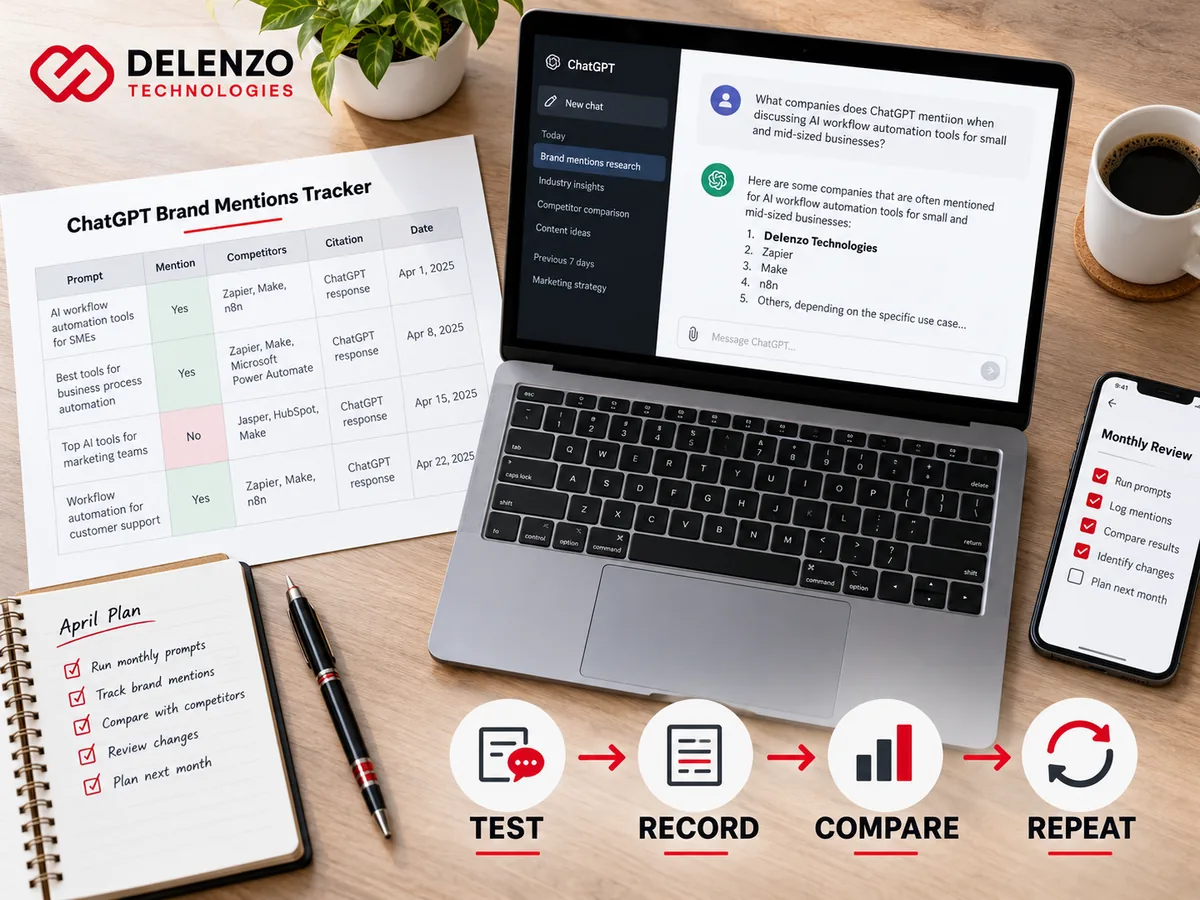
The free method is simple. Test a fixed set of prompts and log every answer in one place. Learning how to check brand mentions in ChatGPT takes four steps and about an hour for the first round.
Build Your Prompt Set
Start with prompts a real buyer would type. A prompt like “Tell me about [Your Brand]” only tests branded awareness. Non-branded prompts show whether new buyers can find you. Split your prompts into five groups:
| Prompt Type | Example Prompt | What It Tests |
|---|---|---|
| Category | List the best SEO agencies for US businesses. | Category visibility |
| Comparison | Compare SEO agencies that also handle AI search visibility. | Shortlist strength |
| Problem | Recommend a company that can improve visibility in ChatGPT and Google AI Overviews. | Problem and solution fit |
| Use case | Suggest good digital marketing agencies for ecommerce brands. | Niche relevance |
| Competitor | Compare [Your Brand] and [Competitor] for SEO services. | Head to head framing |
Aim for 20 to 30 prompts in total. Mix branded and non-branded prompts across all five groups.
Create Prompt Variations
Write 3 to 5 versions of each important prompt. AI answers depend heavily on wording, so one phrasing can mislead you. Take the prompt “best SEO agency for small businesses” as an example. Test these versions as well:
- best SEO company for small businesses
- recommended SEO agencies for growing businesses
- SEO firms for small business growth
- the right SEO company for a small business to hire
If your brand appears in four of five versions, that signal is strong. If it shows up in only one, the signal is weak.
Keep Testing Conditions Consistent
Use the same setup for every round of tests. Record these details each time:
- Date of the test
- ChatGPT model used
- Whether web search was on
- Location or target market
- Exact prompt text
- Full response
- Competitors mentioned
Use a temporary chat or a clean account where possible. Saved memory and chat history can shape answers. Consistency matters more than chasing a perfect test.
Record Results
Log every answer in one sheet. A simple table turns random checks into data you can compare each month.
| Prompt | Brand Mentioned | Competitors Named | Citation and Context |
|---|---|---|---|
| Best SEO agency for small businesses | Yes | Brand A, Brand B | Cited, positive shortlist |
| Agencies for AI search optimization | No | Brand A, Brand C | Not cited, absent |
| SEO firms for ecommerce growth | Yes | Brand B | Not cited, neutral mention |
A good tracking sheet records the prompt, the mention, the competitors, and whether your site was cited. Add a date column in your own copy.
How to Calculate ChatGPT Brand Visibility
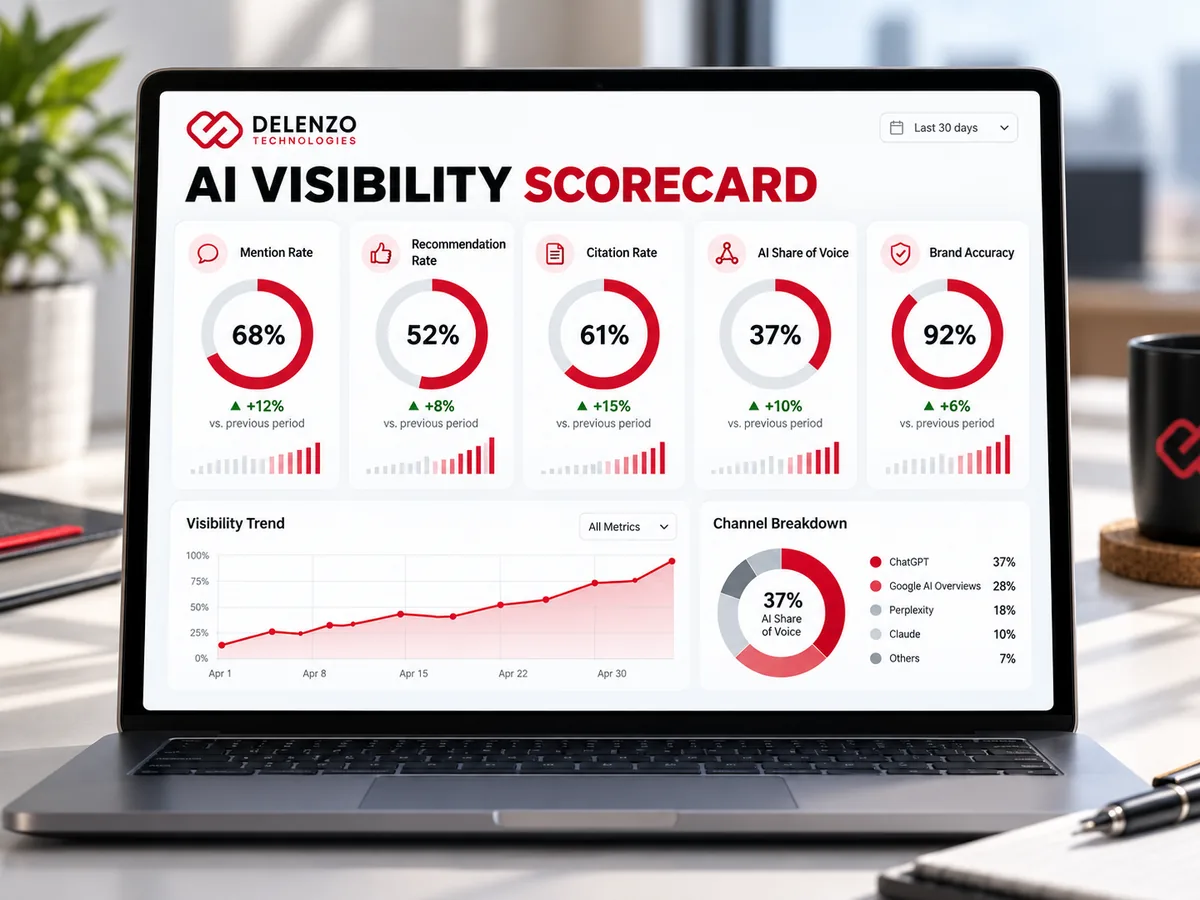
ChatGPT brand visibility is measured with five simple metrics. Each one uses the prompts and answers you already logged. Together, they show how to see brand visibility in ChatGPT as a trend instead of a guess.
Mention Rate
Mention rate shows how often your brand appears across tested prompts.
Formula: Prompts where your brand appears ÷ total prompts tested × 100
Example: Your brand appears in 12 of 30 prompts. Your mention rate is 40%.
Recommendation Rate
Recommendation rate counts only answers where ChatGPT suggests or shortlists your brand. A passing mention does not count here.
Formula: Responses recommending your brand ÷ total responses × 100
A brand can have a high mention rate and a low recommendation rate. That gap usually points to weak positioning.
Citation Rate
Citation rate shows how often ChatGPT uses your website as a source.
Formula: Responses citing your site ÷ total monitored responses × 100
Tracking brand citations in ChatGPT shows which of your pages AI systems trust. Note the URLs that get cited most often. Those pages are your strongest AI assets.
AI Share of Voice
AI share of voice compares your mentions with those of your tracked competitors.
Formula: Your brand mentions ÷ total mentions of all tracked brands × 100
Example: You earn 12 mentions, and three competitors earn 48 combined. Your share of voice is 20%.
Brand Accuracy
Brand accuracy measures whether ChatGPT describes your business correctly. Check each answer for errors in:
- Services or products
- Locations served
- Pricing, where listed
- Positioning and target audience
- Key features
Score each answer as accurate, partly accurate, or wrong. A wrong description can cost you more than no mention at all.
Free Ways to Monitor ChatGPT Visibility
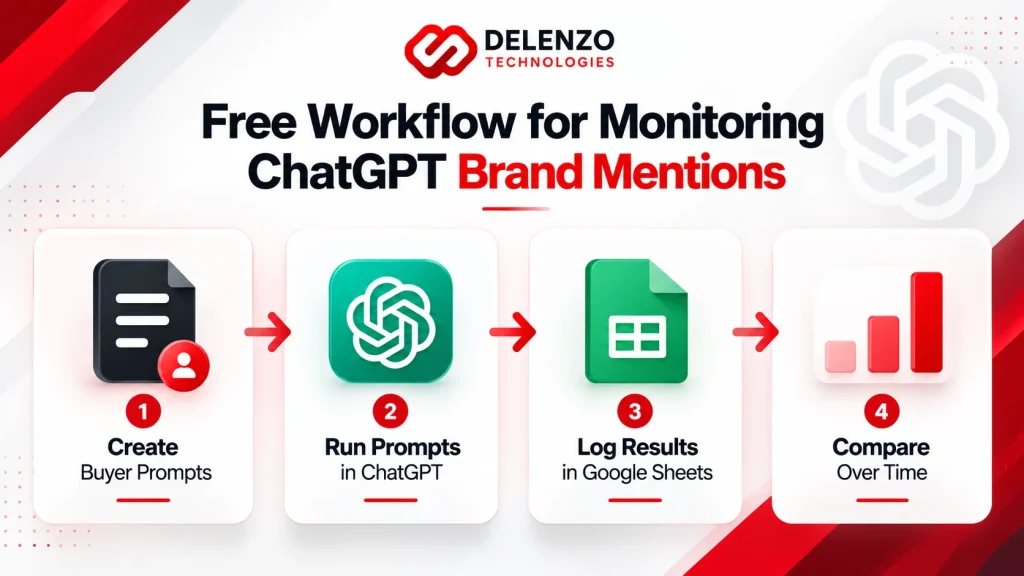
There are three free ways to monitor ChatGPT visibility. You can run manual prompt tests, keep a Google Sheets tracker, and check GA4 referral data. Together they cover how to track brand mentions on ChatGPT without paid software.
Manual Testing
Manual testing means running your prompt set in ChatGPT yourself. It works best for small businesses and a first benchmark. Plan 30 to 60 minutes per round for 20 to 30 prompts. The limit is scale. Nobody can run hundreds of prompts a day by hand.
Google Sheets
Google Sheets turns manual tests into a repeatable tracker. Set up these columns:
- Prompt library with categories
- Brand mentioned (yes or no)
- Recommended (yes or no)
- Competitors named
- Citation URL
- Sentiment or context
- Month over month comparison
Add simple formulas for mention rate and share of voice. Your scores then update as you log new results.
GA4 Referral Traffic
GA4 shows when ChatGPT sends visitors to your website. According to OpenAI’s publisher FAQ, ChatGPT adds utm_source=chatgpt.com to referral links. In GA4, open Reports, then Acquisition, then Traffic acquisition. Filter the session source to chatgpt.com to see visits, landing pages, and conversions.
Key Distinction: Referral Traffic Is Not Mention Tracking GA4 can tell you when ChatGPT sends someone to your website. It cannot tell you every time your brand was mentioned without a click. Use GA4 for traffic value and prompt testing for visibility.
Best Tools to Monitor Brand Mentions in ChatGPT
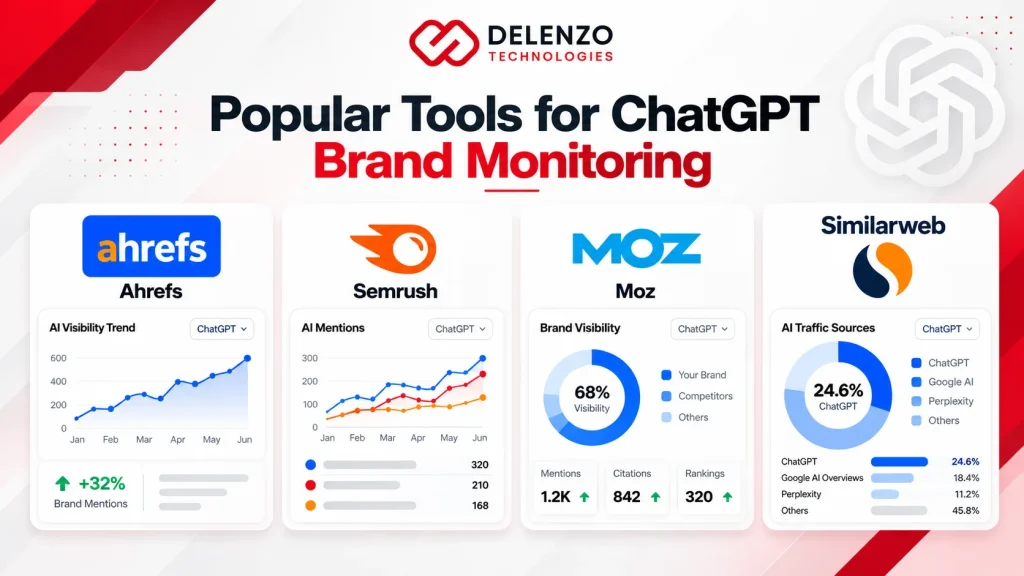
The best ChatGPT monitoring tools run prompts at scale and track mentions, citations, and competitors. Paid tools make sense once manual tracking gets too slow. If you want a tool to see if ChatGPT mentions your brand, the options below are a strong starting point. They are among the best tools to track ChatGPT brand mentions in 2026, grouped by use case rather than ranked.
| Tool | AI Engines Covered | Standout Feature | Best For |
|---|---|---|---|
| Ahrefs Brand Radar | ChatGPT, Perplexity, Gemini, Copilot, AI Overviews | Very large prompt indexes | Teams already using Ahrefs |
| Semrush AI Visibility Toolkit | ChatGPT, AI Overviews, AI Mode, Gemini, Perplexity | Competitor prompt and source gaps | SEO teams on Semrush |
| Profound | ChatGPT on entry plans, more engines on higher tiers | Deep source and conversation analysis | Enterprise brands |
| Peec AI | ChatGPT, Perplexity, Gemini, AI Overviews and more | Simple self serve setup | Mid-sized teams and agencies |
| Otterly.AI | ChatGPT, Perplexity, Copilot, Gemini | Quick prompt and competitor reports | Small businesses on a budget |
| Scrunch AI | Major AI engines | Page readiness checks for AI crawlers | Monitoring plus optimization |
| SE Ranking | ChatGPT, Perplexity, Gemini, Google AI | AI tracking inside a rank tracker | Existing SE Ranking users |
The right tool depends on your budget, the engines you need, and how deep you want the data. Every tool here estimates visibility from sampled prompts. Features and prices change often, so confirm current plans on each vendor’s website before you buy.
What to Look for in a ChatGPT Monitoring Tool
A good ChatGPT monitoring tool shows the prompts, answers, and competitors behind every score. A search for AEO tools brand mentions ChatGPT returns dozens of platforms. Any serious ChatGPT brand tracker should cover most of these eight criteria.
Prompt-Level Tracking
You should see results for each prompt, not one blended score. That shows exactly where you win and lose.
Mention Context
The tool should show how your brand is described. A top recommendation and a passing warning are both mentioned, but they mean very different things.
Citation Tracking
Look for a report of which URLs ChatGPT cites for you and your competitors. It tells you which pages to improve.
Competitor Share of Voice
Your numbers only mean something next to your rivals’ numbers. The tool should benchmark you against competitors you choose.
Historical Trends
Saved history shows whether your SEO and content work is paying off over time.
Multiple AI Engines
Buyers use more than ChatGPT. Coverage of Gemini, Perplexity, Claude, and Google AI Overviews gives a fuller picture.
Location and Model Controls
AI answers differ by market and model. A useful tool lets you set both.
Raw Response Access
A score has little value if you cannot read the answer behind it. Raw responses let you check context, spot errors, and trust the data.
Can You Monitor ChatGPT Mentions in Real Time?
Not in the way social listening works. Most AI visibility tools run chosen prompts on a set schedule. They measure sampled answers, not every private ChatGPT conversation. Tools that claim to monitor real-time brand mentions in ChatGPT usually mean frequent scheduled checks.
| Aspect | Social Listening | AI Answer Monitoring |
|---|---|---|
| What it sees | Public posts and comments | Generated answers to chosen prompts |
| Data source | Real conversations | Sampled prompt runs |
| Coverage | Close to complete for public data | Partial, based on sample size |
| Update speed | Near instant | Daily or weekly schedules |
Social listening watches public conversations, while AI monitoring samples generates answers. For most brands, daily or weekly checks are frequent enough.
How to Track Brand Performance Over Time
Track ChatGPT performance by rerunning the same prompt set on a fixed schedule. This is how to measure brand visibility in ChatGPT in a way that shows real progress. Pick a rhythm that matches your activity:
- Weekly: during active campaigns, product launches, or PR pushes
- Monthly: for stable brands with steady content output
- After major changes: such as a site migration or a new content cluster
Use a simple monthly scorecard like this one. The figures below are examples for illustration only.
| Metric | Last Month | This Month | Change |
|---|---|---|---|
| Mention rate | 30% | 40% | +10 pts |
| Recommendation rate | 10% | 17% | +7 pts |
| Citation rate | 7% | 13% | +6 pts |
| Share of voice | 15% | 20% | +5 pts |
| Top competitor visibility | 60% | 57% | -3 pts |
| Answer accuracy | 70% | 85% | +15 pts |
A monthly scorecard compares the same six metrics side by side, so real progress is easy to spot.
Keep your core prompts the same between rounds. Review the prompt set once a quarter and log any changes. Feed these numbers into your wider AI digital marketing strategy so the budget follows results.
Why Is My Brand Not Showing Up in ChatGPT?
Brands usually go missing from ChatGPT because of weak signals, not bad luck. These six causes explain most gaps, and each one can be fixed.
Your Brand Has Weak Entity Signals
AI systems need a clear picture of who you are and what you do. Vague descriptions and thin About pages make it hard to link your brand to a category.
Competitors Have More Third-Party Mentions
AI answers lean on what other websites say about a brand. Ahrefs research across 75,000 brands found branded web mentions strongly linked with AI visibility.
Your Content Doesn’t Answer Category Questions
Many business sites only describe services. Without content that answers buyer questions, AI has little reason to connect you to those prompts.
Your Website Information Is Unclear or Outdated
Old service lists, wrong locations, or conflicting details confuse AI systems. The result is a skipped brand or a wrong description.
Your Important Pages Are Difficult to Crawl
If crawlers cannot reach your pages, ChatGPT search cannot use them. Blocked bots and strict firewall rules are common causes. Heavy scripts can also hide content from crawlers, which clean website development helps prevent.
You Are Testing the Wrong Prompts
Sometimes the brand is fine and the test is wrong. Match your prompts to how your actual buyers search.
How to Improve Brand Visibility in ChatGPT
Improve ChatGPT visibility by making your brand easy to understand, verify, and cite. These five steps target the causes above.
Clearly Define Your Brand and Services
Give AI systems one clear, consistent description of your business. Focus on:
- A detailed About page
- One service page per core service
- Organization schema and business details
- The same short brand description everywhere
Build Topic Authority
Create content clusters around the questions your buyers ask. Cover their problems, comparisons, how-to queries, and category basics. The same principles behind how to rank a website on Google apply here, since strong pages help in both places.
Earn Third-Party Brand Mentions
AI visibility is not only about your own website. Build credibility across the wider web through:
- Editorial mentions and expert quotes
- Customer reviews on trusted platforms
- Industry roundups and “best of” lists
- Credible directories and digital PR
Active social media marketing also keeps your brand visible on platforms AI systems often cite.
Publish Citation-Worthy Content
AI systems cite pages that offer something useful and specific. Original research, comparisons, statistics, free tools, and checklists all fit. Unique data gives ChatGPT a reason to link to you instead of a competitor. A steady content marketing plan helps you publish these assets on a regular schedule.
Keep Information Consistent Across the Web
Mixed details confuse AI systems and lower trust. Match these details across your site, profiles, and listings:
- Company description and services
- Prices, where you publish them
- Locations served and products
- Leadership information
ChatGPT brand monitoring shows you where your brand stands today. The next step is turning those gaps into stronger AI visibility. That work runs through AEO, GEO, and traditional SEO, since all three shape what AI systems read. Delenzo Technologies, a Dallas agency serving businesses across the USA, connects them through its SEO, AEO and GEO visibility services.
A Simple AI Visibility Framework for Businesses
The Delenzo Technologies AI Visibility Framework turns monitoring into a repeatable improvement cycle. It has five stages:
- Measure: Check mentions, citations, and competitor visibility across a fixed prompt set.
- Diagnose: Find missing entity signals, content gaps, and technical issues.
- Strengthen: Improve service pages, content clusters, citations, and third party authority.
- Monitor: Rerun the same prompt set on a set schedule.
- Improve: Use the results to decide which SEO, AEO, and GEO tasks come next.
Technical Checks for ChatGPT Search Visibility
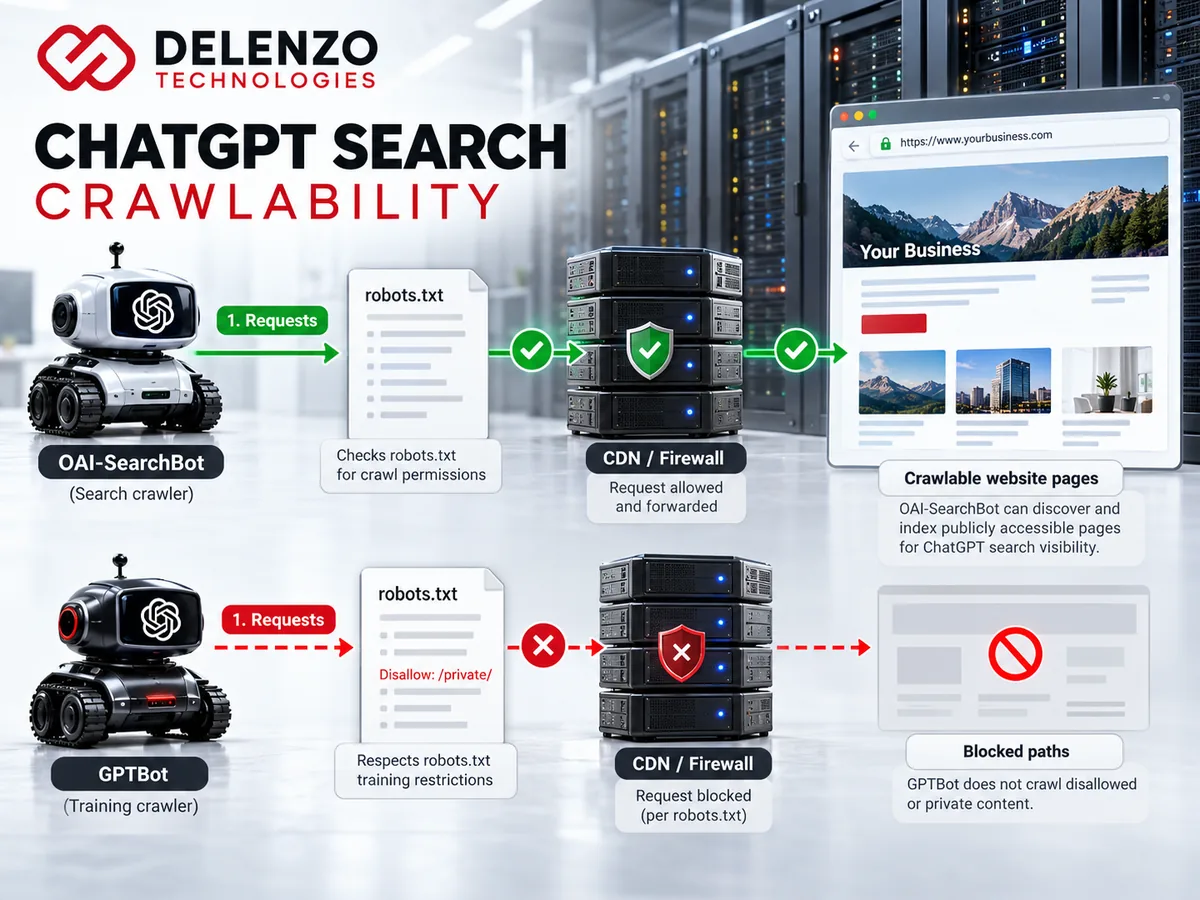
Technical checks confirm that OpenAI’s search crawler can reach and read your pages. Content cannot earn citations if the crawler is blocked. Start with these three checks.
OAI-SearchBot
OAI-SearchBot is the crawler OpenAI uses to surface websites in ChatGPT search. OpenAI’s publisher FAQ says sites should not block it if they want to appear in ChatGPT summaries and snippets. Access is managed through robots.txt. A rule that allows it looks like this:
User-agent: OAI-SearchBot
Allow: /
Do not paste this in blindly. Review your current robots.txt first, since existing rules may already allow access. Also check CDN and firewall settings, which can block bots anyway.
OAI-SearchBot vs GPTBot
OAI-SearchBot and GPTBot do different jobs, and you can manage each one separately.
| Aspect | OAI-SearchBot | GPTBot |
|---|---|---|
| Main purpose | Surfaces sites in ChatGPT search | Collects content that may train OpenAI models |
| Affects ChatGPT search visibility | Yes | No |
| Used for model training | No | Yes, potentially |
| Controlled in robots.txt | Yes, on its own | Yes, on its own |
You can allow OAI-SearchBot for search visibility and still block GPTBot from training use. OpenAI also runs ChatGPT-User, which fetches pages when a user asks ChatGPT to visit a link.
Server Logs
Server logs show whether OpenAI’s bots actually visit your site. Look for the OAI-SearchBot and ChatGPT-User user agents and the pages they request. User agents can be faked, so match IPs against OpenAI’s published ranges. Crawler visits confirm access, but they do not equal brand mentions.
ChatGPT Brand Monitoring vs Traditional Rank Tracking
Rank tracking measures positions, while ChatGPT monitoring measures presence, context, and share of voice. The two answer different questions, so most brands need both.
| Aspect | Traditional SEO Tracking | ChatGPT Brand Monitoring |
|---|---|---|
| Main result | Position 1 to 100 | Mention, no mention, and context |
| Result stability | Fairly stable SERPs | Answers vary between runs |
| Data source | Search Console data | Sampled prompts |
| Success metric | Rankings | Visibility and share of voice |
| Traffic signal | Organic clicks | AI citations and referrals |
| Focus | Keywords | Prompts and entities |
Traditional tracking tells you where a page ranks, while AI monitoring tells you whether your brand gets named.
Should You Monitor ChatGPT Only?
No. ChatGPT is a major AI engine, but your buyers use others too. A brand can do well in one engine and be invisible in another. Cover these engines where your audience uses them:
- ChatGPT for general research and recommendations
- Google AI Overviews and AI Mode inside regular Google searches
- Gemini across Google’s apps and devices
- Perplexity for research heavy, citation rich answers
- Claude for detailed research and business tasks
You do not need five separate processes. Run the same prompt set across each engine and log results in one sheet. Start with ChatGPT and the engine your buyers use second most. AI search is one of the biggest digital marketing trends in 2026, and it is spreading across every engine.
Common ChatGPT Brand Monitoring Mistakes
The most common mistakes come from treating AI answers like fixed search rankings. Avoid these eight:
- Tracking only branded prompts: This tests awareness, not whether buyers discover you.
- Testing one prompt once: One answer is a snapshot, not a trend.
- Confusing citations with mentions: A link and a name are different wins.
- Treating AI visibility as rankings: There is no fixed position 1 in ChatGPT.
- Ignoring competitors: Your numbers mean little without a benchmark.
- Trusting scores without reading responses: Always check the answer behind the number.
- Changing prompts every month: New prompts break your trend line.
- Assuming real time means every conversation: Tools sample answers and never see private chats.
30-Minute Free ChatGPT Brand Audit
You can benchmark your ChatGPT visibility in 30 minutes with a free, simple workflow. Follow these four blocks:
| Time | Task | Output |
|---|---|---|
| Minutes 0 to 5 | Choose your brand, 3 competitors, and 10 buyer prompts | Prompt list |
| Minutes 5 to 20 | Run each prompt in ChatGPT and save the answers | Raw responses |
| Minutes 20 to 25 | Log mentions, recommendations, citations, competitors, and errors | Filled tracking sheet |
| Minutes 25 to 30 | Calculate mention rate and competitor gap, then list next actions | Baseline scorecard |
A 30-minute audit gives you a baseline mention rate, a competitor gap, and a short action list. Repeat the same benchmark monthly with the same prompts. That repeat turns one audit into a real trend.
Need help improving AI search visibility? ChatGPT brand monitoring tells you where your brand appears and where it is missing. Closing those gaps is an AI visibility job. It takes AEO for direct answers, GEO for AI citations, and SEO for a strong foundation. Delenzo Technologies in Dallas brings all three together for businesses across the USA.
Start by Measuring Your Current ChatGPT Visibility
The best first move is a baseline. You cannot improve a number you have never measured. Follow this simple cycle:
- Establish a baseline with a fixed prompt set.
- Monitor the same prompts on a steady schedule.
- Identify the prompts where competitors appear and you do not.
- Improve authority, citations, and content for those gaps.
- Measure again and compare.
Done consistently, monitoring brand mentions in ChatGPT gives you a clear view of where you stand. That view becomes your AI visibility baseline. From there, AEO, GEO, and SEO work turns gaps into mentions and citations. Delenzo Technologies in Dallas supports businesses across the USA through each step of that path. When you are ready to set your baseline, talk to our team.