

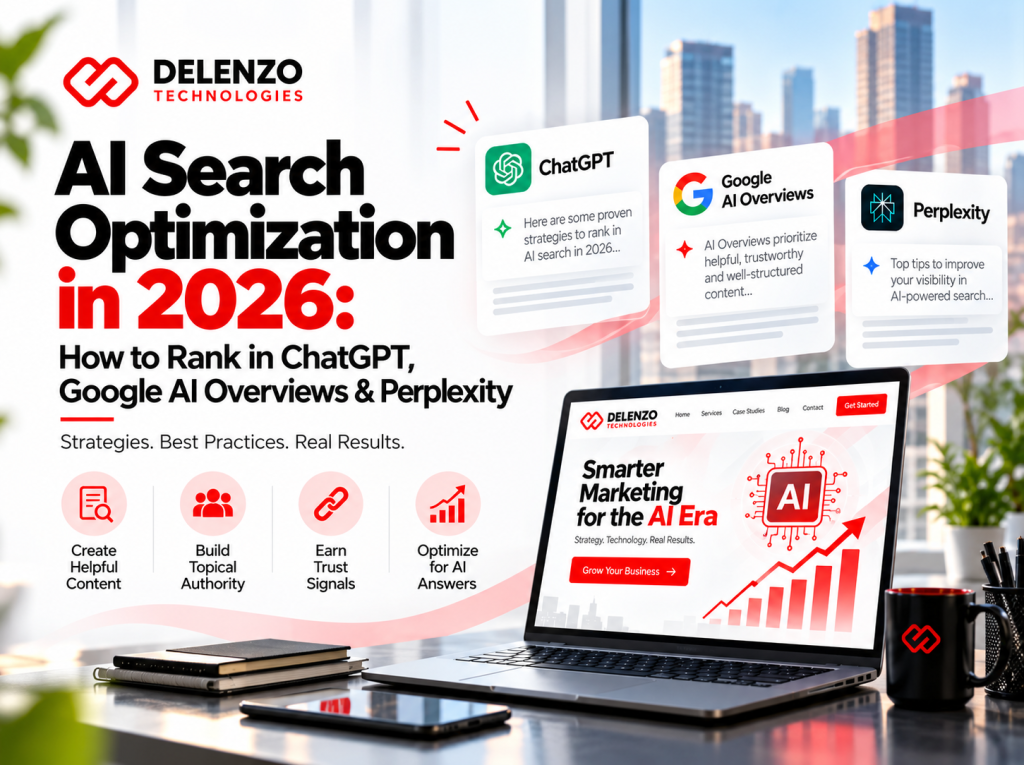
Search is no longer limited to ten blue links on a Google results page. In 2026, users increasingly ask complete questions and expect AI systems such as Google AI Overviews, ChatGPT, Perplexity, and other generative search platforms to research, summarize, compare, and recommend information for them.
This shift has introduced a new priority for businesses: AI search optimization.
Traditional SEO is still important, but ranking on page one is no longer the only objective. Businesses increasingly need their websites, brands, products, experts, and original information to become sources that AI-powered search engines can discover, understand, trust, reference, and cite.
Google itself confirms that traditional SEO best practices continue to matter for its generative AI search experiences. Its AI features use existing Search ranking and quality systems, including retrieval systems that identify relevant web pages before generating answers.
For businesses planning their digital marketing strategy in 2026, the opportunity is clear: optimize not only for rankings, but for visibility across the entire AI-driven search ecosystem.
What Is AI Search Optimization?
AI search optimization is the process of improving a website and its content so that AI-powered search platforms can easily discover, understand, evaluate, and potentially reference it when answering user questions.
Traditional SEO typically focuses on objectives such as:
- Higher organic search rankings
- Increased organic traffic
- Better keyword visibility
- Improved click-through rates
- More leads and conversions
AI search optimization expands those goals.
A business may now want its website to appear as a source in Google AI Overviews, receive citations or links in ChatGPT search, be referenced by Perplexity, or become part of an AI-generated recommendation.
This means businesses need to think about more than individual keywords.
AI systems attempt to understand topics, entities, relationships, context, expertise, evidence, intent, and how different pieces of information connect.
For example, a user might ask:
“What is the best digital marketing strategy for a small ecommerce business with a limited budget?”
An AI search system may interpret that question through several related concepts, including SEO, paid advertising, social media, email marketing, conversion optimization, ecommerce growth, budget allocation, and marketing ROI.
A website with comprehensive, authoritative content across those connected topics may therefore have a stronger foundation for AI visibility than a website publishing isolated articles created only around individual keywords.
SEO vs AEO vs GEO: What’s the Difference?
As AI search has grown, several new terms have become popular.
SEO — Search Engine Optimization
SEO focuses on increasing visibility in traditional organic search results.
It includes:
- Keyword research
- Technical SEO
- On-page optimization
- Link building
- Internal linking
- Content creation
- Search intent optimization
- User experience
AEO — Answer Engine Optimization
Answer Engine Optimization (AEO) focuses on making content easy for systems to use when answering specific questions.
This often involves:
- Clear definitions
- Concise answers
- Question-based headings
- Well-organized content
- Entity clarity
- Supporting evidence
AEO is particularly relevant to conversational searches such as:
“How does local SEO work?”
rather than a shorter traditional keyword such as:
“local SEO services.”
GEO — Generative Engine Optimization
Generative Engine Optimization (GEO) generally refers to improving a brand’s chances of appearing within responses generated by AI platforms.
GEO may therefore include traditional SEO, brand authority, content structure, original research, citations, digital PR, entity optimization, and technical accessibility.
However, these terms should not be treated as entirely separate disciplines.
Google’s current guidance is particularly important here: from Google’s perspective, optimizing for its generative AI search experiences remains fundamentally part of SEO rather than requiring an entirely separate collection of “GEO hacks.”
The most sustainable strategy is therefore to build excellent SEO foundations and adapt them for conversational and generative search behavior.
How AI Search Engines Find and Select Content
AI search platforms do not all operate exactly the same way, but successful content generally shares several characteristics.
Relevance
The page must closely address the user’s question and underlying intent.
A page about “SEO basics,” for example, may not be the strongest source for a detailed question about measuring AI search visibility.
Crawlability and Indexability
Search systems must be able to access the content.
Google states that pages generally need to be indexed and eligible to appear in Search to participate in its generative AI search features.
ChatGPT search has its own crawler. OpenAI states that websites should allow OAI-SearchBot if they want their content to be eligible to appear in ChatGPT search results and summaries. OAI-SearchBot is separate from GPTBot, which is associated with model-training controls.
Information Quality
AI systems benefit from content containing useful facts, explanations, examples, evidence, comparisons, and original insights.
Generic content that simply rewrites what dozens of competitors have already published provides less distinctive value.
Authority and Trust
Strong brands often have signals extending beyond their own website.
These can include:
- Expert authors
- Independent brand mentions
- High-quality backlinks
- Reviews
- Industry publications
- Interviews
- Original studies
- Consistent business information
- Recognized subject expertise
Content Structure
Clear headings, paragraphs, tables, lists, definitions, and logical sections make information easier for both users and machines to interpret.
The goal is not to write robotic content for AI. It is to create information that is logically organized and genuinely easy to understand.
How to Optimize Your Website for ChatGPT and AI Search
There is no single setting that guarantees AI rankings.
Instead, AI search optimization depends on building a strong information ecosystem around your website.
Create Clear, Direct Answers to Search Queries
Modern search behavior is increasingly conversational.
Instead of searching:
“SEO agency Lahore”
a user may ask:
“Which type of SEO agency should a small business hire if it wants local leads?”
Build content around the questions customers genuinely ask during their buying journey.
A useful structure is:
Question → Direct answer → Explanation → Evidence → Example → Next step
For example:
What is AI search optimization?
AI search optimization is the process of making website content easier for AI-powered search platforms to discover, understand, trust, and reference in generated answers.
After providing the short answer, expand with examples and supporting information.
This structure serves readers first while also providing clear contextual information to search systems.
Build Topical Authority and Content Clusters
Publishing dozens of unrelated articles is usually less effective than developing deep expertise around a specific subject.
Suppose your business provides digital marketing services.
Instead of randomly publishing articles about marketing, design, AI, ecommerce, and social media, organize your content into clusters such as:
SEO Cluster
- What is SEO?
- Technical SEO guide
- Local SEO guide
- Ecommerce SEO guide
- Keyword research
- Link building
- SEO audit
- AI search optimization
- Google AI Overview optimization
Then internally connect those pages.
This helps users navigate your expertise while making the relationship between topics clearer.
Google’s 2026 AI optimization guidance emphasizes creating valuable, original, non-commodity content rather than producing large quantities of pages merely to capture every possible search variation.
Use Structured Data and Schema Markup
Structured data gives search engines machine-readable information about the entities and content on your website.
Depending on the website, useful schema types can include:
- Organization
- LocalBusiness
- Product
- Article
- BreadcrumbList
- Person
- Event
- VideoObject
For example, Organization schema can provide information such as your company name, website, logo, contact information, and other applicable organizational details.
Google confirms that structured data can help it understand page information and make content eligible for certain enhanced Search features.
However, structured data is not a special AI-ranking shortcut.
Google specifically states that no special schema markup is required to appear in generative AI search.
One important 2026 update concerns FAQ schema. Google discontinued the FAQ rich-result feature in Search in May 2026. You can still maintain genuinely useful FAQ content for readers, but adding FAQ markup should not be treated as a strategy for gaining FAQ rich results in Google Search.
Strengthen E-E-A-T and Brand Authority
E-E-A-T represents:
Experience, Expertise, Authoritativeness, and Trustworthiness.
Strong authority signals become particularly valuable when users ask AI systems for recommendations.
Improve trust by including:
- Real author profiles
- Relevant professional experience
- Clear About pages
- Accurate company information
- Original case studies
- First-hand testing
- Customer examples
- Expert commentary
- Research methodology
- References to trustworthy sources
Avoid publishing hundreds of generic AI-generated articles simply to increase content volume.
Google’s latest guidance states that generative AI can help with research and content organization, but publishing large numbers of AI-generated pages without meaningful added value can violate its policies on scaled content abuse. Accuracy, quality, relevance, originality, and human review remain important.
How to Optimize for Google AI Overviews
Google AI Overviews generate responses using information retrieved through Google’s broader Search infrastructure.
Google explains that its generative AI experiences can use technologies such as retrieval-augmented generation and query fan-out.
Query fan-out is particularly important.
Someone asking:
“What is the best CRM for a small marketing agency?”
may trigger related searches concerning pricing, team size, automation, integrations, usability, reporting, and alternative products.
Your content therefore needs depth rather than simply repeating one primary keyword.
To improve your foundation for Google AI visibility:
- Maintain strong technical SEO
- Ensure important pages can be crawled and indexed
- Match search intent accurately
- Provide original expertise
- Cover important subtopics naturally
- Add useful images and videos
- Use descriptive headings
- Strengthen internal linking
- Demonstrate real-world experience
- Keep important information updated
Google also warns against common AI-search myths. You do not need special AI-only markup, artificially tiny content “chunks,” endless long-tail keyword variants, or an llms.txt file to improve visibility in Google Search. Google currently says llms.txt neither helps nor harms Google rankings or AI-search visibility.
How to Increase Visibility in ChatGPT and Perplexity
Optimizing for ChatGPT and other answer engines starts with many of the same principles as SEO: accessibility, authority, relevance, clarity, and useful information.
For ChatGPT specifically, website owners should check whether OAI-SearchBot is allowed to access important public content.
OpenAI says public websites can appear in ChatGPT search and recommends allowing OAI-SearchBot and its published IP ranges. It also notes that referral links from ChatGPT search include utm_source=chatgpt.com, making resulting traffic easier to identify in analytics platforms.
Beyond crawler accessibility, focus on creating material worth citing.
Examples include:
- Original statistics
- Industry research
- Detailed comparison guides
- First-hand product testing
- Surveys
- Case studies
- Expert commentary
- Unique frameworks
- Pricing studies
- Market data
- Clear definitions
A generic article explaining “10 benefits of SEO” has little distinctive information.
A study showing how organic conversion rates changed across 50 local businesses after six months of SEO work provides original evidence that other publishers and AI systems may have a reason to reference.
The same principle can strengthen visibility across systems such as Perplexity: create information that contributes something useful to the web rather than merely reproducing existing summaries.
Common AI Search Optimization Mistakes to Avoid
AI search creates opportunities, but it has also created many questionable optimization tactics.
Common mistakes include:
Keyword stuffing: Repeating phrases such as “AI search optimization” unnaturally will not make weak content authoritative.
Publishing mass AI content: Generating hundreds of pages without expert review, original insight, or useful differentiation can create quality problems.
Ignoring technical SEO: Excellent content cannot perform effectively if crawlers cannot reliably access or index it.
Creating content only for AI bots: Write for humans first. Search platforms are ultimately trying to satisfy human users.
Copying competitor structures: If every article says the same thing, AI systems have little reason to prefer your version.
Ignoring brand building: AI visibility extends beyond individual pages. Your reputation across the wider web matters.
Using fake authority signals: Artificial reviews, low-quality backlinks, spam mentions, and fabricated expertise can create more risk than value.
Google explicitly advises against chasing inauthentic mentions and other supposed generative-search shortcuts.
How to Measure AI Search Visibility
AI search optimization needs its own measurement framework.
Start by tracking:
Google Search Performance
Monitor:
- Organic impressions
- Clicks
- Queries
- Landing pages
- Rankings
- Conversions
Google has expanded Search Console reporting for generative AI search experiences in 2026, providing site owners with more direct ways to evaluate how their content appears in these environments.
AI Referral Traffic
Use your analytics platform to identify referral traffic from AI platforms.
Track:
- Sessions
- Engaged sessions
- Leads
- Revenue
- Assisted conversions
- Landing pages receiving AI referrals
Brand Mentions and Citations
Periodically test important questions that your customers ask.
For example:
- “Best [service] company for small businesses”
- “How to solve [customer problem]”
- “Best tools for [industry task]”
- “[Brand] vs competitor”
- “Recommended companies for [service]”
Record whether your brand appears and, more importantly, which sources are being cited.
This competitor-source analysis can reveal content gaps and digital PR opportunities.
Business Results
Do not treat AI citations as the final KPI.
The real question is whether AI search visibility generates:
- Qualified visitors
- Leads
- Sales
- Sign-ups
- Brand searches
- Assisted conversions
- Revenue
Visibility without business impact is not enough.
Future of SEO: Why Businesses Need an AI Search Strategy
SEO is not disappearing.
It is expanding.
Users may still search on Google, but they can also ask ChatGPT, use AI Overviews, explore AI Mode, consult Perplexity, search visually, speak to assistants, or delegate research tasks to AI agents.
This means websites need to become more than collections of keyword-targeted landing pages.
They need to become reliable knowledge sources.
Businesses should therefore combine:
- Traditional SEO
- Technical optimization
- Topical authority
- Entity optimization
- Original research
- Digital PR
- Strong brand signals
- Structured data
- Multimedia content
- AI crawler accessibility
- Conversion optimization
The brands most likely to succeed will not be those searching for one secret “GEO trick.”
They will be businesses consistently publishing information that deserves to be retrieved, recommended, referenced, and trusted.
Final Thoughts
AI search optimization in 2026 is an evolution of SEO rather than a complete replacement for it.
Google AI Overviews, ChatGPT, Perplexity, and other AI-driven discovery platforms are changing how people find information, compare businesses, evaluate products, and make purchasing decisions.
The strongest strategy is therefore simple in principle:
Create technically accessible, genuinely useful, clearly structured, expert-led, original content and build a recognizable authority around your subject.
Do not optimize only for keywords.
Optimize for questions, entities, expertise, trust, evidence, user satisfaction, and brand authority.
Traditional rankings will continue to matter, but the next stage of search visibility is being present wherever AI systems help customers make decisions.
Businesses that begin building that foundation now will be better positioned as generative search continues to expand.
Frequently Asked Questions About AI Search Optimization
What is AI search optimization?
AI search optimization is the process of improving website content, authority, structure, and technical accessibility so AI-powered search platforms can more easily discover, understand, and potentially reference it in generated answers.
Is AI SEO different from traditional SEO?
AI SEO builds on traditional SEO rather than replacing it. Technical SEO, high-quality content, authority, crawlability, internal linking, and user experience remain important, while AI optimization places additional emphasis on conversational queries, entities, original information, and citation-worthy content.
What is GEO in SEO?
GEO stands for Generative Engine Optimization. It describes strategies intended to improve visibility in AI-generated search experiences such as AI answers, summaries, recommendations, and cited sources.
How can I rank my website in ChatGPT?
There is no guaranteed ChatGPT ranking method. Make sure important public pages are accessible to OAI-SearchBot, publish accurate and useful content, build genuine brand authority, earn trustworthy mentions and links, and create unique information that may be valuable enough to reference.
How do I optimize for Google AI Overviews?
Follow strong SEO fundamentals, ensure your pages are indexed and eligible for Search, answer user intent comprehensively, provide original insights, demonstrate expertise, improve technical quality, and use relevant multimedia and structured data where appropriate.
Does schema markup help AI search optimization?
Structured data can help search engines understand information and make pages eligible for supported Search features, but Google states that there is no special schema required for generative AI search. Schema should support a broader SEO strategy rather than be treated as an AI-ranking shortcut.
Can AI-generated content rank on Google?
Yes, AI-assisted content can perform in Search when it is useful, accurate, original, relevant, properly reviewed, and created for users. Mass-generating low-value pages primarily to manipulate search visibility can violate Google’s spam policies.
Is traditional SEO still important in 2026?
Yes. Traditional SEO remains the technical and strategic foundation of AI search visibility. Crawlability, indexing, authority, quality content, internal linking, user experience, and relevance continue to influence how information becomes discoverable across modern search experiences.