

Marketing has never moved this fast. What worked two years ago might already be costing you customers today. If you run a business or help one grow, staying on top of the right digital marketing trends is no longer optional. It’s survival.
Digital marketing is evolving at a pace driven by three unstoppable forces: AI adoption reshaping how brands operate, personalization raising the bar for how customers expect to be reached, and authentic content becoming the only thing audiences actually trust. The brands winning right now aren’t the biggest or the loudest. They’re the most relevant.
Trend articles are everywhere. Useful ones are rare. This guide breaks down what’s actually changing across AI, SEO, content marketing, paid ads, and social media, not buzzwords, not fluff, just real digital marketing strategies that matter, and exactly what you should do about them.
What Are the Biggest Digital Marketing Trends in 2026?
The biggest digital marketing trends in 2026 center around three core forces: AI maturing as a business tool, human trust becoming harder to earn, and platforms fundamentally reshaping how attention works.
AI tools are everywhere but the brands winning aren’t using AI the most, they’re using it the smartest. Audiences have gotten sharper too. They can spot generic content instantly and are choosing brands that feel real over brands that just feel polished.
Search is no longer just a discovery tool. Google now answers questions directly through AI Overviews, meaning your content either gets cited in those answers or gets skipped entirely.
In paid media, third-party cookies are dying, first-party data is everything, and creative quality now determines whether your ads get clicks or get ignored.
These are the digital marketing industry trends and marketing innovations every business needs to understand and act on right now.
AI Trends Shaping Digital Marketing in 2026
Artificial intelligence is fundamentally transforming how modern marketing works, reshaping how brands create content, reach customers, and drive conversions at every stage of the funnel. The AI marketing trends dominating right now aren’t about replacing marketers. They’re about giving smart teams an unfair advantage through automation, personalization, and tools that learn, adapt, and act in real time.
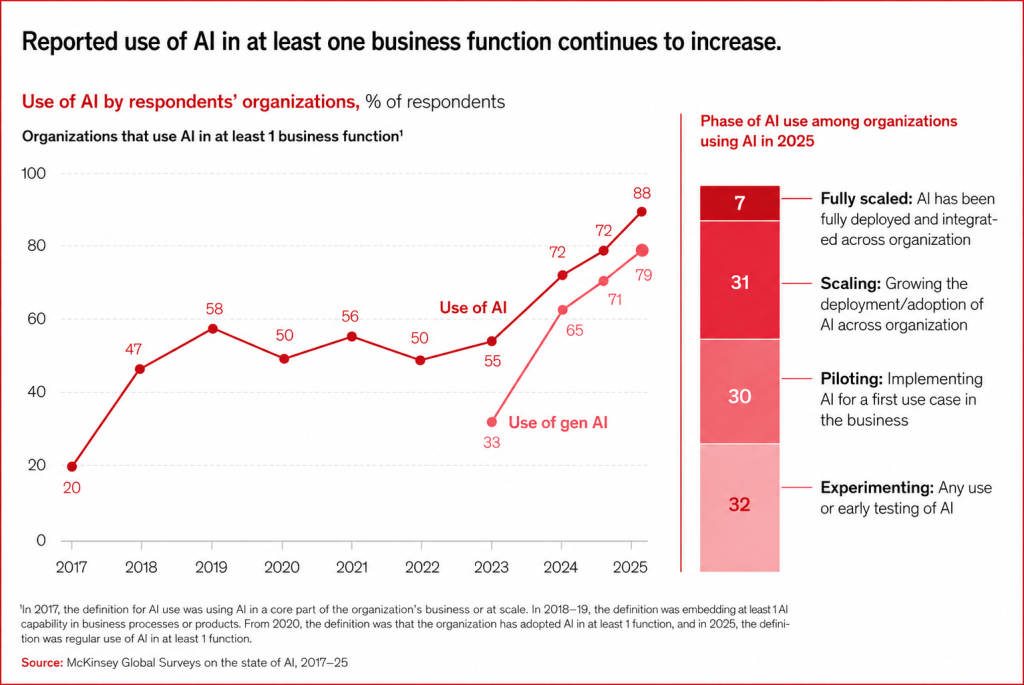
The scale of this shift is backed by hard data. According to McKinsey’s annual State of AI survey, organizational AI adoption grew from just 50% in 2022 to 78% by 2025, and the trajectory heading into 2026 shows no signs of slowing down. The fastest adoption curve of any business technology in the last decade. Marketing and sales consistently rank among the top three functions driving that growth.
- 2022 — 50% of organizations reported adopting AI in at least one business function
- 2023 — 55% of organizations reported AI adoption across business functions
- 2024 — 72% of organizations reported AI adoption — the single biggest year-over-year jump ever recorded in the survey
- 2025 — 78% of respondents reported using AI in at least one business function, with marketing and sales among the top three functions
Three developments stand out above the rest.
Rise of AI Agents
AI agents are probably the biggest shift marketers haven’t fully prepared for yet and the AI marketing trends around them are moving fast.
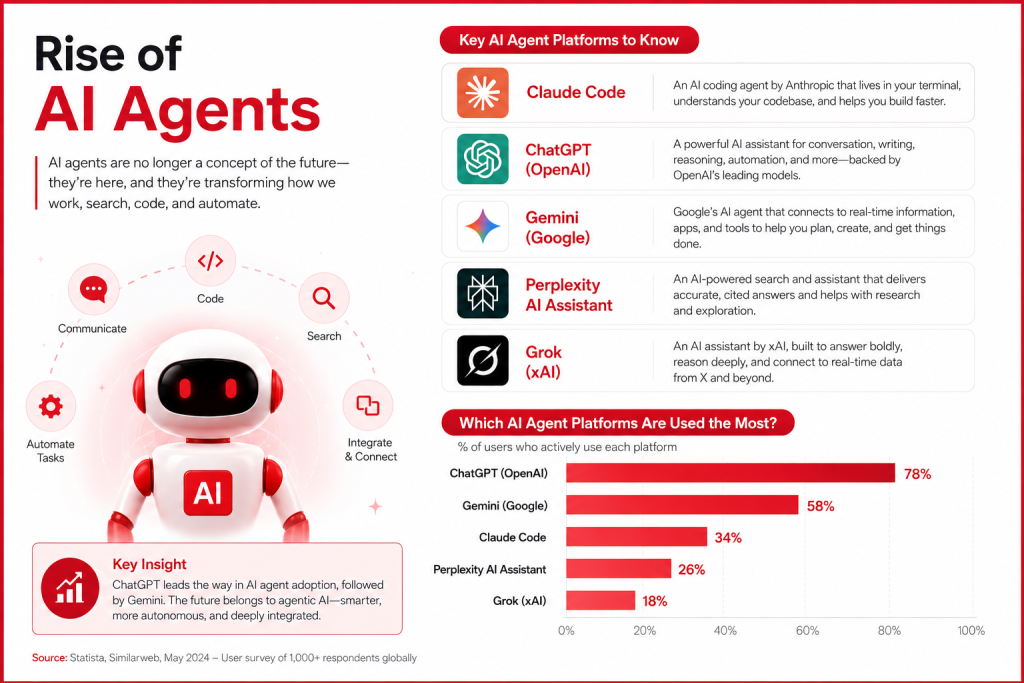
These aren’t just chatbots. AI agents can take real actions, browse the web, book appointments, compare prices, fill forms, and make decisions on behalf of users. Think of them as digital assistants that actually do things, not just answer questions.
Key AI Agent Platforms to Know:
- Claude Code
- ChatGPT (OpenAI)
- Gemini (Google)
- Perplexity AI Assistant
- Grok
For marketers, this changes everything about how you think about the customer journey. When an AI agent is doing the research and building the shortlist instead of a human scrolling through Google your brand needs to be the one that gets recommended. That means structured data, clear value propositions, and content written for both humans and machines.
The latest digital marketing trends confirm this clearly: brands optimizing for agent-readable content right now will have a serious head start before it becomes standard practice.
From AI Automation to AI Elevation
A year ago, the big promise of AI was automation. Write faster. Post more. Cut costs. That era isn’t over, but the smarter goal in 2026 is AI elevation using AI to make your team’s work genuinely better, not just faster.
Here’s the practical difference. Automation replaces a human task. Elevation augments human skill. Instead of using AI to write your entire blog post, you use it to research deeper, identify gaps in your competitor content, generate five headline variations, and then let your writer do what AI can’t: bring real perspective and voice.
This is where ai marketing trends get genuinely useful. The brands doing this well are producing content that’s smarter, more targeted, and more helpful, not just more frequent.
Hyper-Personalization and Conversational Commerce
Personalization used to mean putting someone’s first name in an email. That’s table stakes now.
- Hyper-personalization in 2026 means your messaging changes based on real-time behavior, purchase history, location, device, and intent signals all at once. It’s the difference between an email that feels relevant and one that feels like it was written for a stranger.
- Conversational commerce is connected to this. Customers increasingly want to buy through conversations whether that’s a WhatsApp message, an AI chat on your website, or a DM on Instagram. They want to ask a question, get a real answer, and complete the purchase without leaving the thread.
If your business still treats messaging as a support channel and not a sales channel, you’re leaving real revenue behind.
SEO Trends That Will Dominate 2026
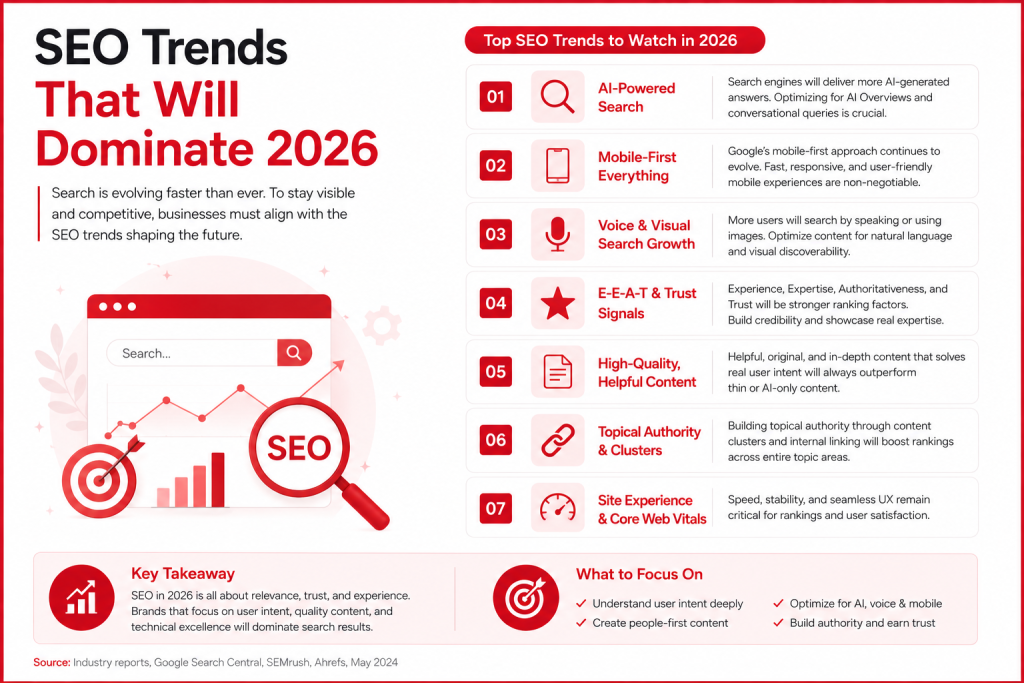
Search engine optimization has entered a new era. AI is now deeply embedded in how Google ranks, reads, and rewards content. Succeeding in this environment isn’t about chasing algorithm tricks anymore, it’s about building a brand that search engines recognize as genuinely authoritative, structurally clear, and consistently useful to real people. The latest marketing trends in search point to three shifts in particular that are defining how modern SEO works right now.
Brand Voice as a Ranking Signal
Google’s Helpful Content system has quietly made brand voice a ranking factor.
The logic behind it is straightforward: Google is getting better at identifying whether content was written by someone who actually knows what they’re talking about or just strung together for clicks. Sites with a consistent, recognizable voice and demonstrated expertise are being rewarded. Generic content, even when it’s technically correct, is losing ground.
This means your brand needs a voice that’s clear, consistent, and actually yours. Not just “professional.” Not just “friendly.” Something specific that reflects how your business thinks and who you’re talking to.
For businesses across the USA, this is actually an opportunity. Local expertise, regional examples, and real market knowledge are hard to fake and Google is rewarding authenticity
Understanding Search Intent
Every search has a reason behind it. Matching your content to that intent is now the core of whether your content ranks at all. Most businesses still get this wrong and the breakdown below shows exactly why:
- Informational — user is learning; write educational guides with depth
- Navigational — user wants a specific site; ensure your brand is easy to find directly
- Commercial investigation — user is comparing options; use comparison content with clear differentiators
- Transactional — user is ready to buy; focus on conversion-focused pages with clear CTAs
Audit your existing content through an intent lens. You’ll often find the fix is simple and the ranking improvement is fast.
Focus on Schema Markup
Schema markup tells search engines exactly what your content is about in language they can process instantly. In 2026, it’s one of the clearest ways to qualify for featured snippets, AI Overviews, and voice search answers.
The right schema depends on your content type:
- Local businesses should add FAQ schema and local business schema to every page to improve visibility in map results and local searches.
- Publishers and bloggers need Article schema and Author schema as non-negotiables; they directly strengthen your EEAT signals in Google’s eyes.
Think of a schema as showing Google the evidence, not just asking it to trust you. It’s a small technical investment with outsized ranking returns.
Content Marketing Trends in 2026
Content is no longer a numbers game it never really was. But in 2026, that truth is finally catching up with every brand that treated publishing as a volume exercise. The rules have shifted, the bar has been raised, and the audience has gotten sharper. What actually moves the needle now isn’t how much you publish, it’s how well. In 2026, the brands winning at content are obsessing over three things: quality that earns trust, originality that stands out, and structure that AI systems can actually read and recommend.
The two biggest content shifts driving this change are worth understanding in detail.
The Overload of AI-Generated Content
The internet is drowning in AI-generated content. Most of it is readable. Some of it is accurate. But almost none of it is memorable, and very little of it builds the kind of trust that turns a reader into a customer. The response to content overload isn’t more content, it’s better content.
- Google is penalizing low-effort AI content that lacks depth, perspective, and real-world experience
- EEAT (Experience, Expertise, Authoritativeness, Trustworthiness) is the filter that separates ranking content from content that disappears
- Using AI to write? A human expert must shape, edit, and add genuine insight to every piece otherwise you’re producing noise
Optimizing Content for AI Search
The way people find information is fundamentally changing. Google’s AI Overviews, Perplexity, Claude and ChatGPT Search don’t just rank pages, they read them, extract useful information, and surface it directly in an answer. Your content either gets cited in those answers or it doesn’t. Answer Engine Optimization (AEO) is becoming as important as traditional SEO.
To make your content AI-ready, these three principles should guide every piece you publish:
- Answer the question directly don’t bury the answer in a long preamble
- Use headers that match real questions people actually search
- Keep facts sourced and verifiable; AI systems are good at spotting content trying to game the system
Paid Advertising Trends in 2026
AI is now running the engine behind every major paid advertising platform. From automated bidding and audience targeting to real-time creative optimization, AI-powered advertising has completely redefined what smart PPC looks like.
The paid advertising trends dominating right now make one thing clear: brands that understand how to work with these systems, not against them, are pulling ahead while everyone else burns budget guessing. Two developments every advertiser needs to understand right now are leading this shift.
Why Ad Creative Matters More Than Ever
Ad creative is now the single biggest performance lever in paid advertising. When everyone is targeting the same audiences with similar budgets, creative quality is what wins.
The latest digital advertising updates confirm it clearly: ad creative the visual, the copy, the hook now outperforms audience targeting and bidding strategy as the primary driver of campaign results. AI-powered platforms like Google and Meta are handling the targeting for you. Your job is to give them something worth responding to.
Great ad creative means a hook in the first two seconds, a message that speaks to a specific pain or desire, and a visual that stops the scroll. Test multiple creative variations constantly and let the platform optimize. The ones investing in conversion-focused creative are seeing cost-per-acquisition drop significantly.
Understanding Google AI Max
Google AI Max is the platform’s newest evolution in campaign management and it’s something every advertiser needs to understand.
AI Max expands the reach of Search campaigns by matching ads to relevant queries beyond your keyword list. It uses AI to identify intent signals and surface your ads to people who haven’t used your exact keywords but are searching for exactly what you offer.
The opportunity here is real but so is the risk. Without proper brand safety settings, negative keywords, and creative guidelines, AI Max can spend your budget on irrelevant traffic. The advertisers winning with it are the ones who combine strong creative, clear business goals, and careful monitoring, not the ones who just switch it on and walk away.
Social Media Trends Marketers Should Watch
Social media engagement has fundamentally changed. Audiences are no longer passive followers; they’re active participants seeking genuine connection, real conversations, and communities that reflect their values. The digital advertising trends spilling into social media make one thing clear: brands that understand this shift are building loyal audiences that paid ads simply cannot buy. Three trends are driving this evolution right now.
The Growth of Community-First Platforms
Facebook groups, Discord servers, Reddit communities, LinkedIn newsletters aren’t new, but they’re having a serious moment.
People want to belong to something, not just follow it. Brands that build genuine communities where members help each other, share real experiences, and feel seen are creating marketing flywheels that paid ads can’t replicate.
Community-first marketing in 2026 means treating your audience as participants, not recipients. It means creating spaces where your customers can connect with each other, not just with you. And it means playing a long game because community trust doesn’t come from a campaign. It comes from showing up consistently over time.
If you haven’t mapped out where your customers already gather online and thought about how your brand can add real value there this is the right time to start.
Social Media Fatigue and Authentic Content
Social media fatigue is real, and it’s getting worse. People are spending more time online but trusting polished, brand-produced content less. What’s breaking through is authentic content behind-the-scenes moments, honest opinions, real customer stories, and content that feels like it was made by a human being, not a marketing department.
This doesn’t mean your content has to be rough. It means it has to be real. Show the process, not just the result. Share the learning, not just the win. Let your team’s personalities come through.
For small and mid-sized businesses across the USA where competitive markets and high consumer expectations define how business gets done this is actually an advantage. You don’t have to fake authenticity. You just have to show what’s already there.
Evolution of Influencer Marketing
The influencer landscape has matured significantly, and the new marketing trends here are about quality over quantity.
Mega-influencers with millions of followers are becoming less effective for most brands. Their audiences are broad, their engagement rates are declining, and their content often feels indistinguishable from traditional advertising.
Micro and nano influencers — people with 5,000 to 50,000 highly engaged followers are where the real performance is happening. They’re trusted within specific niches. Their recommendations feel personal. And their audiences are genuinely interested in the topics they cover.
The smartest brands are building long-term partnerships with a small group of aligned influencers, rather than one-off sponsored posts with whoever has the biggest following. The results in trust, in conversions, in brand affinity are consistently better.
How Businesses Can Prepare for the Future of Marketing
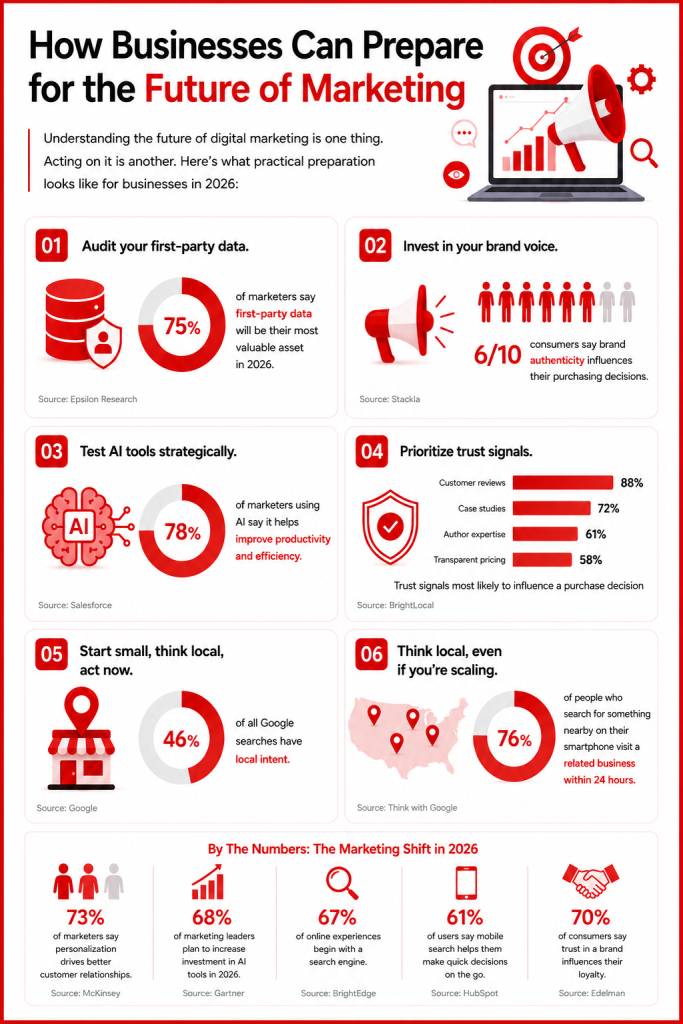
Understanding the future of digital marketing is one thing. Acting on it is another. Here’s what practical preparation looks like for businesses in 2026:
- Audit your first-party data. With cookies dying, the data you collect directly from your customers’ email lists, purchase history, and on-site behavior is your most valuable marketing asset. Build systems to collect it ethically, store it properly, and use it to personalize your outreach.
- Invest in your brand voice. Generic content is getting penalized by search engines and ignored by humans. Develop a clear, specific brand voice that reflects your expertise and your market. Then make sure everything you publish blogs, ads, social posts, emails sounds like you.
- Test AI tools strategically. Don’t use AI to replace human thinking. Use it to enhance it. Find the tasks where AI saves you real time research, first drafts, keyword analysis, A/B testing and let your human team focus on strategy, creativity, and relationships.
- Prioritize trust signals. Reviews, case studies, author bios, transparent pricing, and real customer stories all build the kind of trust that moves people from awareness to purchase. In a world where anyone can produce content at scale, being verifiably trustworthy is a genuine competitive advantage.
- Start small, think local, act now. Small business digital marketing doesn’t require a big budget, it requires the right focus. Digital marketing for local businesses works best when built around three things: a strong local SEO presence that gets you found, authentic content that builds neighborhood-level trust, and community engagement that turns local customers into loyal advocates. Businesses that build this foundation now will be significantly harder to displace later.
- Think local, even if you’re scaling. Whether you’re based in New York, Dallas, Los Angeles, Chicago, or anywhere else in the USA local relevance still matters enormously. Local SEO, local partnerships, and content that speaks to the specific realities of your market will outperform generic content every time.
At Delenzo Technologies, we work with businesses across the USA to put these new digital marketing strategies into practice from technical SEO and content marketing to paid media and brand positioning.
Final Thoughts on Digital Marketing Trends in 2026
The digital marketing trends shaping 2026 aren’t random. They follow a clear pattern: as technology gets more powerful, human judgment, trust, and creativity become more valuable not less.
AI is a tool, not a strategy. Automation is useful, but authentic content is what builds brands. And in a world flooded with content, the businesses that win are the ones people actually want to hear from.
The opportunity is significant for businesses that move with intention. AI adoption creates faster, smarter execution. Community-first platforms open doors to loyal audiences at a fraction of traditional costs. And brands investing in first-party data, strong brand voice, and AI-ready content right now are positioning themselves years ahead of competitors still running on the old playbook. The future of marketing belongs to businesses that combine human creativity with intelligent systems and that future is already here.
The digital marketing industry is evolving faster than ever every month you wait, your competitors get further ahead. Start today, because the cost of waiting is higher than the cost of change.
That’s exactly what Delenzo Technologies is built for. We help businesses across the USA turn these digital marketing trends into real, measurable growth. No jargon. No fluff. Just strategies built for how business actually works. The roadmap is right here. The only thing left is the decision. Let’s make 2026 your strongest marketing year yet.
Frequently Asked Questions
The biggest digital marketing trend in 2026 is AI-driven search optimization. Search engines no longer just rank pages they read, interpret, and cite them. Brands optimizing for AI search and Answer Engine Optimization (AEO) right now are the ones showing up first and winning the click.
AI in digital marketing has moved far beyond basic automation. It now drives predictive analytics, dynamic audience segmentation, and real-time ad optimization. The result is simple: marketers who use AI strategically spend less, target better, and convert more because they’re anticipating what customers need before they ask.
Search intent is the reason behind every query. When your content matches that reason whether someone is learning, comparing, or ready to buy Google rewards it with higher rankings. Nail intent-based SEO and you’ll see stronger engagement, longer dwell time, and rankings that actually hold.
Google AI Max is the next evolution in Search campaign optimization. It goes beyond your keyword list, using real-time signals to match your ads to the right people at the right moment. Used correctly with strong creative and clear guardrails, it’s one of the most powerful PPC optimization tools available right now.
Authentic content starts with being human. Show behind-the-scenes moments, share real stories, and use a natural conversational tone. Prioritize value over self-promotion. Engage genuinely with your community and lean into user-generated content. That’s how you turn followers into loyal customers not with polished campaigns, but with real connection.
The 3-3-3 rule is a focus framework every growing brand should know. Pick 3 core messages, target 3 specific audience segments, and commit to 3 primary marketing channels. It cuts through the noise, removes scattered thinking, and gives your marketing the clarity and direction it needs to actually move people from awareness to action.