


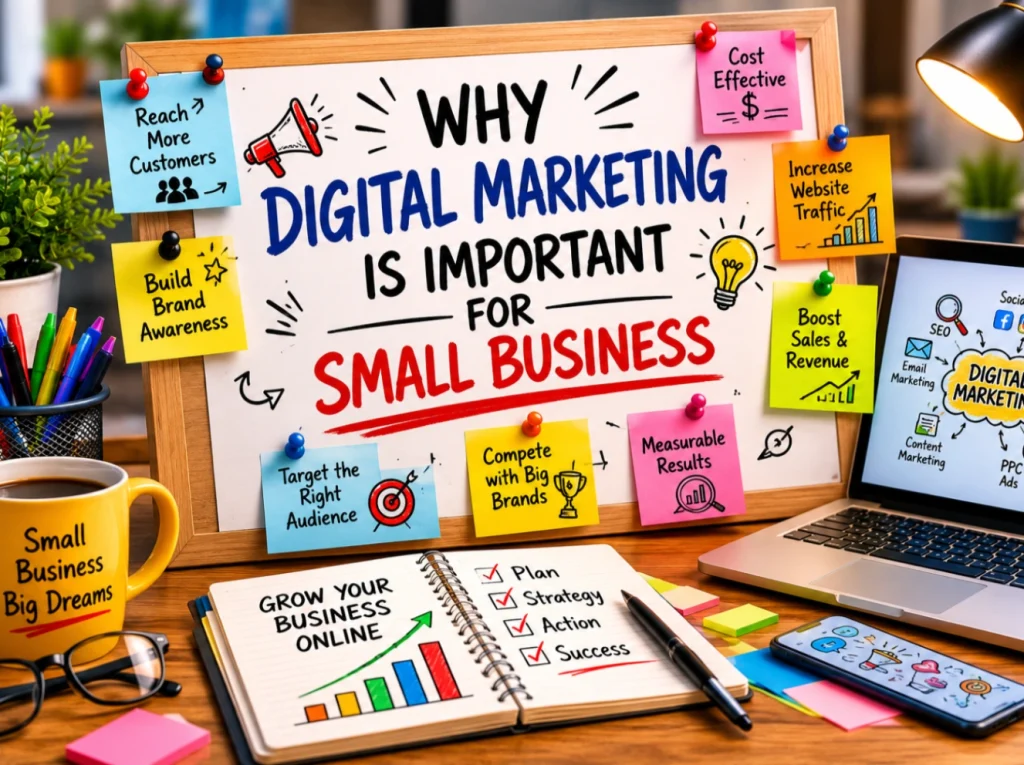
Learning digital marketing for small business has become essential rather than optional, because the way people shop and decide what to buy has moved almost entirely online. Not long ago, a small business could survive on foot traffic, word of mouth, and a local directory listing, but that world is fading fast. Today the average customer researches a purchase online before they ever walk through a door, and global e-commerce now runs into the trillions of dollars a year.
That shift is why going digital is no longer a “nice to have” reserved for big brands. A bakery, a law firm, a boutique, or a plumber all compete for attention in the same crowded online marketplace, and the tools to win it are now cheap, measurable, and within reach. This guide gives you practical digital marketing advice for small businesses, with six proven strategies, common mistakes to avoid, and a clear path forward.
What are the benefits of digital marketing?
The appeal of small business digital marketing comes down to four advantages that traditional advertising simply cannot match.
The first is reach. A single well-targeted post or search-optimized page can reach thousands of relevant people for a fraction of the cost of a billboard. Effective online marketing for small businesses lets a one-person operation compete with companies many times its size.
The second is personalization. Modern platforms let you tailor your message by location, age, interest, and even past behavior, so the right offer reaches the right person at the right moment. Generic mass advertising sprays the same message at everyone; online marketing for small business lets you whisper directly to the people most likely to buy.
The third is engagement. Marketing used to be a monologue; now it is a conversation. Customers comment, share, and tag their friends, turning your audience into participants who spread your message for you.
The fourth, and most important, is measurability. With the right setup you can see exactly how many people saw an ad, clicked, and bought, so every dollar can be tracked and improved. That feedback loop is the foundation of any sensible set of marketing strategies for small businesses.
Getting started on digital marketing for small businesses
paid adsBefore you launch a single campaign, you need a home base: a credible online presence. That usually means a fast, mobile-friendly website, a complete Google Business Profile, and active profiles on the one or two platforms your customers actually use. Think of these as the storefront, signage, and front desk of your digital operation. Even service businesses that never “ship” anything benefit from being bookable, searchable, and contactable online. You do not need to do everything at once. The smartest approach to digital marketing for small business is to start with the basics, measure what works, and expand gradually. Building digital marketing solutions for small businesses is a process of layering: get found, get trusted, get chosen, then get them to come back. The six strategies below show how.
1) Conduct Competitor Research
You cannot outmaneuver competitors you do not understand. By studying who else is fighting for your customers, you learn which messages land, which channels matter, and where there are gaps you can own. Strong online marketing strategies for small business almost always begin with a clear-eyed look at the market and the trends shaping it, so you are not guessing about what your audience already responds to.
Questions to Ask During Competitor Research
When you examine a competitor, work through a consistent checklist so your findings are comparable:
- Content strategy: What topics do they publish, how often, and in what formats? Are they winning with blogs, videos, or guides?
- Social engagement: Which posts get the most likes, comments, and shares? What tone do they use, and how do followers respond?
- Platforms used: Where do they invest their energy? Their choices hint at where your shared audience spends time.
- Influencers and partners: Who promotes them, and which creators sit in your niche?
- Loyalty programs and offers: How do they reward repeat buyers, and what incentives pull first-time customers in?
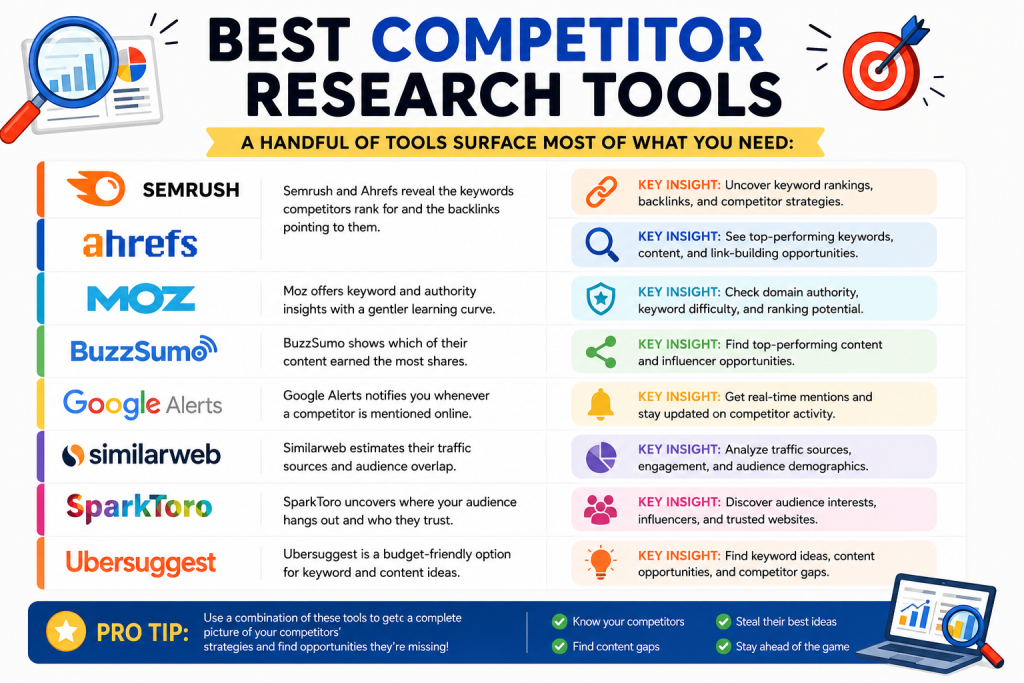
Best Competitor Research Tools
A handful of tools surface most of what you need:
- Semrush and Ahrefs reveal the keywords competitors rank for and the backlinks pointing to them.
- Moz offers keyword and authority insights with a gentler learning curve.
- BuzzSumo shows which of their content earned the most shares.
- Google Alerts notifies you whenever a competitor is mentioned online.
- Similarweb estimates their traffic sources and audience overlap.
- SparkToro uncovers where your audience hangs out and who they trust.
- Ubersuggest is a budget-friendly option for keyword and content ideas.
2) Leverage SEO
Search engine optimization is the engine of long-term, free traffic. When someone searches a need on Google, SEO decides whether your business appears or your competitor does. Unlike paid ads that stop the moment you stop paying, good SEO compounds, earning visits month after month. That durability is why digital marketing for small businesses so often rewards companies that commit to search early and consistently. For a local shop or service, digital marketing for local businesses and search visibility are practically the same conversation.
Why Keywords Matter
Keywords are the bridge between what people search for and what you offer. Broad terms are fiercely competitive, but long-tail keywords, the longer, more specific phrases like “gluten-free birthday cakes in Austin”, attract fewer searchers and far more buyers. Each one is also a content opportunity you can build a page around. Mapping the keywords your customers actually use is the first step toward sustainable small business internet marketing.
Importance of Local SEO
If you serve a specific area, local SEO is your highest-leverage move. Optimizing your Google Business Profile, gathering genuine reviews, and keeping your name, address, and phone number consistent across the web helps you appear in the “map pack” and local results. A well-tuned digital marketing strategy for local business can put you ahead of larger competitors simply because you are more relevant to nearby searchers ready to act today.
Using FAQs and Blogs for SEO
Every question a customer asks is content waiting to be written. A thoughtful FAQ page and a regularly updated blog let you target the exact phrases people search, answer their concerns, and demonstrate expertise. Over time these pages become a library that attracts visitors, builds trust, and quietly answers the question of how to grow my business online without paying for every click.
3) Be Proactive and Reactive on Social Media
Social media is where visibility, engagement, and customer support meet. Being proactive means publishing brand-building content on a steady schedule; being reactive means responding quickly when customers comment, complain, or ask. Brands that do both turn followers into a community, and a community into repeat customers.
Choosing the Right Social Media Platform
You do not need to be everywhere. The skill is choosing two or three platforms where your audience already spends time and matching your content to each one’s strengths. A visual product belongs somewhere visual; a B2B service belongs somewhere professional. Spreading yourself thin across every network is one of the most common mistakes in advertising for small businesses.
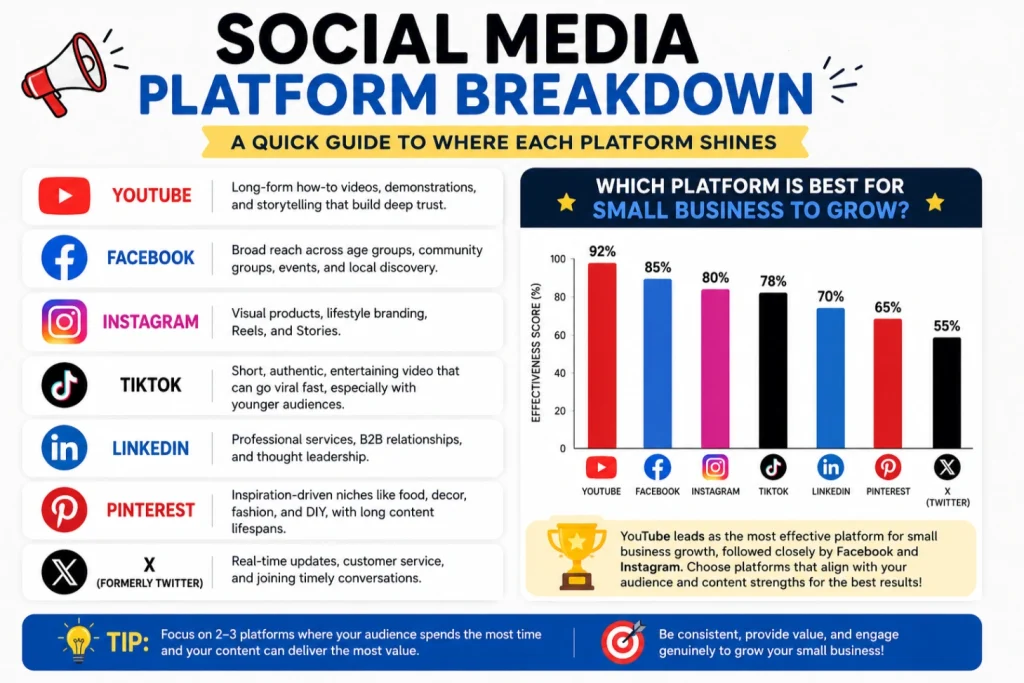
Social Media Platform Breakdown
Here is a quick guide to where each platform shines:
- YouTube: Long-form how-to videos, demonstrations, and storytelling that build deep trust.
- Facebook: Broad reach across age groups, community groups, events, and local discovery.
- Instagram: Visual products, lifestyle branding, Reels, and Stories.
- TikTok: Short, authentic, entertaining video that can go viral fast, especially with younger audiences.
- LinkedIn: Professional services, B2B relationships, and thought leadership.
- Pinterest: Inspiration-driven niches like food, decor, fashion, and DIY, with long content lifespans.
- X (formerly Twitter): Real-time updates, customer service, and joining timely conversations.
User-Generated Content and Customer Interaction
The most persuasive marketing is the kind your customers create for you. Encourage reviews, repost customer photos, celebrate endorsements, and respond promptly to every query, positive or negative. This user-generated content builds social proof at scale and signals that a real, attentive team stands behind the brand, which is the heart of effective best marketing for small business.
4) Target Existing Customers
It is far cheaper to keep a customer than to win a new one, yet many businesses ignore retention. Email marketing remains the highest-return channel precisely because it speaks to people who already trust you, turning one-time buyers into loyal repeat customers. That is why retention belongs in every set of digital marketing strategies for small business.
Customer Segmentation Strategies
Not every customer wants the same message. Segmenting your list, by gender, age, location, interests, and purchase history, lets you send offers that feel personal rather than generic. A first-time buyer needs a different email than a loyal regular; a winter coat customer should not get summer sandal promotions. Thoughtful segmentation is one of the quiet superpowers of digital marketing for local business, where knowing your community closely is a genuine advantage.
How to Grow an Email List
A great email list is built, not bought. Proven tactics include:
- Offering a subscriber discount on the first purchase.
- Running referral programs that reward customers for bringing friends.
- Hosting contests and giveaways that require an email to enter.
- Publishing a genuinely useful newsletter people want to read.
Each gives visitors a real reason to subscribe, and a permission-based list is one of the most valuable assets in small business digital marketing.
5) Reach Out to Influencers
Influencer marketing levels the playing field: a small business does not need a celebrity, just the right voice trusted by the right audience. Micro-influencers, creators with smaller but highly engaged followings, often deliver better results at lower cost than household names, making them ideal partners for online marketing for small businesses on a budget.
Types of Influencer Marketing Activities
Common ways to collaborate include:
- Sponsored posts where a creator features your product to their audience.
- Collaborations on co-created content or limited products.
- Giveaways that boost reach and grow both audiences at once.
- Brand ambassadors who represent you over a longer term.
- Guest blogs that earn exposure and valuable backlinks.
How to Choose the Right Influencer
The biggest mistake is chasing follower counts. Focus instead on brand alignment (do their style and values fit yours), audience relevance (do their followers match your ideal customer), and content quality (would you be proud to be associated with their work). A smaller, perfectly aligned partner almost always outperforms a large, mismatched one. Many digital marketing companies for small businesses will tell you the same: relevance beats reach every time.
6) Focus Your Marketing Budget
A limited budget is not a weakness if you spend it precisely. Digital advertising lets you start small, target tightly, and scale only what works, paying to reach the people most likely to convert rather than buying mass exposure and hoping. That discipline is central to any honest digital marketing strategies for small businesses.
Benefits of Social Media Advertising
Paid social offers three big advantages: budget control (run a campaign for a few dollars a day and pause it instantly), audience targeting (define who sees your ad by interest and demographics), and campaign optimization (the platform improves delivery as data comes in). Affordable, flexible digital marketing packages for small businesses built around paid social lets you test ideas cheaply before committing real money.
Choosing the Right Advertising Platform
The best platform is the one where your audience already is, matched to your goal: a visual retail brand may thrive on Instagram, a B2B consultancy on LinkedIn, a local service on Google and Facebook. Align the channel with both your customer and your objective rather than chasing whatever is trendy. If choosing feels overwhelming, this is often the moment businesses bring in a digital marketing consultant for small business to set the strategy.
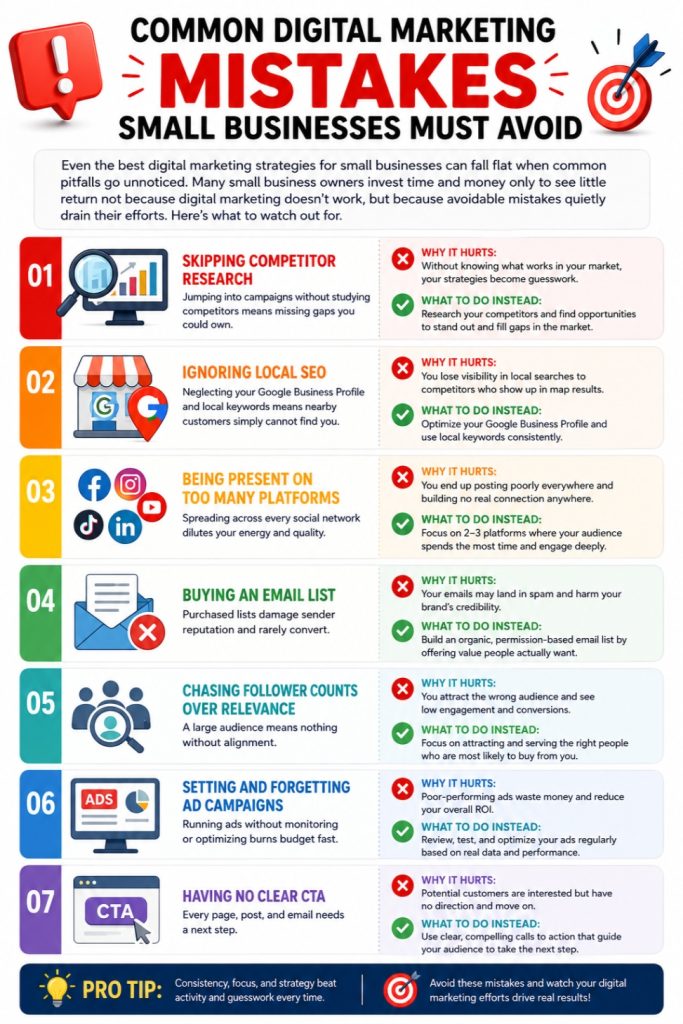
Common Digital Marketing Mistakes Small Businesses Must Avoid
Even the best digital marketing strategies for small businesses can fall flat when common pitfalls go unnoticed. Many small business owners invest time and money only to see little return not because digital marketing doesn’t work, but because avoidable mistakes quietly drain their efforts. Here’s what to watch out for.
- Skipping Competitor Research: Jumping into campaigns without studying competitors means missing gaps you could own. Without knowing what works in your market, your online marketing strategies for small business become guesswork rather than a calculated advantage.
- Ignoring Local SEO: Neglecting your Google Business Profile and local keywords means nearby customers simply cannot find you. For any digital marketing strategy for local business, local SEO is not optional, it is the foundation.
- Being Present on Too Many Platforms: Spreading across every social network dilutes your energy and quality. Effective small business digital marketing means showing up consistently on two or three platforms rather than posting poorly everywhere.
- Buying an Email List: Purchased lists damage sender reputation and rarely convert. Building an organic, permission-based list is one of the most valuable assets in small business internet marketing and should never be a shortcut.
- Chasing Follower Counts Over Relevance: A large audience means nothing without alignment. The best digital marketing for small businesses focuses on reaching the right people, not the most people.
- Setting and Forgetting Ad Campaigns: Running ads without monitoring or optimizing burns budget fast. Every digital marketing package for small businesses should include regular performance reviews and adjustments based on real data.
- Having No Clear CTA: Every page, post, and email needs a next step. Without a clear call to action your online marketing for small business leaves potential customers interested but directionless and they simply move on.
Transform the Marketing Capabilities of Your Small Business
Avoiding mistakes and executing the right digital marketing strategies for small businesses simultaneously is harder than it sounds. Most small business owners wear too many hats to monitor ad performance, build email lists, optimize local SEO, and stay consistent on social media all at once. That is where the right partner changes everything.
Delenzo Technologies, a USA-based digital marketing company for small businesses, takes the guesswork out of growing online. Whether you need a complete strategy or targeted support with SEO and paid ads, our flexible engagements scale with your business instead of locking you in. We don’t just run campaigns, we build coherent, measurable strategies that turn scattered effort into consistent growth. Every service we offer comes with full transparency on what we do and how we measure results, because that is what the best digital marketing services for local businesses should always deliver.
Final Thoughts
Throughout this guide we covered six practical pillars of digital marketing for small businesses researching competitors, leveraging SEO, working social media proactively, nurturing existing customers through email, partnering with the right influencers, and spending every advertising dollar precisely where it counts. We also covered the seven mistakes that quietly undermine even the best online marketing strategies for small business so you know exactly what to avoid.
The path forward is straightforward. Pick one digital marketing strategy for small business, execute it well, measure honestly, and build from there. You do not need to master everything at once, you just need to start.
The businesses winning online today are not necessarily the biggest or the best funded. They are the most consistent. That is the entire philosophy behind successful small business digital marketing in one sentence and it is available to any business willing to act on it today.
Frequently Asked Questions
Digital marketing helps small businesses reach more customers online at a lower cost than traditional advertising. It builds brand visibility, drives website traffic, and generates leads. With the right strategy, even a one-person business can compete with larger brands effectively.
SEO drives free, long-term traffic to your website without paying for every click. It helps your business appear in local search results, builds credibility, and attracts ready-to-buy customers. Good SEO compounds over time, making it one of the smartest small business investments.
The best platform is where your audience spends time. Instagram suits visual products, LinkedIn works for B2B services, and Facebook reaches broad local audiences. Focus on two platforms consistently rather than spreading yourself thin across every network for better results.
Partner with micro-influencers whose audience matches your ideal customer. Collaborate through sponsored posts, giveaways, or brand ambassadors. Micro-influencers are affordable, highly trusted, and deliver stronger engagement than celebrities, making them perfect for small businesses with limited marketing budgets.
SEO and email marketing deliver the highest return on investment for small businesses. SEO attracts free organic traffic while email nurtures existing customers at minimal cost. Both strategies build momentum gradually, consistently generating leads and sales without heavy ongoing advertising spend.