


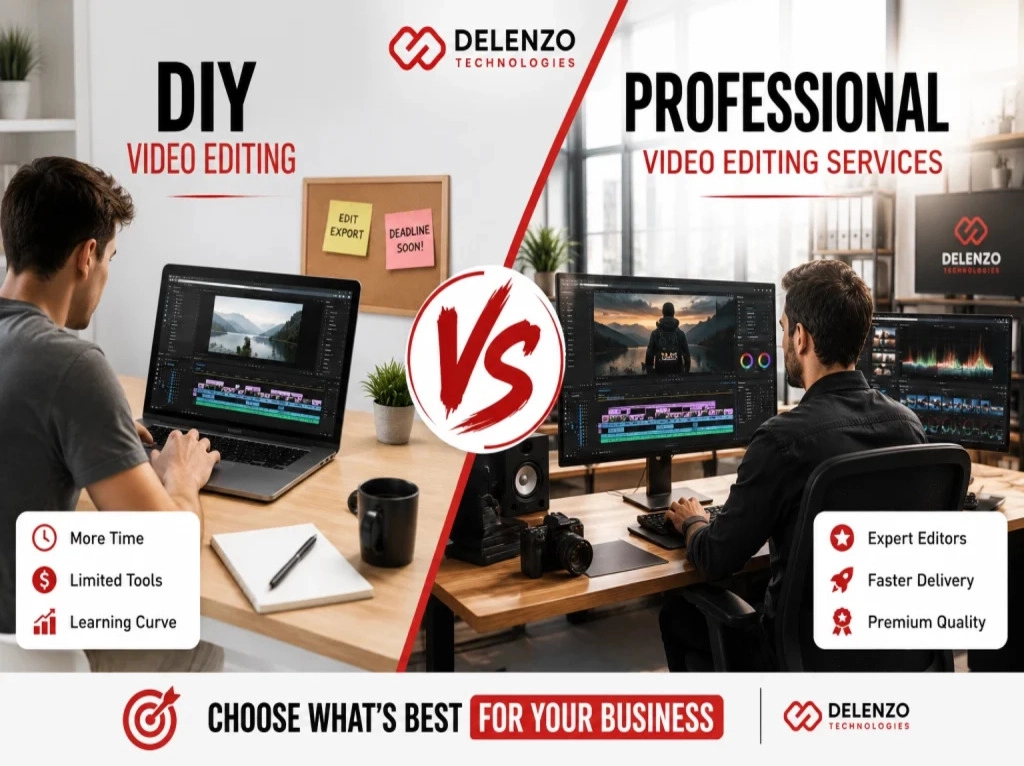
Every business making video content hits the same fork in the road. You can edit the footage yourself, or hand it to trained editors. Both paths produce a finished video. Only one fits your time, budget, and growth plans. The choice of DIY vs professional video editing shapes content quality, publishing speed, and brand perception. Most businesses start in-house because it feels cheap and fully controllable. Then the calendar fills up. Deadlines stack. Quality slips. That is usually the moment professional video editing services enter the conversation.
This blog post breaks down both options honestly, so you can pick based on facts rather than guesswork.
Understanding DIY Video Editing and Professional Video Editing Services
Do-It-Yourself (DIY) editing means your own team cuts the footage using consumer or prosumer software. Professional editing means trained specialists handle the work end to end. The right fit depends on your content volume, budget, and quality standards. Neither option is universally better. The difference shows up in output consistency and the hours you spend getting there.
Both approaches produce a finished video, so the real separation starts with how each one actually runs.
What Is DIY Video Editing?
DIY video editing is when you or an in-house team member edits footage without outside help. It usually starts with free or low-cost software like CapCut, DaVinci Resolve, iMovie, or Adobe Premiere Pro. Some teams use online video editing services with browser-based timelines and drag-and-drop templates. The workflow looks simple. You import clips, trim dead space, add music, add captions, and export.
In practice, every step runs longer than expected. Color correction eats an hour. Audio levels fight you. DIY fits internal clips, quick social updates, and behind-the-scenes footage. The real limit is not software. It is attention.
What Are Professional Video Editing Services?
Professional video editing services put a specialist team in charge from raw footage to final delivery. A video editing company assigns editors who edit full time and nothing else. They work from a brief, a brand guide, and a deadline. The scope covers pacing, story structure, color grading, sound design, motion graphics, subtitles, and platform exports. Many providers package this as post production video editing services.
A video editing agency adds strategy on top, advising on hooks, length, and platform formatting. Delivery makes the difference clear. Your team hands off the footage and gets back a finished video without losing a working day.
DIY Video Editing vs Professional Video Editing: Key Differences
The core difference in DIY vs professional video editing is who absorbs the cost. DIY shifts editing time, software, and skill-building onto your team. Professional editing shifts all three onto a provider, and you pay for finished output. The gap is widest in three areas: quality, time, and technical investment. Each one carries a cost you can measure, and each one changes as your content volume grows.
Quality and Creative Expertise
Professional editing produces higher and more consistent quality than DIY, because trained editors think in story before software.They know where to cut for tension and where to hold for emotion. They match color across clips shot in different lighting. They mix audio so voices sit clean above the music. DIY edits often look functional but flat. Cuts land late. Music overpowers dialogue. Viewers may not name the problem, but they feel it, and they scroll away. Branding is the other separator. Professional teams apply your fonts, colors, and logo treatments consistently, which builds recognition. DIY output drifts as different people edit with different instincts.
Time, Productivity, and Workflow
Professional editing takes less of your team’s time than DIY, and it keeps turnaround predictable across a content calendar.
A polished five-minute video takes a beginner six to ten hours. An experienced editor reaches similar quality in two to four. Multiply that across a calendar. Four videos monthly means twenty-four to forty hours of DIY editing. That is a full working week absorbed by one task. Deadlines suffer next. When editing sits with someone who has another primary role, video always loses. Professional workflows solve this with parallel capacity. Multiple editors handle multiple videos at once, so campaigns stay on schedule.
Software, Tools, and Technical Skills
DIY editing requires you to buy the software, hardware, and skill yourself, while professional providers already own all three.
Adobe Creative Cloud runs roughly 60 dollars monthly per seat as an estimate. Add stock music, sound effects, and plugin licenses, and the stack grows quietly. Hardware is the bigger surprise. Editing 4K footage needs strong processing power, fast storage, and enough RAM to scrub without lag. A capable machine costs an estimated 1,500 to 4,000 dollars. Then comes the learning curve. Competent editing takes months of practice. Genuinely good editing takes years.
DIY Video Editing vs Professional Video Editing Comparison
Professional editing wins on quality, speed, and scalability, while DIY wins on upfront cost and creative control.
| Aspect | DIY Video Editing | Professional Video Editing |
| Output quality | Basic to moderate, varies by editor | Consistently polished and brand-aligned |
| Upfront cost | Low software cost, high hidden costs | Clear per-project or retainer pricing |
| Turnaround time | Slow, depends on team availability | Fast and predictable, often 2 to 5 days |
| Scalability | Limited by internal hours | Scales with volume without hiring |
| Branding consistency | Drifts across videos and editors | Locked to brand guidelines every time |
| Skill requirement | Months to years of learning | Already handled by the provider |
| Business impact | Fine for internal and casual content | Stronger engagement, trust, and conversions |
Cost Comparison: DIY vs Hiring a Professional Video Editing Company
DIY editing costs less upfront but more in total, once software, hardware, and staff time are counted. Outsourcing costs more per invoice but consolidates those costs into one predictable number. DIY looks free because the cost is spread across invisible line items. Outsourcing looks expensive because the cost arrives as a single invoice. The honest comparison counts both, and the sections below break each side down.
Hidden Costs of DIY Video Editing
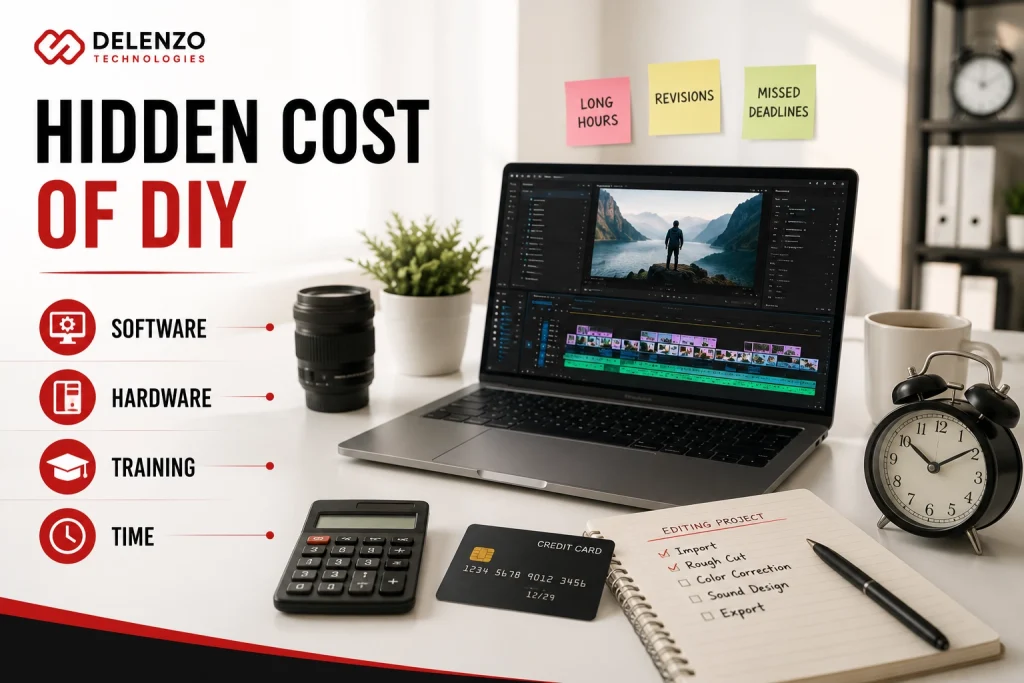
DIY editing carries four hidden costs: software, hardware, training, and time. Time is the largest by a wide margin.
Software runs an estimated 30 to 80 dollars monthly for editing tools and stock assets. That is 360 to 960 dollars annually before a single video ships. Hardware follows. A machine that handles 4K without crashing costs an estimated 1,500 to 4,000 dollars, plus 150 to 400 for storage drives. Training costs real hours, and those hours carry a salary. Four videos monthly takes most beginners twenty-four to forty hours. At 30 dollars hourly, thirty hours equals 900 dollars in redirected salary, as an illustrative estimate. Opportunity cost never appears on a receipt.
Value of Outsourcing Professional Video Editing
Outsourcing converts scattered, unpredictable costs into one clear number, and it returns your team’s hours to revenue work.
Per-video pricing commonly runs 150 to 800 dollars depending on complexity, as an industry estimate. Monthly retainers suit teams publishing consistently. The value goes beyond the invoice. When you outsource video editing services, your team gets their calendar back. Marketing runs campaigns. Founders sell. Editors edit. Long-term results improve because output stays consistent, and consistent quality builds audience expectation. Audiences that expect quality return for the next video. Scaling gets easier too. Going from four videos monthly to twenty needs no hiring, no onboarding, and no new equipment.
Which Option Delivers Better Business Results?
Professional editing delivers better business results for revenue-driving content, while DIY performs well for casual, authentic content. Neither wins outright. Video quality influences engagement, trust, and conversion, but only when the content itself is worth watching. Good editing amplifies a strong message. It cannot rescue a weak one. The right answer depends on what a given video is being asked to do, and the two cases below show where each option earns its place.
When DIY Video Editing Makes Sense
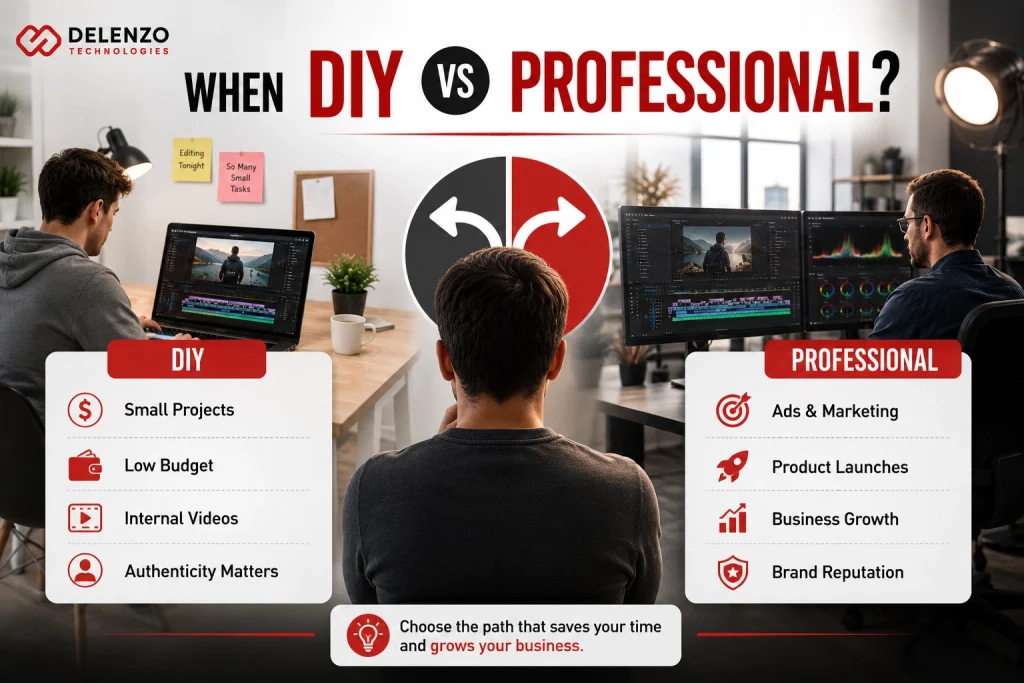
DIY editing makes sense when budgets are tight, stakes are low, and authenticity matters more than polish. It is the right call more often than agencies admit.
DIY fits your situation when:
- Cash is limited. Early-stage startups should spend on product and distribution first.
- Stakes are low. Internal updates, team announcements, and quick tips need no polish.
- Raw performs better. TikTok and Instagram audiences reward unfiltered and over produced.
- You are still testing. Edit rough versions until you learn what resonates.
- Someone enjoys it. Enthusiasm produces better output than obligation ever will.
When Professional Video Editing Is the Better Choice
Professional editing is the better choice once video carries revenue weight, volume climbs, or consistency becomes a competitive advantage.
Outsource when any of these apply:
- Money rides on it. Sales videos, paid ads, and launches punish sloppy editing directly.
- The volume is climbing. More than four to six videos monthly overwhelms in-house teams.
- Consistency matters. Youtube video editing services handle intros, thumbnails, and retention pacing as a repeatable system.
- The work is complex. Motion graphics, multi-camera edits, and color grading sit beyond most DIY skills.
- Editing blocks growth. That is the clearest signal of all.
Factors to Consider Before Choosing the Right Option
Four factors decide the right option: budget, content volume, business goals, and growth plans. The question is not which option is objectively better. It is which one matches your current stage. The two areas below break down how each factor shapes the decision.
Budget, Content Volume, and Business Goals
Your budget sets the floor, content volume sets the pressure, and business goals set the quality standard you cannot fall below. Under 500 dollars monthly for video makes DIY your realistic starting point. Between 600 and 2,500 dollars monthly supports consistent outsourcing at four videos.
Volume works the same way. One or two videos monthly is manageable in-house. Eight or more is not, unless someone edits full time.
Goals settle the rest. A rough cut works fine for brand awareness, but a sales video needs polish. Growth plans matter as much as current numbers. If you plan to triple output next quarter, build the process now. Comparing best video editing services early prevents a scramble later.
Long-Term Scalability and Brand Consistency
Outsource editing scales with budget, while DIY scales only with available hours, and that ceiling arrives sooner than most teams expect.
Internal hours are finite. You can buy better software, but you cannot buy more hours in the day. A video editing agency scales linearly instead of by headcount. Doubling output means doubling the order, not doubling the team.
Brand consistency compounds on top of that. Fifty videos with identical typography, pacing, and color feel like a body of work. Fifty videos edited by five different people feel like noise. That consistency is what makes audiences recognize you before they read your name, and repetition needs a reliable system.
Which Video Editing Option Is Right for Your Business?
Match your business stage against the factors below to find your fit.
| Aspect | Choose DIY Editing | Choose Professional Editing |
| Business size | Solo founder, early startup | Growing SMB, established brand |
| Marketing goals | Awareness, testing, authenticity | Conversions, ads, product launches |
| Monthly budget | Under 500 dollars | 600 dollars and above |
| Turnaround needs | Flexible, no hard deadlines | Fixed campaign and launch dates |
| Content volume | 1 to 3 videos monthly | 4 or more videos monthly |
| Editing complexity | Simple cuts, captions, music | Motion graphics, grading, multi-cam |
| Team capacity | Someone has free hours weekly | Team is already at full load |

Common Mistakes Businesses Make When Choosing DIY Editing
The most common mistake is counting software cost while ignoring time cost. A 20 dollar subscription looks cheap next to 30 unpaid hours.
The other frequent errors:
- Assuming the learning curve is short. Teams budget two weeks. Six months later, output still looks rough.
- Picking DIY for the wrong content. Internal updates in-house are smart. A 5,000 dollar ad campaign is not.
- Switching tools instead of building skills. New software does not fix weak fundamentals. Story, pacing, and audio matter more.
- Underestimating revision cycles. Each stakeholder round restarts the export and review loop.
- Treating the choice as permanent. Hybrid works. Edit casual content internally, send revenue-driving content out.
Comparing a few video editing services online costs nothing and clarifies the decision quickly. Execution mistakes like weak audio, poor pacing, and wrong aspect ratios are a separate problem, covered in our guide to common video editing mistakes.
Final Verdict: DIY or Professional Video Editing Services?
There is no single winner here. There is only the option that fits your stage.
DIY wins when budgets are tight, volume is low, and authenticity beats polish. It is the right starting point for most new businesses, and there is no shame in that.
Outsourcing wins when video drives revenue, volume climbs, or consistency becomes a competitive edge. At that point, editing stops being an expense. It becomes a way to buy back time and protect quality.
The greatest value appears when the numbers align. If editing consumes more than 20 hours monthly, or if video quality is costing you conversions, outsourcing pays for itself.
Our team at Delenzo Technologies works with small and growing US businesses on exactly this transition. We handle video editing services for brands that outgrew DIY but do not want a full in-house hire. Our editors work from your brand guidelines, so every video looks like it came from the same studio.
Final Thoughts
Video editing is a business decision, not a creative preference. Judge it by time saved, quality delivered, and results earned.
Audit your current process before you change it. Track the hours editing actually takes this month. Compare that number against quotes for the same output. If the hours cost more than the quotes, you have your answer.
Look at your next twelve months, not just this quarter. If your video plans are growing, your editing process needs to grow with them. The right choice is the one that keeps you publishing consistently without burning your team out.
Frequently Asked Questions
Is DIY video editing better than professional video editing?
Neither is universally better. DIY suits tight budgets, low volume, and casual content. Professional editing suits revenue-driving videos, higher volume, and brands needing consistency. The right choice depends on your budget, output, and quality standard.
Is hiring professional video editing services worth it?
Yes, once video drives revenue or volume climbs past four videos monthly. Outsourcing returns your team’s hours, keeps quality consistent, and removes software and hardware costs. Below that threshold, DIY usually makes more sense.
How much does professional video editing cost?
Professional video editing costs 150 to 800 dollars per video, depending on complexity, as an industry estimate. Monthly retainers for four videos commonly run 600 to 2,500 dollars. Rush delivery and motion graphics raise pricing.
When should a business outsource video editing services?
Outsource once editing takes more than 20 hours monthly, or once video drives revenue directly. Sales videos, paid ads, and product launches justify professional editing. Volume above four videos monthly also signals the switch.
What is the difference between DIY and professional video editing?
The difference is who absorbs the cost. DIY puts editing time, software, and skill-building on your team. Professional editing shifts all three to a provider, and you pay only for finished output.