

Most US businesses know they should be using AI in digital marketing tools. Very few have a clear plan for actually doing it. Customers expect brands to anticipate their needs before they even search, competitors are moving faster than ever, and the gap between teams that adopt AI and those that don’t grows wider every quarter.
If you’re still planning campaigns the old way, you’re likely leaving money on the table. This guide walks you through building an AI marketing strategy from scratch. No jargon, no hype, just a clear path you can follow. By the end, you’ll know exactly where to start and which steps actually move the needle.
What Is an AI Digital Marketing Strategy and Why Does It Matter?
An AI marketing strategy is a plan that uses artificial intelligence for marketers to manage, improve, and scale your marketing decisions. Instead of guessing what works, you let smart tools study your data, predict customer behavior, and act on it in real time.
Think of it as the difference between reading a map and using GPS. Both get you there. But one reroutes you the second traffic changes. That adaptability is the real value: AI responds while you’re still moving, instead of forcing you to stop and replan.
So why does this matter now? Because AI for digital marketing has stopped being a nice-to-have. Your competitors are already using it to write faster, target sharper, and spend less. The gap between teams that adopt these tools and those that don’t grows wider every quarter.
Here’s what a strong approach gives you:
- Better decisions backed by data, not gut feeling
- More output without hiring more people
- Personalized messages that feel one-to-one, even at scale
- Lower ad waste and a clearer view of what’s working
It’s no longer about working longer hours. It’s about letting machines handle the repetitive parts so your team can focus on creativity and strategy.
The Building Blocks of a Successful AI Marketing Strategy
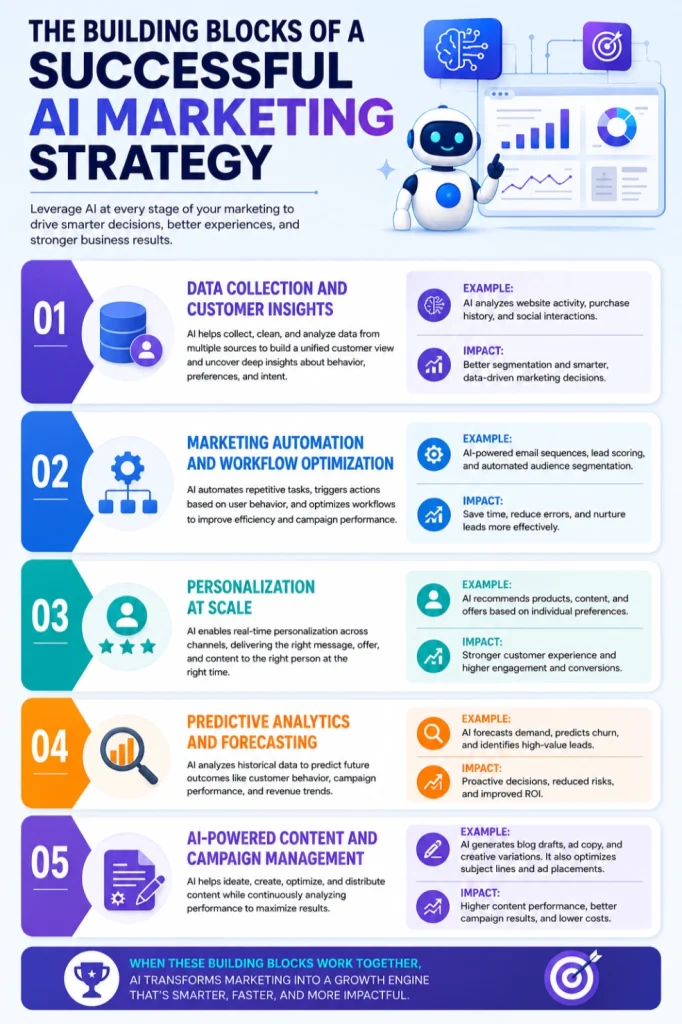
Before you pick tools or launch anything, you need a foundation. Strong AI marketing strategies rest on five pillars: data, technology, automation, personalization, and measurement. Miss one and the rest wobble.
Data Collection and Customer Insights
Data is the fuel. Without it, even the smartest tool runs on empty. Start by gathering clean, organized information about your customers: what they click, what they buy, when they drop off. Good data lets AI spot patterns a human would miss across thousands of interactions, and every smart prediction starts with quality input.
One practical tip: prioritize first-party data you collect yourself. It’s more accurate than third-party sources, easier to act on, and keeps you on the right side of tightening privacy regulations.
Marketing Automation and Workflow Optimization
Repetitive tasks eat your day. Sending follow-up emails, sorting leads, scheduling posts at the right time. Marketing automation hands those jobs to software. Set up a workflow once, and it runs while you sleep. Beyond saving time, it removes the small errors that creep in when people do the same task fifty times a day.
Personalization at Scale
Customers tune out generic messages. They respond to ones that feel made for them. AI reads behavior and serves the right content to the right person at the right moment. One shopper sees a discount on shoes they browsed. Another gets a guide based on what they read last week. Done well, personalization means treating ten thousand people as individuals without ten thousand hours of work.
Predictive Analytics and Forecasting
Predictive analytics looks at past behavior to anticipate what comes next. Who is about to buy it? Who is about to leave? Which product will trend? These insights let you act before things happen instead of reacting after. That head start is where smaller businesses can outmaneuver larger ones that move slowly.
AI-Powered Content and Campaign Management
Writing, testing, and managing campaigns used to take weeks. Now tools draft copy, suggest headlines, and flag underperforming ads in minutes. You still need a human to add voice and judgment, but the heavy lifting gets faster. That speed lets you test more ideas and learn what your audience actually responds to.
Step-by-Step Guide to Creating an AI Marketing Strategy
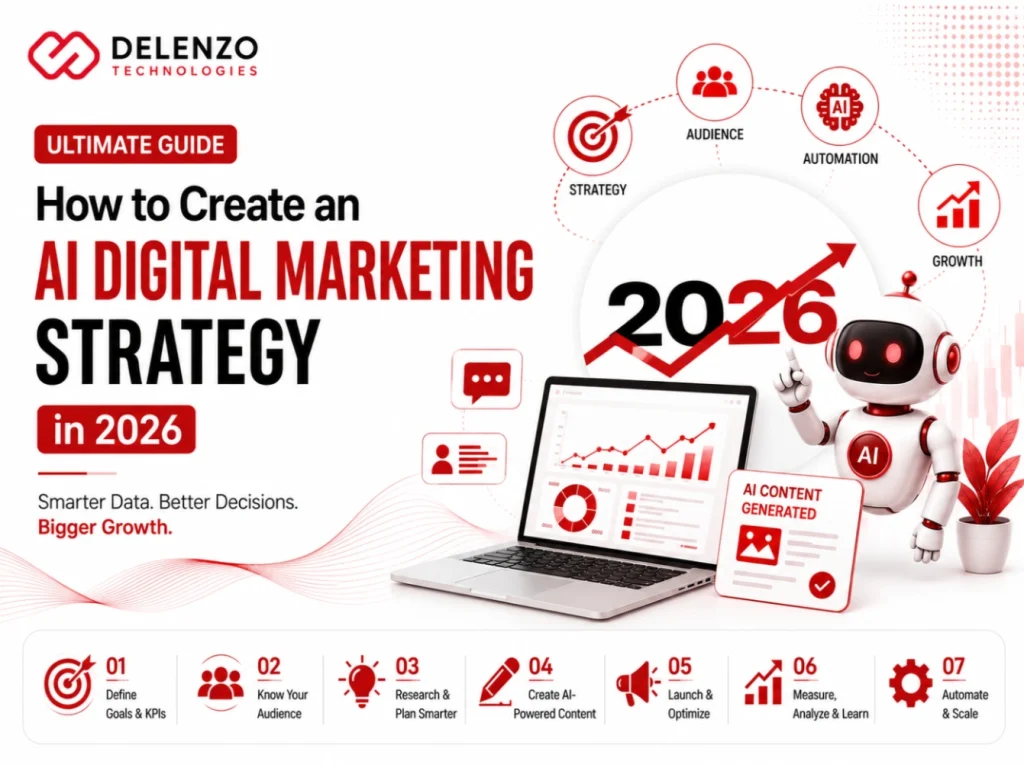
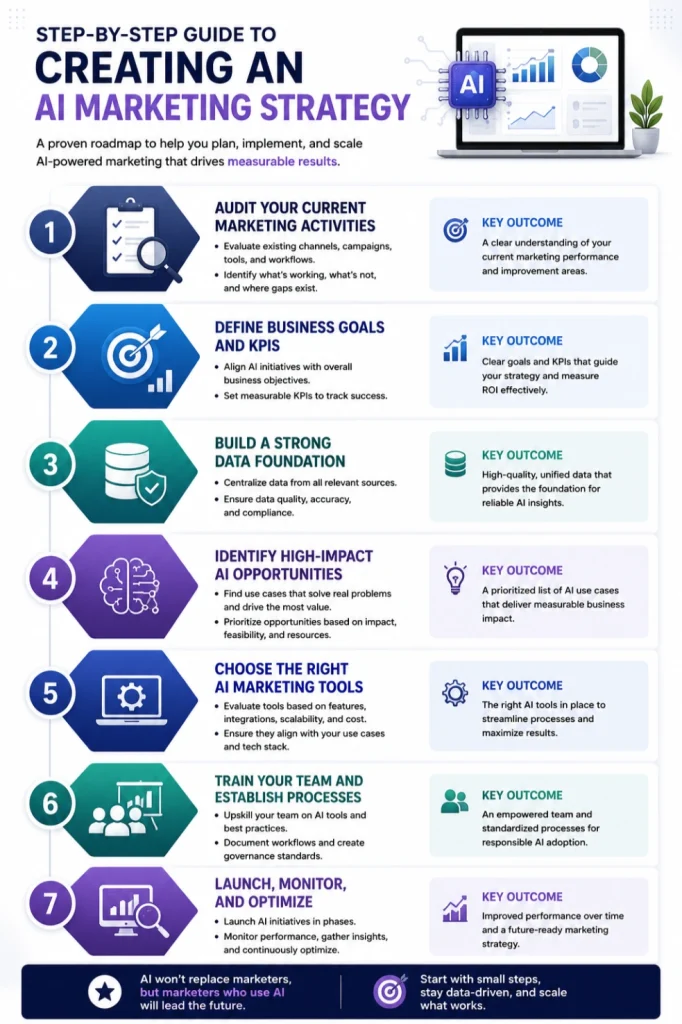
Theory is fine, but you need a plan you can act on. Follow these seven steps in order and you’ll build an AI marketing strategy that fits your business, not a generic template.
Step 1: Audit Your Current Marketing Activities
Start with an honest look at what you already do. List your channels, tools, and results. What’s working? What’s draining time and budget? You can’t improve what you haven’t measured. This audit shows you where AI can help most and where you’re wasting effort. Be ruthless. Cutting a channel that doesn’t perform is as valuable as adding a new tool.
Step 2: Define Business Goals and KPIs
Decide what success looks like. More leads? Lower cost per sale? Higher repeat purchases? Pick clear, measurable goals and the KPIs that track them. Without targets, you can’t tell if anything is paying off. Tie every goal to a number and a deadline so progress is easy to check.
Step 3: Build a Strong Data Foundation
Clean up your data. Remove duplicates, fill gaps, and bring everything into one place where your tools can read it. Messy data leads to bad predictions. This is the quiet step most people skip, and it’s the one that decides whether everything after it works.
Step 4: Identify High-Impact AI Opportunities
Look for quick wins first. Where can AI save the most time or earn the most money with the least setup? For many businesses, that’s email sequences, ad targeting, or customer support. Starting small builds confidence and proves value before you go bigger.
Step 5: Choose the Right AI Marketing Tools
Pick tools based on your goals and budget, not on hype. A local shop and a national brand need very different setups. If choosing feels overwhelming, working with an experienced AI marketing partner helps you avoid paying for features you’ll never touch.
Step 6: Train Your Team and Establish Processes
Tools don’t run themselves. Your people need to know how to use AI in marketing before you go live. Run short training sessions, write simple guidelines, and decide which tasks AI handles and which still need a human sign-off. Teams that skip this step often blame the software when the real gap is training.
Step 7: Launch, Monitor, and Optimize
Go live. Then watch closely. Track your KPIs, spot what works, and adjust fast. AI marketing isn’t set it and forget it. The best results come from steady tweaks over time. Review your numbers weekly at first, then settle into a rhythm that fits your pace.
How AI Enhances Every Stage of the Customer Journey
A smart AI digital marketing strategy doesn’t live in one corner of your funnel. It works across the whole journey, from the first impression to the tenth purchase.
AI for Brand Awareness
At the top of the funnel, AI helps the right people find you. It analyzes audience signals and places your content where attention already lives. Tools surface the topics your audience is searching for and predict which formats will land best. The result: every advertising dollar works harder because it reaches people who are already likely to care.
AI for Lead Generation and Nurturing
Once people notice you, AI separates the curious from the serious. Lead scoring ranks prospects by purchase likelihood, while automated sequences nurture each lead with the right message at the right time. Warm prospects don’t go cold while your team is focused elsewhere.
AI for Conversion Optimization
This is where interest turns into sales. AI tests offers, predicts what each visitor wants, and serves personalized recommendations that nudge them to buy. A better headline here, a smarter product suggestion there. Over thousands of visits, small tweaks compound into real revenue gains.
AI for Customer Retention and Loyalty
Keeping a customer costs less than finding a new one. To how to leverage AI in marketing for long-term growth, this is where it pays off most. Chatbots handle routine questions instantly. Predictive systems flag customers who are drifting and trigger win-back offers before they leave. Loyalty programs use behavioral data to reward people in ways they actually value, rather than generic discounts that anyone can see through.
Best AI Tools for Digital Marketing in 2026
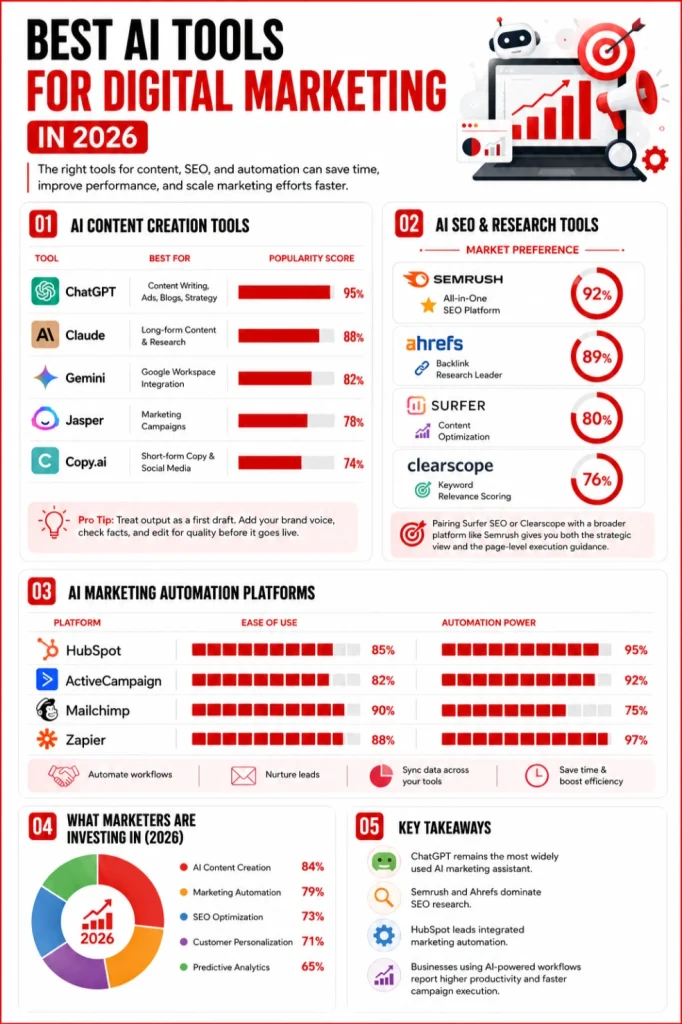
You don’t need every tool out there. You need the right few for your goals. Here’s a clear breakdown of the leading options, including what makes each one worth your attention and where the meaningful differences lie.
AI Content Creation Tools
For writing, brainstorming, and drafting, these are the tools worth your attention:
- ChatGPT — Best for volume and variety. Handles everything from ad copy to long-form drafts quickly.
- Claude — Produces more nuanced, context-aware copy that holds up better for longer, more detailed pieces.
- Gemini — Integrates tightly with Google Workspace, making it a natural fit if your team already lives in Docs and Sheets.
- Jasper — Purpose-built for marketers, with templates designed specifically for ads, emails, and landing pages.
- Copy.ai — Similar to Jasper, strong for structured campaign content and short-form copy at speed.
The key with all of them: treat the output as a first draft. Add your brand voice, check facts, and edit for quality before it goes live.
AI SEO and Research Tools
- Semrush — The most comprehensive all-in-one option. Slight edge for paid search and content marketing features.
- Ahrefs — Generally preferred for deep backlink analysis and organic SEO research.
- Surfer SEO — Analyzes top-ranking pages and tells you exactly how to structure a piece of content to compete.
- Clearscope — Similar to Surfer, strong for content optimization and keyword relevance scoring.
Pairing Surfer SEO or Clearscope with a broader platform like Semrush gives you both the strategic view and the page-level execution guidance.
AI Marketing Automation Platforms
- HubSpot — The most complete option for businesses that want CRM, email, and automation in one place. More expensive but reduces the complexity of connecting separate tools.
- ActiveCampaign — Comparable automation depth at a lower price point, with particularly strong email sequencing.
- Mailchimp — The easiest entry point for smaller businesses that primarily need email and basic flows.
- Zapier — Sits above all of these as a connector, linking your existing tools so data moves automatically without manual exports.
infographic
AI Analytics and Reporting Tools
- Google Analytics 4 — The baseline. Should be running on every site without exception.
- Looker Studio — Connects to GA4 and other data sources to build custom dashboards that make reporting far faster than pulling numbers manually.
- Predictive analytics tools — Flag where performance is likely to drop before it happens, giving you time to act rather than just react.
Common Challenges of AI Marketing and How to Overcome Them
No tool is magic. Smart adoption means knowing the risks and planning around them. Below are the three issues that trip up most businesses using AI for marketing.
Data Privacy and Compliance
AI runs on data, and data comes with rules. US privacy laws keep tightening, and customers care more than ever about how you use their information. Be transparent. Collect only what you need, store it safely, and let people opt out easily. Handling data responsibly isn’t just legal cover. It builds the trust that keeps customers around.
Maintaining Content Quality
AI writes fast, but fast isn’t always good. Publish generic content and your brand starts to sound like everyone else. The fix is balance: use AI to handle drafts and research, then add the human touch that makes content distinctly yours. Quality still beats quantity, even when the machine can produce endless quantity.
Avoiding Over-Automation
It’s tempting to automate everything. Resist that urge. Customers can tell when they’re talking to a system with no judgment and no warmth. Keep a human in the loop for anything personal or sensitive. The goal is to automate repetitive work and protect the moments that need real human care.
Future Trends Shaping AI Marketing Strategies
Where is all this heading? Several shifts are already taking shape and will define what competitive digital marketing looks like over the next few years.
AI Agents Moving from Advisors to Operators
Today, most AI tools respond to prompts. You ask, they answer. The next phase is agentic AI: systems that take initiative, plan sequences of actions, and execute them independently within the boundaries you set. In marketing, this means an AI that doesn’t just suggest a campaign — it builds the brief, drafts the assets, schedules the send, monitors performance, and reallocates budget toward what’s working. The human role shifts from operator to director.
Hyper-Personalization at the Individual Level
Current personalization largely works at the segment level. What’s coming is hyper-personalization at the individual level, in real time. AI will adapt messaging, offers, and even page layouts based on a single person’s behavior patterns, mood signals, and predicted intent at that specific moment. The brands building clean, rich first-party data pipelines now are the ones who will be ready for this.
Predictive Marketing Getting Bolder
Predictive analytics models are becoming confident enough to act on, not just observe. Rather than telling you that a customer segment is at risk of churning, systems will automatically trigger retention flows, adjust pricing, or shift creative before the drop happens. The window between insight and action collapses, and marketing becomes less about reacting to what happened and more about shaping what happens next.
Conversational AI That Actually Feels Human
Early chatbots were easy to spot. The responses were rigid, the fallback messages were frustrating, and the experience often made customers feel less supported than a FAQ page. That’s changing quickly. Modern conversational AI understands context, handles ambiguity, and recovers from misunderstandings in ways that feel more like texting a knowledgeable colleague than filling out a form. For customer support, lead generation, and post-purchase engagement, this creates a scalable channel that doesn’t sacrifice quality.
The broader takeaway is simple. The brands experimenting now will be ready when these capabilities go mainstream. The ones that wait will spend the next few years catching up to where their competitors already were.
Conclusion
Building an AI marketing strategy isn’t about chasing every shiny tool. It’s about a clear plan: solid data, the right marketing automation, real personalization, and steady measurement. Follow the seven steps, apply AI across your whole customer journey, and avoid the common traps, and you’ll be ahead of most businesses in your space.
The truth is that AI in digital marketing rewards action over perfection. You learn by doing, not by waiting for the ideal setup. You don’t have to figure it all out at once. Pick one quick win, prove the value, and grow from there.If you’d rather skip the trial and error, that’s where the right partner helps. Delenzo Technologies builds AI digital marketing services around your specific goals, so your next campaign works harder than your last one. Reach out, and let’s build something that works.
Frequently Asked Questions
An AI digital marketing strategy uses artificial intelligence to plan, automate, and improve your marketing. It studies data, predicts customer behavior, and personalizes campaigns, helping you make faster, smarter decisions with far less guesswork.
AI improves marketing performance by automating repetitive tasks, targeting the right audience, and personalizing messages at scale. It analyzes data in real time so you spend less, convert more, and reach customers at the right moment.
The right tools depend on your goals. For content, ChatGPT, Claude, and Jasper are strong starting points. For SEO, Semrush and Ahrefs lead the category. For marketing automation, HubSpot and ActiveCampaign are the most capable options at different price points. Start with one area and expand from there.
No. AI handles repetitive tasks and data analysis, but human marketers bring strategy, creativity, and judgment. The strongest results consistently come from people and AI working together. The marketers who learn to direct these tools well are becoming significantly more productive, not redundant.
Start by auditing your current marketing, then set clear goals and clean your data. Pick one high-impact area, choose a tool that fits your budget and use case, train your team, and measure results before scaling up. Starting narrow and proving value first is far more effective than trying to transform everything at once.