


Choosing the right SEO service provider is one of the most consequential marketing decisions a business owner can make, and also one of the easiest to get wrong. Every owner eventually asks the same question about search engine optimization: is it actually worth the money? The honest answer is that it depends on what you pay, what you get, and who you hire. SEO is rarely a quick fix, and the gap between a campaign that pays for itself and one that quietly drains your budget usually comes down to who runs it.
In this guide we break down what SEO services should include, what they cost in 2026, how SEO stacks up against paid ads, and how to measure the return. If you’ve been looking for SEO services but feel buried in jargon and vague pricing, this should give you a clear picture before you spend a cent. Understanding the true SEO services meaning behind each deliverable is the first step toward spending your budget wisely instead of just hoping for the best.
What Should SEO Services Include?
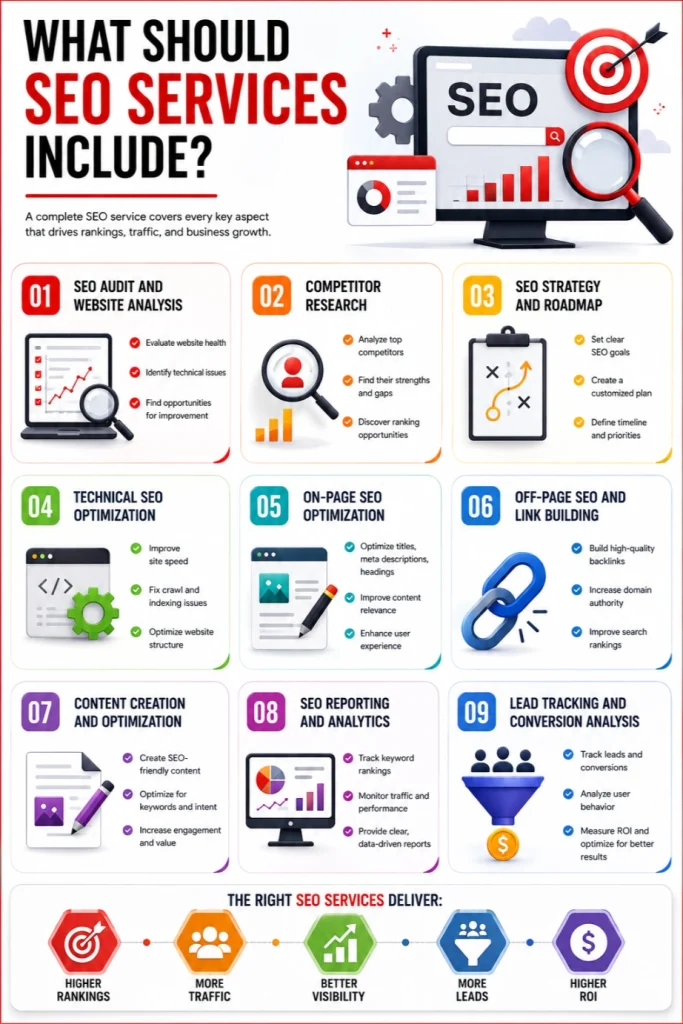
A complete business SEO service covers four core areas: technical health, content, authority building, and performance measurement. These areas must work together over time to drive sustainable organic growth.
Not all SEO packages are equal. Thin packages list tasks without strategy. A legitimate service addresses the factors search engines evaluate holistically — site structure, content relevance, link equity, and measurable outcomes rather than treating each in isolation.
Here is a breakdown of every component a results-driven SEO service provider should include, and why each one matters.
SEO Audit and Website Analysis
Every serious campaign starts with an audit. This is a top-to-bottom review of your site’s crawlability, speed, indexing, broken links, and mobile usability. The audit tells you why you aren’t ranking and what to fix first. Good SEO website optimization services treat this as the foundation rather than a box to tick, because patching structural problems early saves months of wasted effort later. Skip the audit and you’re optimizing in the dark.
Competitor Research
You don’t rank in a vacuum. Competitor research shows which keywords your rivals win, how strong their backlink profiles are, and where the gaps sit. That intelligence shapes a realistic plan instead of guesswork. It also reveals the low-hanging fruit, the keywords your competitors have ignored where you can rank quickly while you chip away at the harder ones. Knowing who you’re up against sets honest expectations about how long results will take and how much ground you have to make up.
SEO Strategy and Roadmap
Data only helps when someone turns it into a plan. A roadmap maps out target keywords, priority pages, content needs, and a timeline. Strong search engine optimization management keeps that plan on schedule and adjusts it as rankings move and algorithms shift. Without a roadmap, SEO becomes a pile of disconnected tasks that never compound into anything.
Technical SEO Optimization
Technical SEO makes your site easy for search engines to crawl and index. That means clean code, fast load times, structured data, secure HTTPS, and a logical site architecture. A proper Google search engine optimization service also watches Core Web Vitals closely, since page experience now feeds directly into how you rank. Much of this work is invisible to visitors but obvious to crawlers.
On-Page SEO Optimization
On-page work covers everything a visitor and a crawler see on a single page: title tags, headings, meta descriptions, internal links, image alt text, and keyword placement. Thoughtful website search optimization services align each page with a clear search intent, so it has a real chance to rank for the terms that actually bring you customers rather than empty traffic.
Off-Page SEO and Link Building
Authority is earned off your own site. Link building, digital PR, and brand mentions signal to Google that other credible sites trust yours. Quality matters far more than volume here; a handful of relevant, authoritative links beats hundreds of spammy ones. This is also where shortcuts get businesses penalized, so the approach should stay conservative, white-hat, and transparent.
Content Creation and Optimization
Content is what you actually rank with. That includes blog posts, service pages, guides, and refreshes of older pages that have slipped down the results. A capable SEO service for website growth pairs keyword research with genuinely useful writing, because thin content built only to please an algorithm rarely holds its position for long. Search engines reward pages that answer the question better than the next result.
SEO Reporting and Analytics
If you can’t see it, you can’t judge it. Monthly reporting should show rankings, organic traffic, and the work completed, all in plain language. The best search engine optimization SEO services company ties these numbers back to business outcomes rather than burying you in vanity metrics that look impressive and mean little. Clear reporting is also how you hold an agency accountable.
Lead Tracking and Conversion Analysis
Traffic that never converts is just a number. Lead tracking connects rankings to phone calls, form fills, and sales, so you know which keywords actually bring revenue. This matters most for an SEO for service based business, where a single new client can be worth thousands. Conversion analysis is what turns SEO from a line item into an investment you can defend to anyone who asks.
How Much Do SEO Services Cost?
In the US, SEO services typically run between $1,000 and $5,000 a month on a retainer, while a one-time project tends to land anywhere from $1,000 to $30,000, depending on competition, site size, and scope. Most reputable providers use one of these two pricing models, and the figure should always map cleanly to a defined scope rather than a vague promise.
SEO Pricing by Model (2026)
| Pricing Model | Typical US Rate (2026) | What’s Usually Included | Best For |
|---|
| Monthly SEO Retainer | $1,000 – $5,000 / month | Ongoing technical SEO fixes, content creation, link building, keyword optimization, and monthly reporting | Businesses that want long-term, sustainable growth through continuous SEO efforts |
| Project-Based SEO | $1,000 – $10,000 per project | Defined deliverables such as SEO audits, website migrations, content overhauls, technical fixes, or penalty recovery | Companies needing one-time SEO improvements or testing SEO before committing to a monthly retainer |
| Hourly SEO Consulting | $100 – $300 / hour | SEO strategy sessions, technical audits, second opinions, staff training, and expert guidance | In-house marketing teams requiring specialist SEO expertise without full-service outsourcing |
| Local SEO Package | $500 – $1,500 / month | Google Business Profile optimization, local citations, local keyword targeting, review management, and local ranking improvements | Local businesses targeting customers within a specific city, region, or service area |
| Enterprise SEO | $5,000 – $25,000+ / month | Large-scale technical SEO, enterprise-level content strategy, multi-location SEO, international SEO, and management of thousands of pages | National brands, large e-commerce businesses, franchises, and multi-location organizations |
Providers offering online SEO services usually structure retainers in tiers, so a local shop and a national brand never pay for the same scope. Small business search engine optimization services sit at the lower end of the retainer range, while competitive national markets climb higher. Many businesses start with a single project, see early results, then move to a retainer once they trust the team.
Factors That Influence SEO Costs
A few things move the final price up or down:
- Industry competitiveness: a national e-commerce store chasing thousands of product keywords costs far more than a local plumber targeting one city.
- Site size and current SEO health: bigger sites and longer backlogs of technical issues take more hours to fix.
- Geographic reach: local, national, and multi-location campaigns each scale differently.
- Speed of results: the faster you want to move, the more resources a campaign needs up front.
- Provider type: Paid SEO services from an established firm cost more than a solo freelancer, but bring a wider team, better tools, and more accountability.
The cheapest quote is rarely the best value, and the most expensive one isn’t automatically the safest. What matters is the ratio of price to scope.
SEO vs PPC: Which Is Better for Your Business?
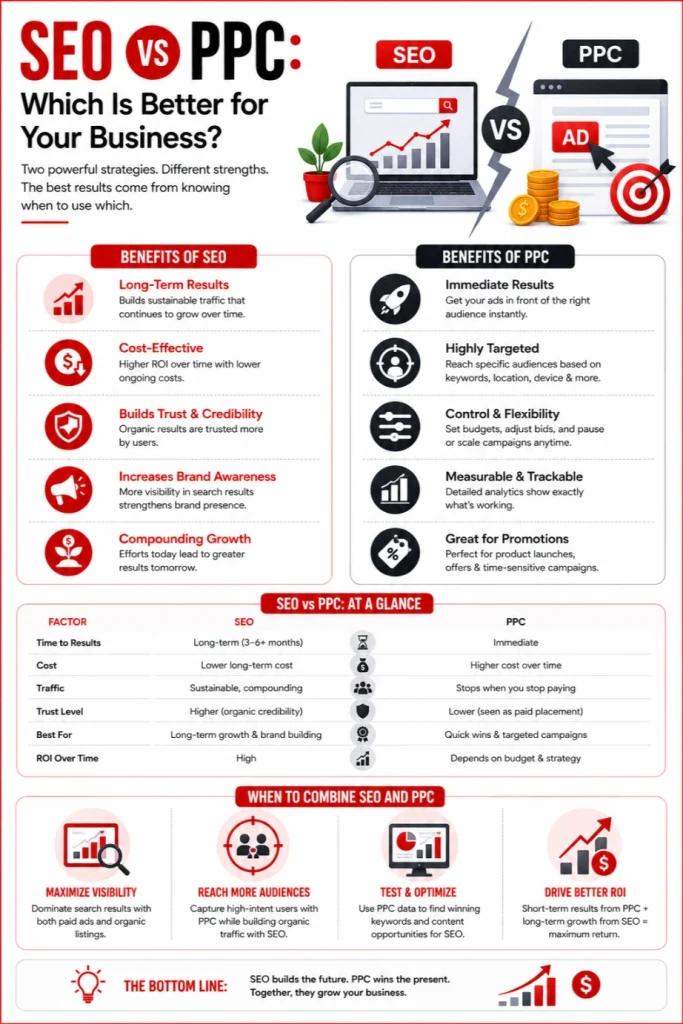
Neither SEO nor PPC is universally better; the right choice depends on your timeline, margins, and budget. SEO builds an asset you own that keeps drawing traffic without paying for every click, while PPC buys instant visibility for as long as you fund it. Most businesses get the strongest results by combining the two, using paid ads for quick wins while organic rankings compound over time.
Benefits of SEO
- Lasting traffic: once a page ranks, it can keep drawing visitors for months or years without paying for every click.
- Lower cost over time: the cost per visitor usually drops as your authority grows.
- More trust: organic listings tend to earn more credibility than paid ads.
- The trade-off: results take patience, often three to six months, sometimes longer in tough niches.
Benefits of PPC
- Instant visibility: the moment your campaign goes live, you can appear at the top of the results page.
- Tight control: you set the targeting and budget down to the dollar.
- Great for testing: ideal for trialing offers or capturing demand during a promotion.
- The catch: traffic stops the second you stop paying, and costs can climb fast in competitive auctions.
When to Combine SEO and PPC
For many companies the smartest approach is to run both. Use PPC to generate leads now while your SEO builds momentum for the long haul. Paid search also produces keyword and conversion data you can feed straight back into your organic strategy. A capable SEO service for business growth will tell you honestly where each dollar works hardest, rather than pushing one channel just because it’s easier to sell.
SEO vs PPC: Which Is Better for Your Business?
| Factor | SEO (Search Engine Optimization) | PPC (Pay-Per-Click Advertising) |
| Speed of Results | Takes 3–6 months or longer to gain strong rankings | Generates traffic immediately after campaign launch |
| Traffic Duration | Long-lasting traffic that can continue for months or years | Traffic stops as soon as the ad budget ends |
| Cost Structure | Upfront investment in content, optimization, and authority building | Pay for every click and visitor |
| Long-Term ROI | Usually provides higher ROI over time as costs per visitor decrease | ROI depends on ongoing ad spend and campaign performance |
| Trust & Credibility | Organic rankings often earn higher user trust | Some users skip ads and prefer organic results |
| Targeting Control | Limited control over who sees your content | Precise audience targeting by location, demographics, interests, and keywords |
| Scalability | Growth compounds over time through content and authority | Easily scalable by increasing budget |
| Testing Opportunities | Slower to test new offers and landing pages | Excellent for testing promotions, products, and messaging quickly |
| Competition Impact | Requires outperforming competitors in search rankings | Higher competition can significantly increase CPC costs |
| Best For | Long-term growth, brand authority, and sustainable lead generation | Immediate leads, product launches, promotions, and seasonal campaigns |
How to Measure SEO ROI
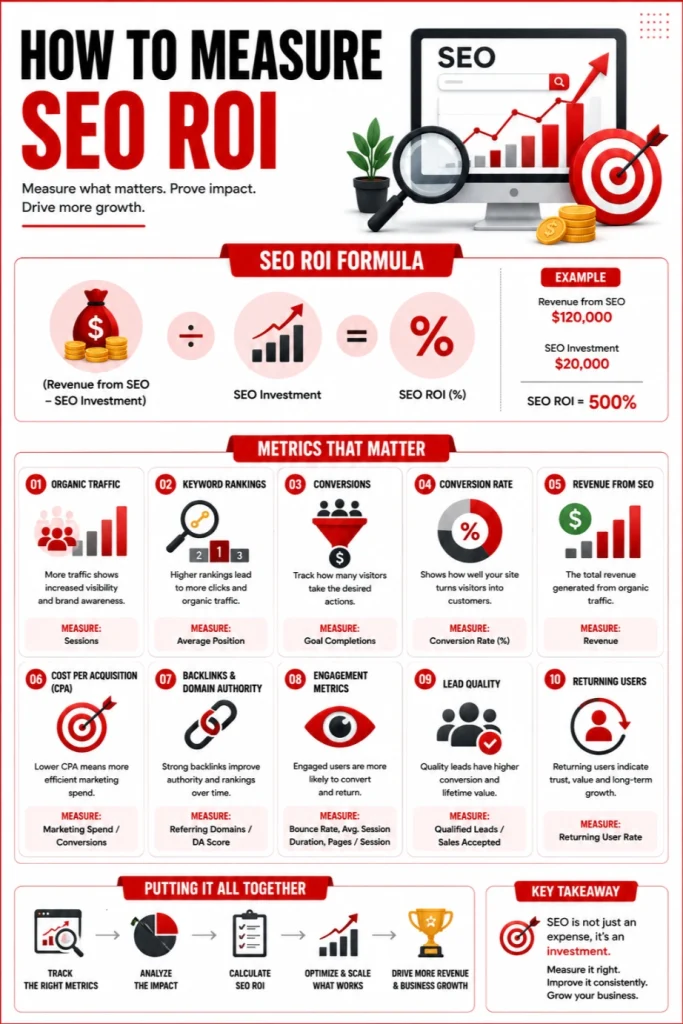
You measure SEO ROI by comparing the revenue it generates against what you spent, using the formula below. Organic search is one of the most trackable channels you have, and any reliable SEO service provider should prove its value with hard numbers rather than promises. Even so, the result is only as accurate as your conversion tracking and whether you count a customer’s full lifetime value, not just the first sale.
SEO ROI Formula
SEO ROI = (Revenue from SEO − SEO Investment) ÷ SEO Investment × 100
The math is the easy part. Spend $12,000 a year and earn $48,000 in new revenue, and your ROI is 300%. The hard part is attributing that revenue accurately, which is exactly why conversion tracking deserves attention before the campaign even begins. A good SEO service also factors in the lifetime value of a customer, not just the first sale, because organic leads often come back. Someone who finds you through search this month may still be buying from you in three years.
Metrics That Matter
Rankings are satisfying, but they’re a means, not the goal. The metrics that actually prove ROI are:
- Organic traffic: the raw audience SEO is bringing in.
- Qualified leads: visitors who fit your customer profile.
- Conversion rate: how many of them take action.
- Revenue by channel: the number that ties it all to the bottom line.
Keyword visibility and click-through rate help explain the trend, while time on page and bounce rate hint at content quality. Whether you run SEO in-house or buy SEO services online, tie every metric back to one question: is this bringing customers? Reporting that answers it is one of the clearest benefits of using an SEO company worth its fee.
How to Choose the Right SEO Agency
Choosing the right SEO agency comes down to evidence over promises: pick the provider who shows case studies with real numbers, explains its methods in plain language, sets realistic timelines, and reports on revenue rather than rankings alone. The same budget produces very different results depending on who spends it, so a trustworthy SEO service provider earns your business by what it can prove, not what it claims.
Signs of a Great SEO Company
A great search engine optimization service provider shows its quality before you ever sign. Look for these signs:
- It stays transparent about its methods and realistic about timelines, backing both with case studies that have real numbers.
- It leads with your goals, asking about your business objectives before quoting a price.
- It reports in plain language it can stand behind, and a quality SEO service will happily explain what it’s doing and why at any point.
- It tracks revenue rather than rankings alone, and when an SEO service partner ties its work to leads and sales, you’ve probably found a keeper.
Red Flags to Avoid
Some warning signs should send you straight to the next candidate:
- Be wary of anyone guaranteeing the number one spot, because no honest SEO service provider can promise that.
- Watch out for secret methods they won’t describe, especially around link building.
- Avoid monthly reports stuffed with jargon and zero business metrics.
- Steer clear of long lock-in contracts with no clear exit.
- Treat prices that look too good to be true as a warning rather than a bargain.
If a search optimization company won’t explain its process or show past results, take that as your answer and walk away.
Questions to Ask Before Hiring
Come prepared with a short list:
- How do you measure success, and what does reporting look like?
- Who will actually do the work on my account?
- Have you handled businesses like mine, and can I see references and recent case studies?
An established search engine optimization service company answers all of this comfortably, while a weak one dodges and deflects. Whether you hire a large search engine optimization services firm or a lean specialist, the right fit is the one whose answers line up with your goals and your budget.
If you’re a US business that wants an SEO service provider already working this way, that’s where we come in. Delenzo Technologies is a US-based digital marketing agency, and we hold every campaign to these same standards: transparent methods, realistic timelines, and reporting tied to revenue rather than vanity metrics. Before you commit to anything, we’re glad to walk you through real results from businesses like yours.
Is SEO Worth the Investment?
Yes, SEO is worth the investment for most businesses as long as you treat it as a long-term play rather than a monthly expense to second-guess. Organic search drives a large share of all web traffic, and because those visitors are already searching for what you offer, the leads tend to convert well, with no cold pitch to overcome.
The catch is that returns depend on choosing well and being patient. Partnering with the best search engine optimization service you can reasonably afford beats chasing the cheapest quote, since quality work compounds while shortcuts unravel. Find an experienced SEO service provider company whose results you can actually verify, and the traffic you build keeps working long after the invoice is paid.
Conclusion
SEO costs what it costs because real results take skill, tools, and time. The smartest spend isn’t the smallest one; it’s the one tied to a clear scope, honest reporting, and returns you can measure. Know what your services should include, understand the two main pricing models, weigh SEO against paid ads for your situation, and scrutinize any agency hard before you sign anything.
That’s the standard we hold ourselves to at Delenzo Technologies. As a US-based SEO service provider agency, our team builds SEO campaigns around your revenue, not just your rankings, with transparent reporting at every step so you always know where your money is going. When you’re ready to put that standard to work, reach out for a free consultation and let’s map out what growth looks like for your business.
Frequently Asked Questions
Most businesses pay $1,000–$5,000 per month on retainer. Project-based work runs $1,000–$10,000 depending on scope. Local campaigns cost less; competitive national markets cost more.
Industry competition, site size, geographic reach, and how quickly you need results. Larger sites with technical backlogs take more hours. Established agencies cost more than freelancers but deliver broader accountability.
Yes, for most businesses. Organic traffic converts well because visitors are already searching for what you offer. Returns compound over time, making SEO one of the highest-ROI marketing channels available.
Compare revenue generated from organic search against your total SEO spend using this formula: (Revenue from SEO − SEO Investment) ÷ SEO Investment × 100. Track qualified leads, conversion rate, and channel revenue rankings and vanity metrics alone will never tell the full story.
Look for verified case studies, transparent methods, and reporting tied to revenue. Ask who handles your account, request references, and walk away from anyone guaranteeing number one rankings.
A complete package covers technical SEO, on-page optimization, content creation, link building, competitor research, and monthly reporting tied to leads and revenue not vanity metrics.
Both serve different needs. PPC delivers instant visibility; SEO builds lasting traffic. Most businesses get the best results running both paid ads for quick wins, SEO for long-term compounding growth.