
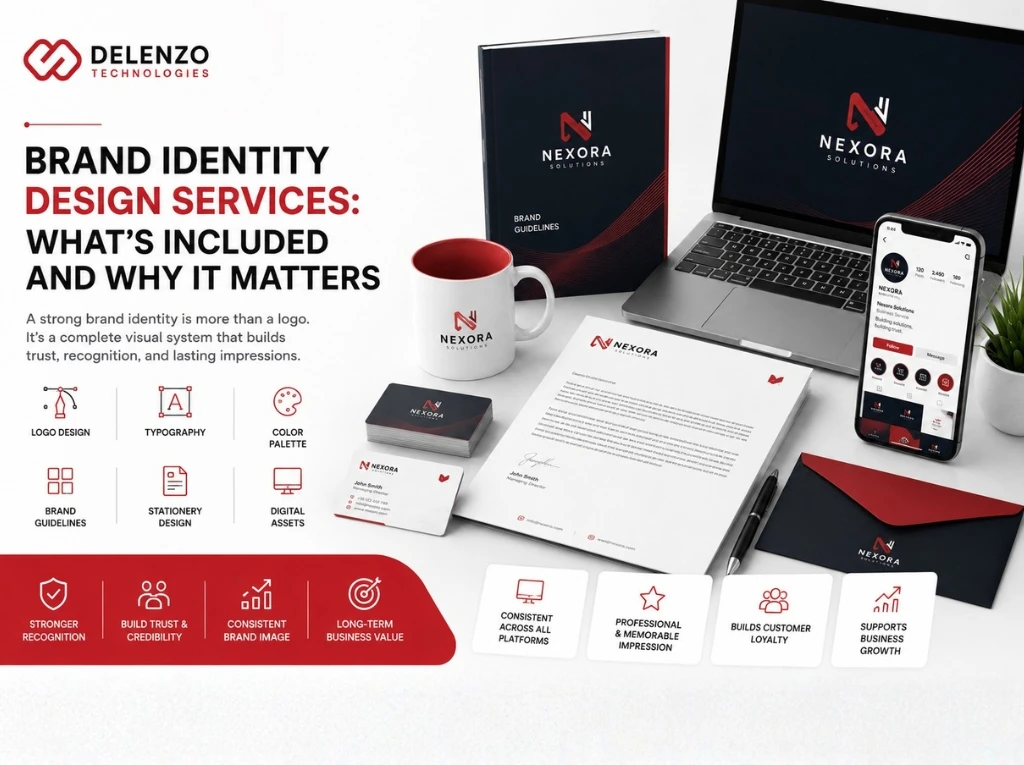
Most businesses think they need a logo. What they actually need is a complete visual system that works everywhere a customer encounters them, on a website, a storefront, an invoice, or a shipping box. Brand identity design services build exactly that: a coordinated system of logo, color, typography, voice, and application rules that stays consistent from a business card to a billboard. Without that system, growth exposes the gaps. A logo that looks fine on a website falls apart on a delivery van. Colors drift between platforms because no one wrote down the codes, and messaging starts to sound different depending on who’s writing it that week.
This guide breaks down what’s actually included in a professional identity project, what it typically costs at different tiers, and the mistakes that waste both money and first impressions.
What brand identity design actually means?
Brand identity design is the visual and verbal system a business uses to express itself consistently, logo, colors, type, imagery, and voice working as one language. It is not a single deliverable or a personal style choice. It translates strategy into something customers recognize, trust, and remember across every touchpoint, from a search result to a repeat purchase.
Brand identity vs. logo design
A logo is one asset; brand identity is the full system that asset lives inside. The two differ in scope and output:
| Aspect | Logo Design | Brand Identity Design |
| Output | A single mark | Color, typography, imagery, and voice system |
| Consistency | Not guaranteed on its own | Built in through documented usage rules |
| Typically sold as | Standalone project | Complete system, often bundled with logo |
That’s why logo and brand identity design are often sold together, but a great logo alone doesn’t guarantee a consistent identity across every surface.
Brand identity vs. branding
Branding is the broader strategic effort; identity design is the visual toolkit that supports it. The difference shows up like this:
| Aspect | Branding | Brand Identity Design |
| Focus | Positioning, perception, reputation | Logo, color, typography, voice |
| Sets | The direction a business wants to own | A recognizable face for that direction |
| Risk if weak | Confusion across touchpoints | Polish with no substance behind it |
Together, the two let customers recognize a business instantly, before reading a single word.
A Brand identity vs. brand image
Brand identity is what a business creates. Brand image is how customers perceive it. Control is the key difference:
| Aspect | Brand Identity | Brand Image |
| Controlled by | The business, directly | Customer perception, indirectly |
| Shaped by | Colors, fonts, voice, logo | Service, pricing, reviews, word of mouth |
| Strengthened by | Strong visual identity design | Consistent execution over time |
The tighter that gap, the less room there is for customers to form a confused or contradictory impression of the business.
What’s included in professional brand identity design services
Designing brand identity systems well means covering nine core components, not just picking colors and a font pairing. Each piece plays a distinct role, from the strategic groundwork that shapes every later decision to the templates that keep a brand consistent long after the design project wraps up.
Brand strategy and discovery
Discovery comes first because design without direction is guesswork dressed up as creativity. This phase covers competitor research, audience definition, positioning, and the core message a business wants to own in a crowded market. It typically produces a short strategy document that guides every design decision that follows, so choices about color, tone, and imagery are justified by research rather than picked because they looked nice in a mood board.
Logo system design
A logo system includes a primary mark, secondary variations, an icon or symbol version, and lockups for different formats and orientations. This range matters because a single logo rarely works at every size and on every surface, from a favicon that’s sixteen pixels wide to a storefront sign visible from across a parking lot. A one-size logo usually means a business ends up stretching, cropping, or distorting the mark to make it fit, which is exactly what a proper system is built to prevent.
Color palette
A professional palette defines primary, secondary, and accent colors with exact HEX, RGB, and CMYK codes, plus usage ratios for where each color should dominate versus support. Precise codes matter because color shifts subtly between print and screen without them, and a slightly different blue on a website versus a business card quietly undermines the consistency the whole system is supposed to deliver.
Typography system
Typography includes a primary typeface for headlines, a secondary typeface for body copy, and defined hierarchy rules for sizing, spacing, and weight across different contexts. A good typography system stays legible across web, print, and packaging without requiring a fresh decision every time someone opens a new document, which is exactly the kind of small inconsistency that adds up over a year of marketing.
Brand voice and messaging
This defines tone, vocabulary, and the phrases a business does and doesn’t use, so writing sounds consistent whether it comes from a founder, an employee, or an outside agency. It usually includes a short tagline framework and example copy for common scenarios like social captions, email subject lines, and customer service replies, giving the team a reference instead of guesswork.
Iconography and supporting graphics
Custom icons, patterns, or graphic devices extend the identity beyond the logo, giving a business a recognizable visual language for social posts, presentations, and packaging instead of leaning on generic stock graphics that any competitor could use. This layer is often what makes a brand feel fully developed rather than just logo-plus-colors. If you need custom visuals tailored to your brand, explore our professional graphic design services to see how we build these assets.
Photography and imagery direction
This sets rules for photo style, lighting, color treatment, cropping, and subject matter, so images feel like they belong to the same brand even when they come from different shoots, photographers, or stock libraries over time. Without this direction, a brand’s photo feed can look like it belongs to three different companies within a year.
Brand guidelines document
The brand guidelines document compiles every rule above into one reference: logo usage and misuse, color codes, typography, voice, and imagery direction, usually organized so anyone can find an answer in under a minute. It’s the asset that keeps a brand consistent once outside vendors, freelancers, or new hires start producing content on their own, without a designer checking every file before it goes out.
Application templates and collateral
Templates apply the identity to real, ready-to-use assets: business cards, letterhead, social media templates, email signatures, and presentation decks built on the approved system. These turn an abstract set of rules into something a team can actually open and use starting on day one, instead of reinterpreting the guidelines from scratch for every new piece of marketing.
A partial system tends to fail in the same predictable way: a business gets a logo and a couple of colors, then improvises everything else project by project. The first few pieces might look fine on their own, but placed side by side, a website banner, a set of business cards, and a social template start to look like they came from three different companies. That’s the practical cost of treating identity as a single file instead of a full system built to hold up across every channel a business actually uses.
Brand identity design packages
what tier is right for your business?
Brand identity design services pricing typically ranges from $1,500 to $100,000+, depending on scope, business size, and deliverable count. The table below breaks down what’s included at each tier.
| Tier | Investment Range | What you get |
| Essential | $1,500–$3,500 | Logo system + color palette + typography + basic guidelines |
| Standard | $3,500–$8,000 | Full identity system + voice guidelines + templates + full brand book |
| Comprehensive | $8,000–$25,000 | Complete system + strategy + application design + living guidelines |
| Enterprise | $25,000–$100,000+ | Multi-brand architecture, global system, extensive application |
The ranges above are illustrative industry benchmarks, not fixed quotes. Which tier fits depends on where a business stands today:
- New local business, single product line: Essential or Standard
- Preparing to franchise, launch new locations, or add product lines: Comprehensive
- Multi-brand, multi-market, or enterprise operation: Enterprise
A brand identity design company scopes each project around where a business is today and where it’s growing next, not just its current size. Looking at brand identity design examples from different tiers makes this easy to see: the real difference is consistency across formats, not just a nicer-looking logo.
That investment pays off over time. A consistent identity helps customers recognize and trust a business faster, and that shows up everywhere: ads, packaging, and search results. The price tag is just the starting point. What happens after matters more.
Common mistakes businesses make with brand identity design
Most brand identity mistakes come down to skipping steps or skipping documentation. The result looks fine at first, then breaks down as more people touch the brand or it shows up on more surfaces. Five mistakes show up most often:
- Skipping strategy to go straight to design. A logo built without positioning or audience research looks fine but says nothing specific, so it gets lost next to any competitor’s mark.
- Choosing a cheap logo and calling it a brand. A logo file isn’t a system. Without color codes, type rules, or guidelines, consistency breaks the moment anyone else touches the brand.
- Letting the system drift over time. Without documented guidelines, colors, fonts, and logo usage shift with every new hire or vendor, until the brand barely resembles its original version.
- Confusing personal taste with brand direction. Founders sometimes swap out research-backed choices for a personal favorite color or font, weakening the fit between the design and its actual audience.
- Ignoring every surface the brand will appear on. An identity built only for a website often fails on packaging, signage, or merchandise, because those formats were never part of the plan.
How Delenzo Technologies delivers brand identity design
Delenzo Technologies is a Dallas-based agency providing branding and identity design services for small and growing businesses that need a complete, durable visual system, not a single logo file. As a brand identity design company, every project is built as long-term marketing infrastructure, not a one-time deliverable revisited only when it starts to look dated.
The process starts with discovery, not assumptions: understanding what the business stands for, who it serves, and where it competes. As a full-service agency, everything we do at Delenzo Technologies is built to scale with your business.
Each project includes:
- A full logo system
- A color palette with exact code specifications
- A typography hierarchy
- Brand guidelines documentation
- Core template assets
That covers what a business needs to stay consistent from day one, without waiting on a designer for every new piece of marketing.
The identity system extends into logo design, social media design, print design, and UI/UX design, so the same visual language shows up everywhere a customer finds the business, on Instagram or in person.
Final Thoughts
A strong identity system is what separates a business that looks consistent everywhere from one that looks improvised. The nine components covered here, strategy, logo, color, typography, voice, iconography, imagery, guidelines, and templates, work as a set. Skip one, and the gap shows up later as inconsistency, which costs more to fix than to plan for upfront.
If a business is comparing options, the next step is looking at real work, not just price ranges.
Explore Delenzo Technologies logo design, social media design, and print design services to see a complete identity system in action, or get in touch to find the right package tier.
GET IN TOUCH
Discuss Your Project
Frequently Asked Questions
Brand identity design matters because it makes a business instantly recognizable across every touchpoint. Without it, marketing looks inconsistent, trust builds slower, and customers struggle to tell one business apart from a similar competitor nearby.
Most brand identity design projects take a tentative four to eight weeks, depending on tier and scope. Essential packages can often wrap in two to three weeks, while comprehensive systems may take up to ten.
A logo alone creates a symbol, not consistency. Without color codes, typography rules, and guidelines, that logo gets used differently everywhere it appears, making the brand look inconsistent and less trustworthy over time.
Invest in brand identity design services before a major launch, rebrand, or expansion, ideally before spending on ads or new locations. Building the system early prevents costly redesigns and inconsistent marketing down the line.