

For a small business, choosing the right SEO company can have a major impact on online visibility, lead generation, and long-term growth. The challenge is that hundreds of agencies, freelancers, consultants, and digital marketing companies claim to offer the “best” SEO services.
So how do you actually identify the best SEO company for a small business?
The right answer is not simply the agency with the lowest price, the largest team, or the boldest ranking promises. A strong SEO partner should understand your industry, customers, location, competition, website condition, budget, and business objectives before recommending a strategy.
For most small businesses, effective SEO combines:
- Keyword and search-intent research
- Technical SEO
- On-page optimization
- Content development
- Local SEO
- Google Business Profile optimization
- Authority and backlink development
- Conversion optimization
- Performance measurement and reporting
The best SEO companies for small businesses build strategies around business outcomes rather than chasing rankings alone.
If you want to understand the complete ranking process first, read Delenzo Technologies’ guide on how to rank your website on Google.
This guide explains what small business SEO involves, how much it can cost, what services you should expect, which tools matter, how local SEO works, and how to choose the right agency or consultant.
What Is SEO for Small Businesses?
SEO, or Search Engine Optimization, is the process of improving a website so that it can become more visible when potential customers search for relevant products, services, questions, or businesses through search engines.
For a small business, SEO is especially valuable because it can connect the company with customers who are already looking for what it offers.
For example, a roofing contractor may want to appear for searches such as:
- roof repair near me
- roofing company in Dallas
- emergency roof repair Dallas
- commercial roofing contractor
- roof replacement cost
A dental practice may target completely different searches:
- dentist near me
- cosmetic dentist Dallas
- emergency dental clinic
- dental implants cost
- teeth whitening Dallas
The goal is therefore not to attract as much traffic as possible.
The goal is to attract relevant searchers who have a realistic chance of becoming customers.
Small business SEO typically includes five major areas.
| SEO Area | Purpose |
| Technical SEO | Makes the website easier to crawl, index, load, and use |
| On-Page SEO | Helps search engines and users understand individual pages |
| Content SEO | Targets customer questions, needs, problems, and search intent |
| Local SEO | Improves visibility for geographically relevant searches |
| Off-Page SEO | Builds authority through backlinks, mentions, citations, and reputation |
A successful strategy connects all five rather than treating SEO as keyword insertion alone.
Why SEO Is Important for Small Businesses
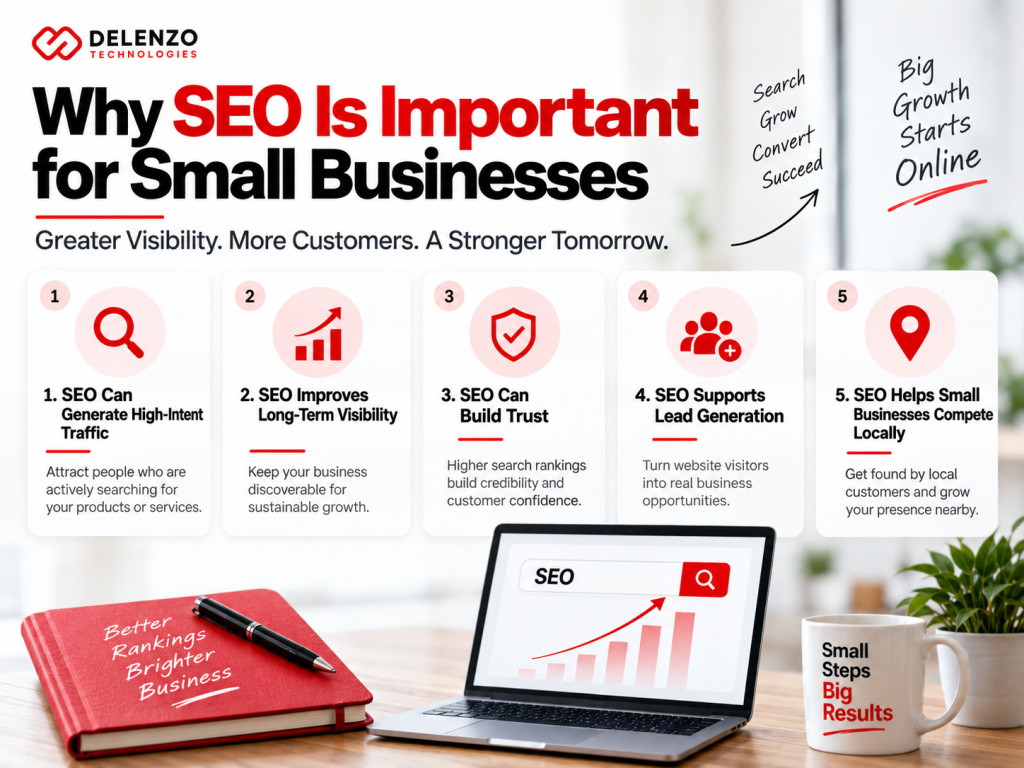
Small businesses frequently compete against larger companies with bigger advertising budgets. SEO gives them another opportunity to compete based on relevance, expertise, location, usefulness, and customer experience.
1. SEO Can Generate High-Intent Traffic
Someone who searches for “commercial photographer Dallas” or “accounting company for small business” is already expressing a specific need.
SEO can place your business in front of this audience at the moment they are researching or preparing to make a decision.
2. SEO Improves Long-Term Visibility
Paid advertising normally stops producing traffic when the advertising budget stops.
SEO works differently.
A strong service page, local landing page, product category, article, comparison guide, or FAQ resource can continue generating impressions and visits over time as long as it remains relevant and competitive.
That does not mean rankings are permanent, but SEO can create compounding value when content and website authority improve continuously.
3. SEO Can Build Trust
Customers often research a business before contacting it.
When a company repeatedly appears across:
- Search results
- Maps
- Helpful guides
- Service-related searches
- Reviews
- Relevant industry queries
it can strengthen brand familiarity and credibility.
4. SEO Supports Lead Generation
SEO should not stop at traffic.
A commercially useful SEO strategy connects search visibility with conversion elements such as:
- Calls
- Quote forms
- Appointment bookings
- Product purchases
- Consultation requests
- WhatsApp inquiries
- Email leads
That is why a business should evaluate SEO performance using conversions and revenue alongside rankings and organic sessions.
5. SEO Helps Small Businesses Compete Locally
A local business does not necessarily need to outrank every national company.
It needs strong relevance within the locations and service categories that matter most.
For many small businesses, a carefully optimized local strategy can create more commercial value than attempting to rank nationally for extremely broad keywords.
How to Choose the Best SEO Company for a Small Business
The best SEO agency for one company may not be the best choice for another.
A local plumber, ecommerce brand, SaaS startup, law firm, B2B manufacturer, and multi-location healthcare provider need different strategies.
Use the following factors when comparing SEO companies.
Check Their Small Business SEO Experience
Small business SEO has different realities from enterprise SEO.
Small businesses often have:
- Smaller marketing budgets
- Smaller websites
- Fewer internal resources
- Limited brand awareness
- Stronger dependence on local customers
- Faster need for qualified leads
- Limited content-production capacity
A good small business SEO company should understand how to prioritize activities instead of recommending everything at once.
For example, a local service company may benefit more from improving:
- Core service pages
- Google Business Profile
- Local landing pages
- Reviews
- Technical issues
- Internal linking
- Relevant citations and backlinks
before investing heavily in large-scale informational content.
Ask an agency whether it has experience with businesses similar to yours in terms of size, industry, geography, and customer journey.
Review Their SEO Strategy and Process
A professional SEO agency should be able to explain what it intends to do and why.
A complete SEO process may include:
Website Audit
The agency reviews areas such as:
- Indexability
- Crawlability
- Site architecture
- Page speed
- Broken links
- Redirects
- Duplicate content
- Metadata
- Structured data
- Internal linking
- Mobile usability
Keyword and Intent Research
Keyword research should identify more than search volume.
The agency should understand whether a query is:
- Informational
- Commercial
- Transactional
- Navigational
- Local
For example:
“what is local SEO” is primarily informational.
“best local SEO company Dallas” is commercial.
“hire SEO agency Dallas” shows stronger transactional intent.
Different intent requires different pages.
Competitor Analysis
Competitor research can reveal:
- Search topics competitors rank for
- Content gaps
- Backlink opportunities
- Local positioning
- Service-page structures
- SERP features
- Content formats search engines favor
On-Page SEO
This includes optimizing elements such as:
- Titles
- Headings
- URLs
- Page content
- Images
- Internal links
- Entity context
- FAQs
- Conversion pathways
Technical SEO
Technical work may include:
- Crawl improvements
- Canonicalization
- Sitemap management
- Redirect corrections
- Mobile optimization
- Core Web Vitals improvements
- Structured data
- Site architecture improvements
Content Strategy
Content should be based on customer problems, search intent, topical gaps, and commercial opportunities rather than publishing blogs simply for volume.
Authority Development
Depending on the business, this may include:
- Digital PR
- Relevant directory listings
- Industry citations
- Partnerships
- Resource outreach
- Local links
- Editorial backlinks
To understand these components in greater detail, see Delenzo Technologies’ complete SEO ranking guide.
Compare SEO Pricing and Packages
Price matters, but SEO should not be evaluated only by the cheapest monthly package.
Two agencies can both charge monthly retainers while providing dramatically different levels of work.
One may include:
- Technical SEO
- Content planning
- Content optimization
- Local SEO
- Reporting
- Conversion tracking
- Link development
- Strategy calls
Another may provide only basic keyword tracking and a few backlinks.
Ask exactly what the package includes.
For a deeper breakdown of service models, costs, expected deliverables, and ROI, read Delenzo Technologies’ guide to SEO services cost, benefits, pricing, and agency selection.
Ask About Reporting and KPIs
A professional SEO report should help you understand whether organic search is contributing to business growth.
Useful KPIs can include:
| KPI | What It Tells You |
| Organic clicks | How much traffic search generates |
| Organic impressions | How often your pages appear in search |
| Search queries | What customers search before finding you |
| Keyword visibility | Whether target topics are gaining exposure |
| Leads | How many inquiries came through SEO |
| Calls | Phone inquiries attributable to organic/local search |
| Conversions | Important completed actions |
| Revenue | Ecommerce or trackable sales influenced by SEO |
| Indexed pages | Whether important pages are available to search engines |
| Local visibility | Performance in Maps/local results |
Rankings matter, but they should not be the only metric.
A business gaining thousands of irrelevant visits but generating zero qualified leads does not necessarily have a successful SEO strategy.
Affordable SEO for Small Businesses: What Should You Expect?
Affordable SEO does not mean doing everything cheaply.
It means investing available resources into the activities most likely to produce meaningful results.
A small local business may not need hundreds of articles every month.
It may need:
- A technically healthy website
- Strong core service pages
- Local optimization
- Better internal linking
- Google Business Profile improvements
- Reviews
- Several high-value content assets
- Conversion tracking
Prioritization is what makes SEO affordable.
Affordable SEO vs. Cheap SEO
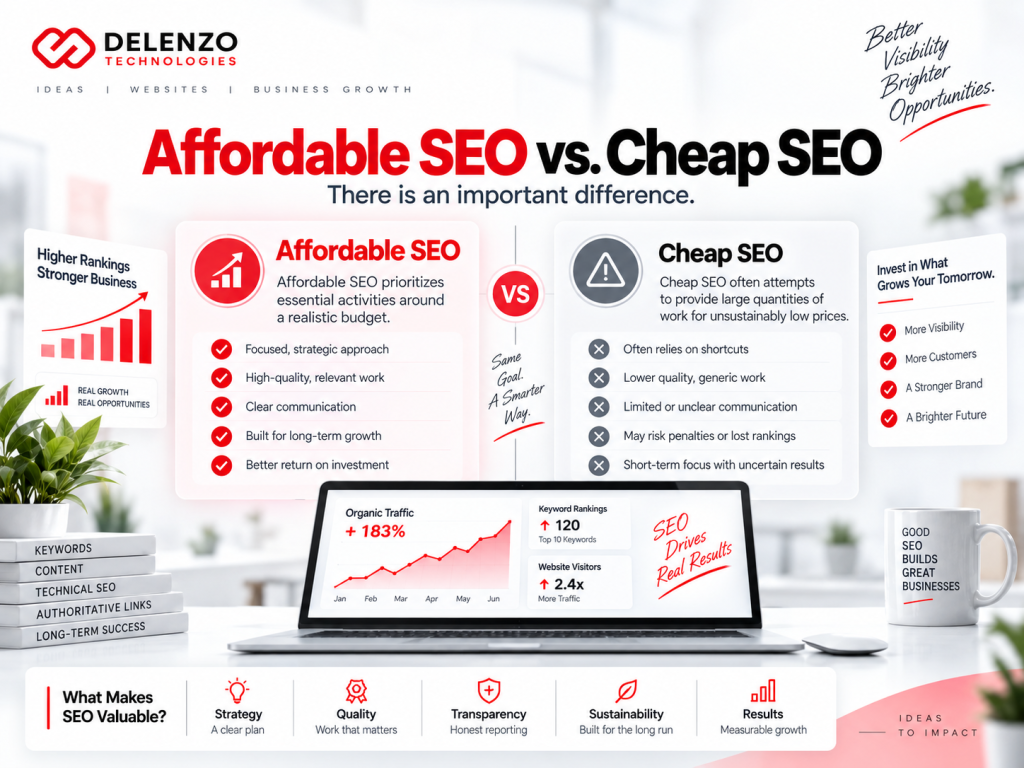
There is an important difference.
Affordable SEO prioritizes essential activities around a realistic budget.
Cheap SEO often attempts to provide large quantities of work for unsustainably low prices.
Warning signs may include:
- Guaranteed #1 rankings
- Hundreds of backlinks promised immediately
- No SEO audit
- No strategy explanation
- Generic content
- Automated directory spam
- Keyword stuffing
- Little or no reporting
- Identical packages for every business
Good SEO does not need to be unnecessarily expensive, but quality research, writing, technical work, strategy, outreach, and analysis require resources.
How Much Should Small Businesses Spend on SEO?
There is no universal SEO budget.
Cost depends on variables including:
- Industry competition
- Geographic competition
- Website condition
- Number of services
- Number of target locations
- Content requirements
- Technical issues
- Backlink competition
- Ecommerce complexity
- Reporting requirements
- Current domain authority
- Speed of desired expansion
A single-location service business may require a smaller program than an ecommerce store with thousands of products.
Before choosing a package, determine what the agency will actually deliver and what business objective each deliverable supports.
Local SEO for Small Businesses
Local SEO helps businesses become more visible when customers search within particular geographic areas.
Examples include:
- electrician near me
- dentist Dallas
- roofing contractor Dallas TX
- SEO company near me
- best photographer in Dallas
Local search is especially important for:
- Restaurants
- Clinics
- Contractors
- Lawyers
- Salons
- Retail stores
- Agencies
- Home-service businesses
- Consultants
- Professional services
Google explains that local rankings primarily consider relevance, distance, and prominence.
That means local SEO should improve both the accuracy of your business information and the broader authority of your business online.
Google Business Profile Optimization
A complete Google Business Profile can support visibility in Google Search and Maps.
Important elements include:
- Correct business name
- Accurate address or service area
- Phone number
- Website
- Opening hours
- Primary category
- Secondary categories where appropriate
- Services
- Business description
- Photos and videos
- Customer reviews
- Review responses
Information should remain accurate and consistent.
Do not add unnecessary keywords to your business name simply to manipulate rankings.
Local Keyword Research
Local keyword research combines customer needs with geographic intent.
For example:
Service keyword: web development company
Location: Dallas
Potential target query:
web development company Dallas
Other formats include:
- service + city
- service + neighborhood
- service + state
- best + service + location
- affordable + service + location
- service + near me
Keyword research should also consider variations customers actually use rather than forcing every service into the same pattern.
Local Citations and NAP Consistency
NAP stands for:
Name, Address, Phone Number
These details should be consistent across important directories, business listings, industry platforms, social profiles, and local citations.
For example, avoid having:
- Three different phone numbers
- Old addresses
- Several business-name variations
- Duplicate profiles
Consistency helps users and platforms understand the correct business information.
Reviews and Local Reputation
Reviews influence customer trust and can also contribute to a company’s local prominence.
Encourage genuine customers to leave honest feedback.
Avoid buying reviews or creating misleading testimonials.
Businesses should also respond professionally to reviews—positive and negative—because prospective customers often evaluate responses as carefully as the original review itself.
SEO for Service-Based Businesses
Service businesses need an SEO structure that connects specific customer problems with specific solutions.
Typical industries include:
- Contractors
- Marketing agencies
- Accountants
- Consultants
- Attorneys
- Healthcare providers
- Photographers
- Cleaning companies
- HVAC companies
- Plumbers
A strong service-business website usually needs dedicated pages rather than one generic “Services” page.
Create Dedicated Service Pages
If a company provides several distinct services, each important service may deserve its own optimized page.
For example:
/seo-services/
/web-development/
/social-media-marketing/
/paid-advertising/
Each page should clearly explain:
- What the service is
- Who it is for
- Which problems it solves
- How the process works
- Important deliverables
- Relevant benefits
- FAQs
- Next steps
The objective is to match the searcher’s intent as closely as possible.
Build Location-Based Landing Pages
A company serving multiple legitimate locations may create location-focused landing pages.
For example:
/seo-services-dallas/
/seo-services-fort-worth/
However, businesses should avoid creating dozens of nearly identical pages where only the city name changes.
Useful location pages should contain genuinely relevant information such as:
- Services available in the location
- Local customer needs
- Service area
- Local examples
- Unique FAQs
- Contact information
- Relevant testimonials or projects where available
Build Local Authority With Content
Useful local content can include:
- Buying guides
- Local industry guides
- Cost guides
- Customer FAQs
- Local case studies
- Event-related content
- Location comparisons
- Regulatory information
- Seasonal advice
The goal is to develop topical authority around the services and locations the business genuinely serves.
Best Local SEO Tactics for Small Businesses
A practical local SEO strategy can include the following.
Optimize On-Page SEO
Important on-page elements include:
- Descriptive page title
- Clear H1
- Logical H2/H3 structure
- Relevant service keywords
- Location references where appropriate
- Helpful content
- Descriptive URLs
- Image alt text
- Contextual internal links
- Calls to action
Avoid repeating the same keyword unnaturally.
Write primarily for the customer while providing enough context for search engines and AI systems to understand the page.
Improve Technical SEO
Even strong content can struggle when important technical problems prevent search engines from accessing or understanding the website.
Review:
- Crawlability
- Indexing
- HTTPS
- Mobile usability
- Page experience
- Internal linking
- Duplicate URLs
- XML sitemap
- Robots directives
- Canonical tags
- Redirects
- Broken pages
- Structured data
A technically stable site gives content a stronger foundation.
If you are redesigning an existing website, protecting current organic equity becomes especially important. Review Delenzo Technologies’ guide to website redesign and SEO before changing URLs, navigation, content, or site architecture.
Build Relevant Backlinks
Backlinks can help search engines discover relationships and authority across the web, but quality matters much more than raw quantity.
Useful sources may include:
- Local organizations
- Industry publications
- Business associations
- Supplier websites
- Partners
- Editorial mentions
- Digital PR
- Local news
- Relevant niche directories
Avoid evaluating link building purely by the number of links acquired.
A smaller number of legitimate, relevant links can be more valuable than thousands of low-quality placements.
Best SEO Tools for Small Businesses
You do not need dozens of expensive platforms to start measuring SEO.
A practical toolkit normally covers:
- Keyword research
- Website auditing
- Search performance
- Analytics
- Competitive analysis
Keyword Research Tools
Popular options include:
- Google Keyword Planner
- Semrush
- Ahrefs
- Moz
- Keyword-focused research platforms
- Google Search Console
Use keyword tools to investigate:
- Search demand
- Related queries
- Commercial intent
- Long-tail opportunities
- Competitor rankings
- Keyword difficulty
- Topic clusters
Remember that keyword-volume estimates are not exact forecasts.
A low-volume query can still be commercially valuable if it attracts highly qualified prospects.
Website Audit and Technical SEO Tools
Useful categories include:
- Site crawlers
- Page-performance tools
- Search Console
- Technical audit platforms
- Structured-data testing tools
These can identify problems such as:
- 404 errors
- Redirect chains
- Missing titles
- Duplicate metadata
- Internal-link issues
- Crawl problems
- Indexation concerns
SEO Performance and Analytics Tools
Google Search Console can show:
- Search queries
- Clicks
- Impressions
- Click-through rates
- Indexed URLs
- Crawling and indexing information
Analytics platforms can help connect organic visits with user behavior and conversions.
The strongest reporting setup connects SEO activity with business outcomes.
AI SEO Tools for Small Businesses
Artificial intelligence can make SEO workflows faster, but it should not replace expertise, source verification, business knowledge, or editorial review.
AI tools can assist with:
- Topic discovery
- Content briefs
- Keyword clustering
- SERP analysis
- FAQ research
- Content ideation
- Entity identification
- Schema drafting
- Content-gap analysis
- Reporting summaries
- Internal-link suggestions
The best approach is AI-assisted SEO, not uncontrolled mass generation.
AI-generated content still needs:
- Accurate information
- Unique value
- Appropriate expertise
- Logical structure
- Brand voice
- Original insights
- Human review
- Useful examples
For AEO and GEO, content should make important answers easy to locate and understand.
Useful patterns include:
- Question-based headings
- Concise answers directly under headings
- Tables
- Definitions
- Comparisons
- Step-by-step instructions
- First-hand evidence
- Specific examples
- Clear entity relationships
Do not create dozens of shallow pages simply because AI makes content creation faster.
Depth and usefulness remain more important than publishing volume.
SEO Consultant vs. SEO Agency for Small Businesses
Both options can work.
The better choice depends on your needs.
| SEO Consultant | SEO Agency |
| Often one primary specialist | Multi-specialist team |
| Usually lower overhead | Usually broader capabilities |
| Direct communication | Structured account management |
| Good for strategy/advisory work | Good for execution across several disciplines |
| Capacity may be limited | Can handle larger workloads |
| May specialize deeply | Can combine technical, content, local and outreach teams |
When Should You Hire an SEO Consultant?
A consultant may be suitable when:
- Your internal team can execute recommendations
- You primarily need strategy
- Your website is relatively small
- Your budget is limited
- You need specialist expertise
- You already employ content or development teams
When Should You Hire an SEO Agency?
An agency may be preferable when you require several skills simultaneously, including:
- Technical SEO
- Content strategy
- Content production
- Local SEO
- Link development
- Analytics
- SEO project management
- Website optimization
An agency can also be useful when your internal team does not have enough capacity to implement recommendations.
B2B SEO Agencies for Small Businesses
B2B SEO differs from many local or consumer SEO strategies because the buying journey can be significantly longer.
B2B prospects often perform multiple searches before contacting a vendor.
They may research:
- Problems
- Solutions
- Product categories
- Providers
- Comparisons
- Pricing
- Integrations
- Case studies
- Reviews
A strong B2B SEO agency should therefore understand the full funnel.
Top-of-Funnel Content
Examples:
- Guides
- Industry trends
- Educational resources
- Problem-focused articles
Middle-of-Funnel Content
Examples:
- Comparison articles
- Solution pages
- Use cases
- Case studies
Bottom-of-Funnel Content
Examples:
- Service pages
- Product pages
- Pricing information
- Demo pages
- Consultation pages
The objective is to capture demand throughout the buyer journey rather than targeting only high-volume informational keywords.
Search Engine Marketing vs. SEO for Small Businesses
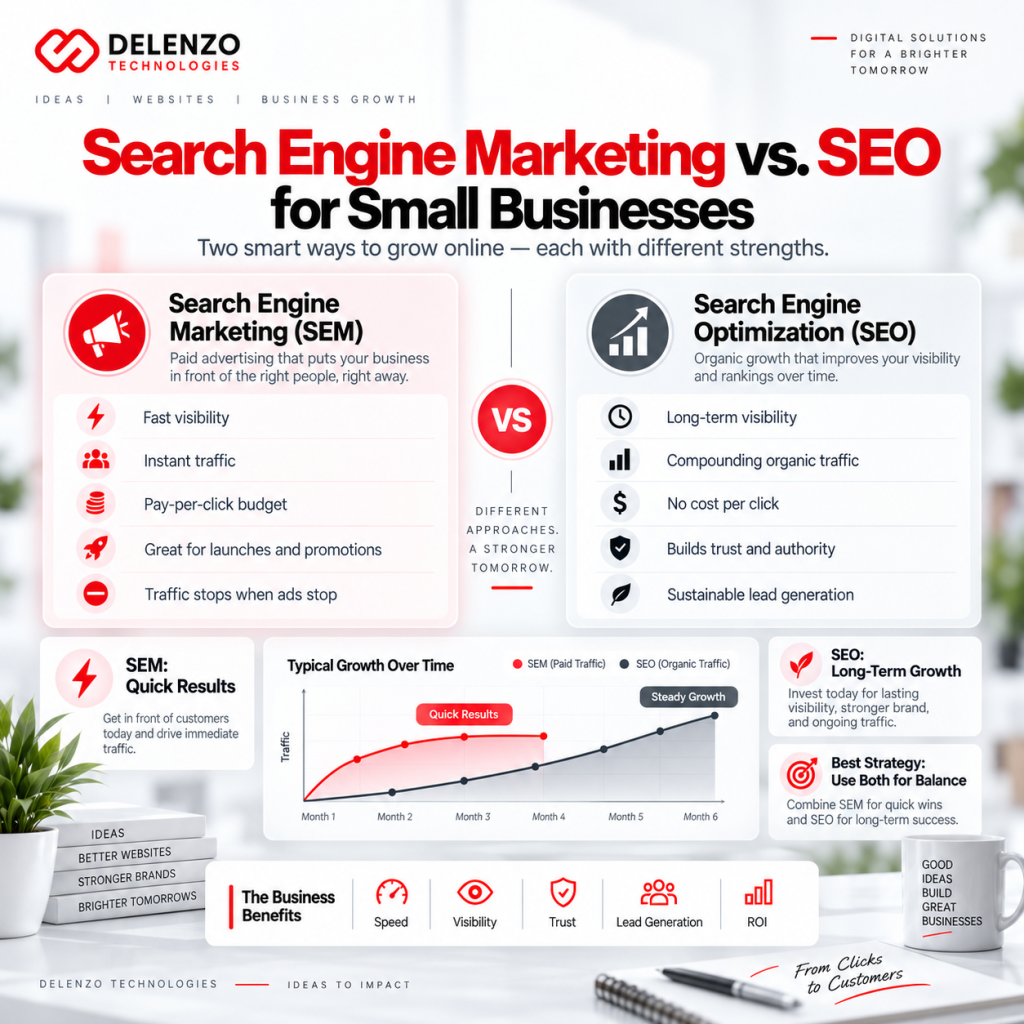
Search engine marketing may include paid search advertising, while SEO focuses primarily on organic search visibility.
Here is the difference:
| SEO | Paid Search / PPC |
| Organic visibility | Paid placements |
| Usually takes time to build | Can generate visibility quickly |
| Compounding content value | Requires continued ad spend |
| Strong for long-term demand capture | Strong for immediate campaigns |
| Rankings are earned algorithmically | Placement influenced by bidding and ad quality |
Neither approach is universally superior.
A business may use paid search for immediate lead generation while simultaneously building SEO assets for sustainable organic visibility.
In many situations, combining both creates stronger market coverage.
Search Engine Marketing in Dallas for Small Businesses
Dallas is a competitive business market, so companies targeting customers in the area need a localized search strategy rather than generic national optimization alone.
Delenzo Technologies serves businesses from Dallas and works across digital marketing, SEO, web development, branding, and related growth services.
A Dallas-focused SEO strategy can connect:
- Location relevance
- Service intent
- Google Maps visibility
- Local content
- Organic rankings
- Paid search
- Conversion tracking
Dallas Small Business SEO Strategy
A small Dallas business should begin by identifying:
- High-value services
- Target customer segments
- Commercial keywords
- Relevant Dallas-area searches
- Existing competitors
- Website gaps
- Google Business Profile opportunities
Then create or improve the pages most likely to influence customer acquisition.
Local SEO in Dallas
For geographically dependent businesses, local SEO may include:
- Google Business Profile optimization
- Dallas-focused service pages
- Consistent business information
- Genuine customer reviews
- Relevant local backlinks
- Local citations
- Location-specific content
The strategy should reflect the actual service area rather than adding “Dallas” unnaturally throughout every paragraph.
Dallas SEO Keyword Strategy
A local keyword framework may include:
Service + location
SEO company Dallas
Service + state
SEO company Dallas TX
Commercial modifier + service + location
best SEO agency Dallas
Cost-based query
SEO services cost Dallas
Problem + location
improve Google rankings Dallas
Long-tail local queries may have lower search volume but stronger commercial intent.
How Long Does SEO Take for a Small Business?
SEO does not have a fixed timeline.
Meaningful progress may appear gradually over several months, but the exact speed depends on the website and competitive environment.
Factors include:
- Website age
- Existing authority
- Technical condition
- Competition
- Content quality
- Number of indexed pages
- Backlink profile
- Local competition
- Search demand
- Implementation speed
A site with serious technical problems may improve quickly after fixes.
A new business competing for highly competitive national terms may require significantly more time.
The better question is not simply:
“How long will SEO take?”
Ask:
“Which milestones should we expect during each stage of the SEO campaign?”
Examples might include:
Early Stage
- Technical fixes
- Keyword mapping
- Tracking setup
- On-page improvements
Growth Stage
- More indexed optimized pages
- Improved search impressions
- Better rankings for relevant terms
- Growing non-branded traffic
Commercial Stage
- More qualified organic inquiries
- Higher conversion volume
- Improved SEO-attributed revenue
SEO should be measured as a progression rather than a guaranteed ranking deadline.
Common SEO Mistakes Small Businesses Should Avoid
1. Keyword Stuffing
Repeating a keyword unnaturally does not make a page more helpful.
Write for users and search intent first.
2. Publishing Thin AI Content at Scale
AI can support content production, but hundreds of generic pages can weaken overall site quality.
Add expertise, examples, facts, analysis, and business-specific value.
3. Buying Low-Quality Backlinks
Avoid spammy link packages promising hundreds or thousands of instant backlinks.
Prioritize relevance and credibility.
4. Ignoring Technical SEO
Broken pages, incorrect redirects, blocked resources, duplicated URLs, or indexing problems can undermine otherwise strong content.
5. Creating Duplicate Location Pages
Do not generate dozens of nearly identical city pages solely to target location keywords.
Make each legitimate location page useful.
6. Ignoring Conversions
Traffic alone is not the goal.
Track:
- Calls
- Form submissions
- Sales
- Bookings
- Qualified leads
7. Constantly Redesigning URLs
Website redesigns can affect rankings if URLs, internal links, metadata, redirects, or content change without an SEO migration plan.
If a redesign is planned, use Delenzo Technologies’ website redesign and SEO checklist to reduce unnecessary ranking risk.
8. Expecting Guaranteed Rankings
Search rankings depend on competitive and algorithmic systems that no legitimate agency controls directly.
Evaluate an agency based on strategy, execution, transparency, and measurable growth rather than guarantees.
Small Business SEO Checklist
Use this checklist before launching or evaluating an SEO campaign.
Technical SEO
- Website uses HTTPS
- Important pages can be crawled
- Important pages are indexed
- XML sitemap is configured
- Broken links are fixed
- Mobile experience works properly
- Redirects are correctly implemented
- Canonicalization is reviewed
- Important structured data is validated
On-Page SEO
- Each key page targets a clear search intent
- Page titles are descriptive
- H1 headings are unique
- H2 and H3 headings are logically structured
- URLs are readable
- Content answers customer questions
- Images include appropriate alt descriptions
- Internal links connect related pages
Content
- Core services have dedicated pages
- Content addresses the buyer journey
- Articles target genuine audience questions
- Content is accurate and useful
- Thin or duplicate content is minimized
- Important pages are regularly reviewed
Local SEO
- Google Business Profile is complete
- Business information is accurate
- Categories are relevant
- Services are included
- Photos are updated
- Genuine reviews are encouraged
- Business information is consistent across important platforms
Authority
- Relevant backlinks are developed
- Local citations are accurate
- Industry mentions are pursued
- Spammy link schemes are avoided
Measurement
- Google Search Console is configured
- Analytics is configured
- Leads are tracked
- Calls are tracked where appropriate
- Organic conversions are measured
- SEO reporting focuses on business outcomes
Frequently Asked Questions About Small Business SEO
Yes, SEO can be worth investing in when potential customers use search engines to find your products, services, expertise, or local business.
SEO is especially valuable when the business has clear commercial search demand and can convert organic visitors into customers.
However, SEO should be treated as a long-term acquisition channel rather than a guaranteed shortcut.
The best SEO company is the one that best matches your business goals, industry, website condition, location, budget, and required services.
Look for an agency that provides transparent strategy, realistic expectations, relevant experience, measurable reporting, and clear communication.
Avoid choosing an agency solely because it promises the cheapest price or guaranteed #1 rankings.
SEO cost depends on competition, website size, location, technical requirements, content needs, authority, and campaign scope.
A local business targeting one city generally requires a different investment than a competitive national ecommerce brand.
For a detailed breakdown, read the Delenzo Technologies guide to SEO services cost and benefits.
Yes, especially at the beginning.
Business owners can often manage tasks such as:
Updating Google Business Profile
Collecting reviews
Publishing expert content
Improving basic titles
Answering FAQs
Checking Search Console
Professional help becomes more valuable when the business needs technical SEO, competitive keyword strategy, website migration support, scalable content, authority development, or advanced analytics.
The best strategy usually begins with high-intent opportunities.
Prioritize:
Technical website health
Core product or service pages
Local SEO where relevant
Search-intent-focused content
Internal linking
Genuine authority development
Conversion tracking
Continuous optimization
Do not attempt every SEO tactic simultaneously.
Focus first on activities most closely connected to revenue.
Yes.
Local SEO can be particularly effective for service-based businesses because customers often search using location terms or “near me” queries.
Strong Google Business Profile information, relevant service pages, local landing pages, reviews, citations, and local authority can improve the business’s ability to compete for these searches.
Hire a consultant when you mainly need expertise, auditing, direction, or strategy and already have people who can implement recommendations.
Consider an agency when you need several capabilities—such as technical SEO, content, local SEO, link development, reporting, and execution—from one team.
They solve different problems.
SEO is typically better suited to developing long-term organic visibility.
Google Ads can provide faster paid exposure for targeted keywords.
Many businesses benefit from using both: paid search for immediate demand capture and SEO for sustainable organic growth.
AI can automate or accelerate parts of SEO, including research, clustering, ideation, analysis, and drafting.
It cannot independently replace strong business strategy, technical judgment, customer knowledge, editorial quality, relationship-driven link acquisition, conversion strategy, or human accountability.
AI works best as a productivity tool within an expert-led SEO process.
Final Thoughts: Finding the Right SEO Partner for Your Small Business
Finding the best SEO company for a small business is not about identifying one universally superior agency.
It is about finding the right partner for your particular situation.
Before hiring an SEO company, evaluate:
- Relevant experience
- Strategy
- Technical capabilities
- Content quality
- Local SEO expertise
- Reporting
- Communication
- Pricing transparency
- Understanding of your customers
- Ability to connect SEO with leads and revenue
Avoid shortcuts built around mass content, spammy backlinks, keyword stuffing, or guaranteed rankings.
A sustainable small business SEO strategy should improve the entire search presence of the company—from technical accessibility and content relevance to local visibility, authority, user experience, and conversions.
At Delenzo Technologies, the goal is to connect SEO strategy with broader business growth. Rather than treating SEO as an isolated ranking exercise, businesses should build search ecosystems that help customers discover, understand, trust, and ultimately choose their brand.
If your website is still developing its organic visibility, start with the fundamentals in the complete Google ranking guide by Delenzo Technologies.
If budget planning is the next concern, review the detailed guide to SEO services cost, benefits, and agency selection.
And if your business is preparing for a website rebuild, follow the website redesign and SEO guide before changing high-performing pages or URLs.
The companies most likely to win in modern search will not be those that simply publish the most pages.
They will be the businesses that consistently provide the clearest, most credible, useful, relevant, and accessible information for the customers they want to reach.