

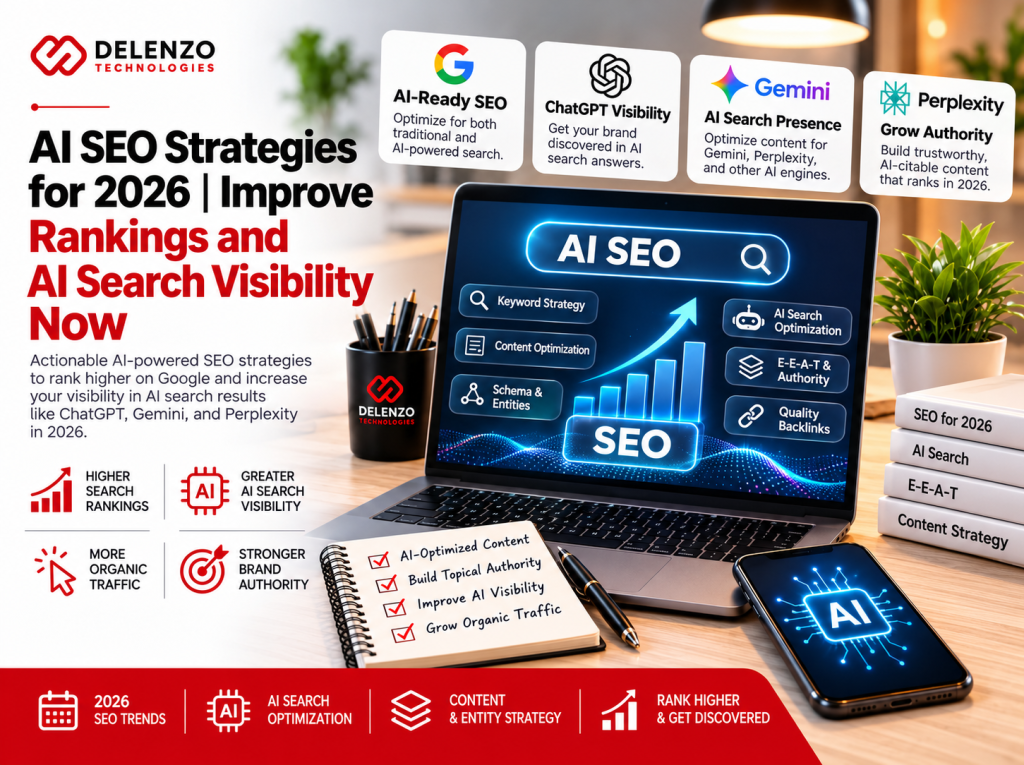
Search no longer ends with ten blue links. In 2026, people get answers from Google AI Overviews, AI Mode, ChatGPT, and Perplexity before they ever click a website.
That shift is the real AI impact on SEO. Your page now has two jobs. It must rank in classic results, and it must be clear enough for AI tools to quote.
Many small business owners feel this already. Traffic dips slightly, yet impressions in Google Search Console keep climbing. People see your brand in AI answers but click less often.
The good news is simple. The basics still work, and AI tools make them faster to apply. Below, you will learn the AI SEO strategies we use for clients. Each one comes with tools, costs, and mistakes to avoid.
What Is an AI SEO Strategy?
An AI SEO strategy is a plan that uses AI tools to speed up SEO work. It also shapes content so AI search engines can find, trust, and cite it.
It has two sides:
- AI for SEO: Using tools like ChatGPT, Semrush, or Surfer to research keywords, find gaps, and audit pages faster.
- SEO for AI: Shaping your content so Google AI Overviews and chatbots pick it as a source.
Most businesses only do the first part. They use AI to write faster but never check if AI engines mention them. A complete plan covers both.
AI SEO vs Traditional SEO
The core difference is the goal. Traditional SEO chases rankings and clicks, while AI SEO also chases mentions and citations inside AI answers.
Here is how AI SEO vs traditional SEO compares on the points that matter most:
| Aspect | Traditional SEO | AI SEO |
| Main goal | Rank in top 10 links | Rank and get cited in AI answers |
| Keyword focus | Exact match phrases | Topics, entities, and full questions |
| Content format | Long pages built around keywords | Clear answers, short sections, lists |
| Success metric | Rankings and clicks | Rankings, clicks, and AI mentions |
| Research speed | Days of manual work | Hours with AI support |
In short, AI SEO does not replace traditional SEO. It adds a new layer on top of solid SEO fundamentals like crawlable pages, fast load times, and quality backlinks.
How AI Is Changing Search Results
AI is turning search into a conversation. Instead of scanning links, users read a summary, ask a follow-up, and only click when they need more depth.
This is why AI search optimization matters now. Your content must answer a question fully in a few lines, then offer extra value worth the click.
User behavior has changed in three clear ways:
- Queries are longer. People type full sentences like “best CRM for a 5-person roofing company in Texas.”
- Follow-ups are common. Users refine their search inside the same chat or AI Mode thread.
- Brand trust happens earlier. Being named in an AI answer builds familiarity before the first visit.
Google AI Overviews and Search Visibility
Google AI Overviews are AI summaries shown at the top of many results. They pull facts from several web pages and link to those sources.
Google states its AI features use the same core ranking systems as regular Search. So Google AI Overviews SEO starts with strong, indexable, helpful pages. No special markup or secret tag gets you in.
What does help is structure. Pages that answer a question in the first one or two sentences are easier to quote. Clean headings, short lists, and simple tables also make extraction easier.
One practical tip: AI Overview and AI Mode data appears inside the regular Performance report in Google Search Console. Watch for pages with rising impressions and falling clicks. Those pages are often being summarized.
ChatGPT, LLMs, and Conversational Search
Large language models (LLMs) like ChatGPT, Claude, Gemini, and Perplexity now act as research assistants. Many buyers ask them for vendor shortlists before visiting Google.
LLM SEO means making your brand easy for these tools to find and describe correctly. Some models browse the live web, while others lean on training data and trusted sources.
To improve your chances:
- Keep your business name, services, and location consistent across your site, Google Business Profile, and directories.
- Get mentioned on respected sites, such as industry blogs, local news, and review platforms.
- Publish clear service pages that state who you help, what you do, and where you work.
- Allow trusted AI crawlers like OAI-SearchBot in your robots.txt file if you want ChatGPT search visibility.
Practical AI SEO Strategies for 2026
The most effective tactics combine AI speed with human judgment. These nine AI SEO strategies work even with a small team, and you can start this month.
Use AI for Keyword Research and Clustering
AI makes it far faster to find keywords and group them into topic clusters. A task that once took a full day now takes about an hour.
Start your AI keyword research with a seed term in Semrush or Ahrefs. Export 500 to 1,000 related keywords. Then paste them into ChatGPT and ask it to group them by search intent and subtopic.
For example, a Dallas roofing company might get clusters like:
- Repair: “roof leak repair Dallas,” “emergency roof repair near me”
- Replacement: “roof replacement cost Texas,” “metal vs shingle roof”
- Insurance: “hail damage roof claim,” “does insurance cover roof replacement”
Each cluster becomes one pillar page plus several supporting blog posts. Always check search volume in a real SEO tool, since chatbots often guess numbers.
Create Helpful AI-Assisted SEO Content
AI can help you draft content faster, but people must add the experience, examples, and opinions. Google rewards helpful content no matter how it was produced.
A smart AI SEO content strategy splits work between machine and human. Let AI handle outlines, first drafts, and summaries. Your team then adds real cases, photos, pricing, and expert insight. Our content marketing services follow this same human-first approach.
A simple workflow that works:
- Build an outline from the top five ranking pages and common user questions.
- Generate a rough draft with AI for each section.
- Rewrite it with your own data, client stories, and local details.
- Fact-check every claim, stat, and price.
- Have a subject expert review it before publishing.
Google’s spam policies target scaled content created mainly to manipulate rankings. Publishing 100 thin AI posts a month is risky. Ten strong, reviewed posts will do more.
Optimize Content for Search Intent
Search intent is the reason behind a query. If your page does not match that reason, it will not rank, however well written it is.
AI tools make search intent optimization easier. Paste the top 10 results for a keyword into ChatGPT and ask what format, depth, and angle they share.
The four main intent types and best formats:
| Intent | Example query | Best format |
| Informational | “what is local SEO” | Guide or explainer |
| Commercial | “best SEO agency Dallas” | Comparison or list |
| Transactional | “hire SEO consultant” | Service page with pricing |
| Navigational | “Delenzo Technologies contact” | Brand or contact page |
Match the format first, then beat competitors on depth, clarity, and examples.
Improve Visibility in AI Overviews and LLMs
To get cited by AI engines, give short, factual answers that are easy to lift. Back them with clear sources, since structure matters as much as quality.
This practice is called generative engine optimization, or GEO. It overlaps with answer engine optimization (AEO), which targets featured snippets and voice answers.
Tactics that help pages get cited:
- Lead with the answer. Put a direct 40 to 60 word reply right under each heading.
- Use question-based subheadings. Match how people phrase queries in chat.
- Add specific facts. Numbers, dates, prices, and named sources are more quotable than vague claims.
- Use lists and tables. AI systems pull structured content more easily.
- Add schema markup. Article, Organization, LocalBusiness, and Product schema help machines read your page.
- Show authorship. Add author bios with real credentials and experience.
Strengthen Semantic SEO and Topical Authority
Search engines now read meaning, not just words. They connect people, places, brands, and concepts, known as entities, to judge if your site covers a topic well.
Entity-based SEO means covering all the related concepts a real expert would mention. A page about “home solar panels” should naturally cover inverters, net metering, tax credits, and payback periods.
Practical ways to build topical authority:
- Use tools like Surfer, Clearscope, or InLinks to spot missing terms and entities.
- Link related posts together so each cluster forms a clear hub.
- Create an About page that confirms who you are, where you work, and what you specialize in.
- Stay focused on a few core topics instead of writing about everything.
Automate Technical SEO and UX Audits
AI-powered crawlers can find broken links, slow pages, and indexing problems in minutes. They also suggest fixes your website development team can apply quickly.
AI technical SEO usually starts with a crawl. Screaming Frog, Sitebulb, or the Semrush Site Audit tool will flag most problems automatically.
Common issues to fix first:
| Issue | Why it hurts | Typical fix |
| Slow page speed | Users leave, rankings drop | Compress images, use caching |
| Broken internal links | Wasted crawl budget | Redirect or update links |
| Missing meta tags | Weak click-through rate | Write unique titles and descriptions |
| Poor mobile layout | Fails Core Web Vitals | Responsive design fixes |
| Blocked AI crawlers | No AI search visibility | Update robots.txt rules |
Most small sites can clear their top technical issues within two to four weeks. Run a fresh crawl monthly to catch new problems early.
Refresh Existing Content Using AI Insights
Updating old posts is often the fastest SEO win. A refreshed article can regain lost rankings within weeks, while a new post may take months.
AI content optimization helps you spot what to fix. Export pages that lost traffic in Google Search Console over the last six months. Then compare each one with current top results using AI.
Typical improvements include:
- Updating stats, prices, and screenshots from older years.
- Adding sections that cover questions competitors now answer.
- Rewriting intros so the main answer appears first.
- Merging thin posts on the same topic into one stronger guide.
We usually suggest reviewing your top 20 pages every quarter. That small habit protects your best traffic sources.
Improve Link Building With AI Research
AI cannot build links for you, but it cuts prospecting time sharply. It finds relevant sites, contact details, and pitch angles much faster than manual searching.
Good AI link building starts with a list. Pull competitor backlinks from Ahrefs or Semrush, then ask AI to sort them by relevance and likely interest.
Ways AI helps with outreach:
- Finding resource pages and roundups in your niche.
- Summarizing a target site’s recent posts so your pitch feels personal.
- Drafting outreach emails you then edit by hand.
- Spotting unlinked brand mentions you can turn into links.
Avoid sending mass AI-written emails. Editors spot them instantly. Five personal pitches beat 200 generic ones.
Predict SEO Trends With AI Analytics
AI analytics can forecast which topics will grow, so you publish before competitors. Early content has more time to earn links and authority.
Predictive SEO analytics combines search trend data with past performance. Tools like Google Trends, Exploding Topics, and Semrush Trends show rising topics months ahead.
Simple ways to use forecasting:
- Plan seasonal content six to eight weeks before demand peaks.
- Spot rising questions in your industry and cover them first.
- Use GA4 predictive metrics to find which pages drive future conversions.
A Dallas HVAC company, for example, should publish AC repair content in March. Texas heat pushes searches up sharply by May.
How to Build an AI SEO Plan
A good plan follows four steps: audit your site, pick priorities, optimize content, and track results. Without a plan, AI tools just create more busy work.
Your SEO strategy with AI should fit your size and budget. A local Plano dentist needs a different plan than a national e-commerce brand selling 2,000 products. Some owners prefer outside help, so compare the best SEO companies for small businesses first.
| Business type | Starting focus | Rough monthly tool budget |
| Local service business | Google Business Profile, service pages, reviews | $0 to $150 |
| Small e-commerce store | Product pages, category content, technical fixes | $150 to $400 |
| Growing B2B company | Topic clusters, thought leadership, link building | $300 to $800 |
These budget ranges are estimates based on common tool plans in 2026. Actual costs depend on the tools and seats you choose.
Audit, Prioritize, and Optimize Content
Start with an audit so you know where you stand. Then fix the issues and pages that can bring results fastest.
A useful website SEO analysis covers four areas:
- Technical health: crawl errors, speed, mobile usability, and indexing.
- Content quality: thin pages, outdated posts, and missing topics.
- Authority: backlink profile and brand mentions.
- AI visibility: whether ChatGPT and Google AI Overviews mention your brand.
Next, rank tasks by impact and effort. Fix quick wins first, like broken links and weak titles. Then move to bigger projects like new topic clusters.
At Delenzo Technologies, our SEO services follow a similar path. Week one is a full audit of your site, analytics, ads, and competitors. Weeks two and three set goals, then we launch with weekly results reviews.
Track Rankings and AI Search Visibility
Track both classic rankings and AI mentions, since one without the other gives an incomplete picture. Clicks alone no longer show your full search presence.
Solid AI SEO performance tracking uses a mix of tools:
| What to track | Tool | How often |
| Rankings and clicks | Google Search Console | Weekly |
| Traffic from AI tools | GA4 referral report | Monthly |
| AI Overview mentions | Semrush or Ahrefs AI tracking | Monthly |
| Brand mentions in chatbots | Manual prompt checks | Monthly |
To check AI traffic in GA4, filter referrals for sources like chatgpt.com, perplexity.ai, and gemini.google.com. Visitors from these sources often convert well because they arrive with clear intent.
For manual checks, ask ChatGPT and Perplexity the same 10 buyer questions each month. Note if your brand appears and how it is described.
Common AI SEO Mistakes to Avoid
The biggest mistakes come from trusting AI output without review. Fast content that is wrong or generic can hurt rankings and brand trust.
The main AI SEO challenges we see in audits include:
- Publishing AI drafts with no human editing.
- Copying AI keyword volumes without checking real data.
- Ignoring technical SEO while chasing content volume.
- Measuring only clicks and missing AI visibility.
- Using the same AI prompts as competitors, which creates lookalike content.
Maintain Content Accuracy and E-E-A-T
E-E-A-T stands for Experience, Expertise, Authoritativeness, and Trustworthiness. Google uses these signals to judge content quality, especially for money and health topics.
Strong E-E-A-T SEO depends on human review. AI tools sometimes invent stats, sources, or product details. A single false claim can damage reader trust fast.
Steps to protect your content quality:
- Add author bios with real names, roles, and experience.
- Cite primary sources like Google Search Central or government data.
- Include first-hand photos, client examples, and original data where possible.
- Show an “updated on” date and refresh content regularly.
- Have an expert sign off on medical, legal, or financial advice.
Avoid Duplicate Content and Cannibalization
When AI writes many posts on similar topics, pages often end up competing for the same keyword. That splits your ranking power.
Keyword cannibalization happens when two or more of your pages target the same search intent. Google may switch between them, and neither ranks well.
How to find and fix it:
- Search your target keyword in Google Search Console and check which URLs get impressions.
- If several pages share one query, pick the strongest page.
- Merge useful content from weaker pages into it.
- Set 301 redirects from the old pages to the main one.
- Give every future post one clear keyword and intent before writing.
Future AI SEO Trends Beyond 2026
Search is moving toward multimodal and predictive experiences. People will search with images, voice, and video, and AI will suggest answers before they finish asking.
The future of AI SEO points to a few clear trends:
- Multimodal search: Google Lens and AI Mode let users search with photos and video. Descriptive alt text and original images will matter more.
- AI agents: Assistants will compare products and book services for users. Clear pricing and structured data will help agents choose you.
- Personalized results: AI answers will vary by user history and location. Local signals become even more valuable.
- Video and short clips: YouTube content already appears in AI answers. Short, clear explainer videos will earn more visibility.
- Brand over keywords: Repeated mentions across trusted sites will matter more than exact match phrases.
Businesses that adapt early will gain the most. Those that wait will compete for a smaller share of clicks.
Conclusion: Build a Smarter AI SEO Strategy
AI has changed how people search, but strong SEO basics still decide who wins. Helpful content, clean technical setup, and real authority remain the foundation.
A smarter AI SEO strategy uses AI for speed and people for judgment. Use tools to research, audit, and track. Let your team add experience, accuracy, and brand voice.
Start small and stay consistent:
- Audit your site and fix the top technical issues first.
- Refresh your 10 best pages with direct answers and current facts.
- Build one topic cluster around your main service.
- Track AI mentions alongside rankings every month.
Delenzo Technologies helps small businesses and e-commerce brands across Dallas and the USA grow with SEO, GEO, AEO, and content marketing. We work on flexible contracts and share weekly results reviews, so every step stays clear. Book an SEO audit with our team, and we will show you where AI search can bring your next customers.
Frequently Asked Questions
AI improves rankings by making research, audits, and content updates faster and more accurate. AI driven SEO helps you spot keyword gaps, fix technical issues sooner, and match search intent more closely.
Yes, AI-generated content can rank if it is helpful, accurate, and reviewed by people. Google judges quality, not the tool used. Good AI generated content SEO always adds human experience and fact-checking.
ChatGPT works best for keyword clustering, outlines, meta descriptions, and content gap ideas. Smart ChatGPT SEO use means checking its keyword data in real tools and editing every draft before publishing.
Answer the main question in the first one or two sentences under each heading. Strong Google AI Overviews SEO also needs indexable pages, clear lists, specific facts, and solid E-E-A-T signals.
Generative engine optimization is the practice of shaping content so AI tools like ChatGPT, Gemini, and Perplexity cite it. GEO focuses on clear answers, trusted mentions, and structured content.