

You have $2,000 a month for paid advertising. Where do you put it?
Google Ads? Facebook Ads? Split it between both? Run TikTok instead?
If you’ve been going back and forth on this decision, you’re not alone. It’s one of the most common questions small business owners ask before spending their first dollar on ads — and one of the most important ones to get right.
Here’s the honest answer: both platforms work. But not for every business. Put your budget in the wrong place and you’ll burn through it with nothing to show. Put it in the right place and you’ll have a steady stream of leads or sales within weeks.
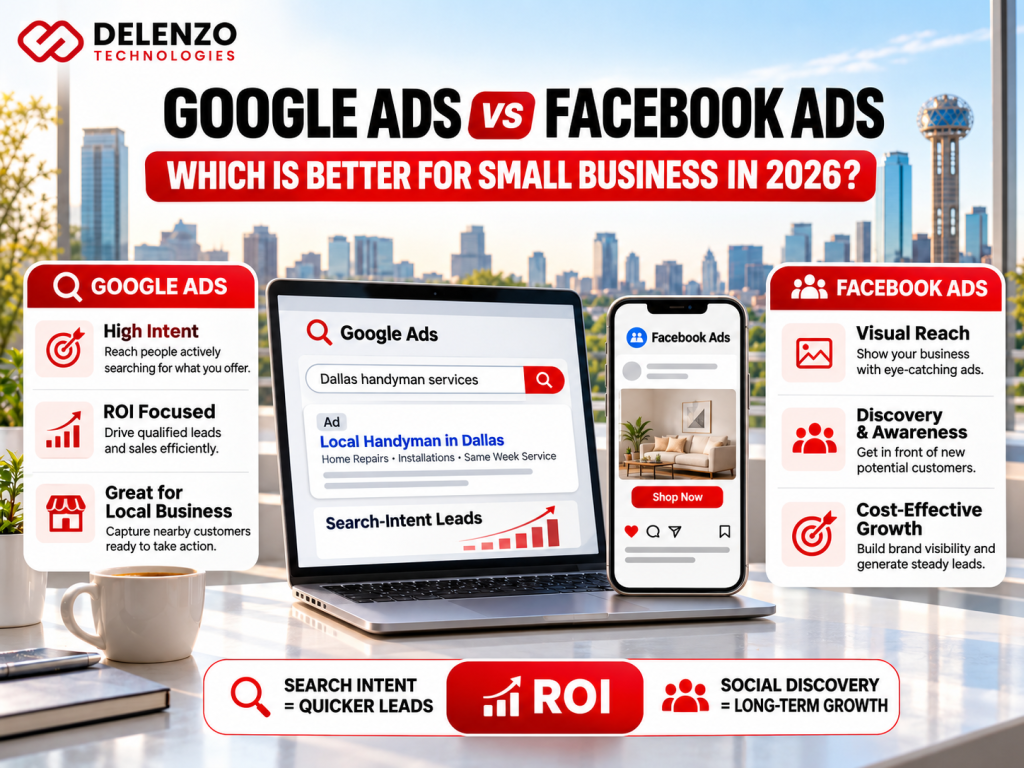
Quick answer: Google Ads is usually the better starting point when customers actively search for your service. Facebook Ads is often stronger for visual products, awareness and demand creation. With a limited budget, choose one platform, prove a stable CPA, then add the second.
By the end of this article, you’ll know exactly which platform fits your business — and why.
The Fundamental Difference (And Why It Changes Everything)
Before comparing costs, targeting options, or ROAS, you need to understand one core concept. Google Ads and Facebook Ads are built on completely different mechanics. That difference determines everything — which platform you should start on, how much to budget, and what results to expect.
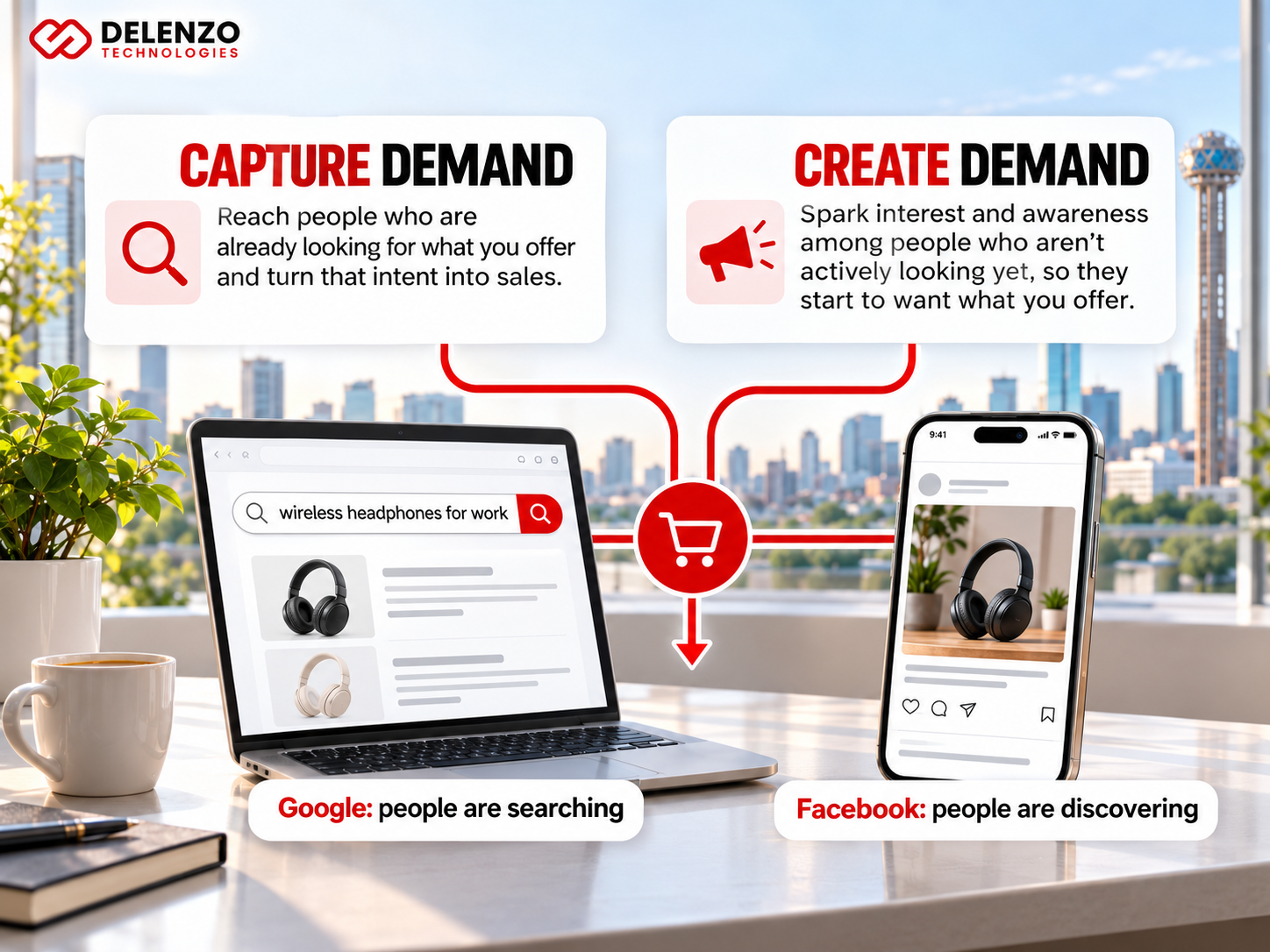
Google Ads = Capturing Demand
Google Ads works because someone is already looking for what you sell.
When a homeowner’s pipe bursts at 11pm, they don’t scroll Instagram hoping to find a plumber. They pull out their phone and type “emergency plumber near me.” Your Google Ad appears at the top of those results — at the exact moment that person is ready to call.
That’s demand capture. The intent is already there. Your ad simply intercepts it.
This is why Google Ads works so well for service businesses, local contractors, healthcare providers, legal professionals, and anyone selling something people actively search for. The customer is already in buying mode. You just need to show up.
Facebook Ads = Creating Demand
Facebook Ads works differently. Nobody opens Facebook to look for a plumber, a marketing agency, or a web design service.
Instead, you reach people based on who they are — their age, location, interests, job title, purchasing behavior, and dozens of other data points Meta has collected. You interrupt their scroll with an ad that’s relevant enough to make them stop and pay attention.
That’s demand creation. The customer wasn’t looking for you — but now they know you exist.
This is why Facebook Ads works well for e-commerce brands, lifestyle products, apps, clothing, food, and businesses where visual storytelling can make someone want something they didn’t know they needed five minutes ago.
One line to remember: Google answers questions. Facebook starts conversations.
Google Ads vs Facebook Ads — 2026 Stats at a Glance
Here’s how the two platforms compare on the numbers that matter most for small businesses in 2026:
| Metric | Google Ads | Facebook Ads |
|---|---|---|
| Avg. CPC | $2.69 | $0.83 |
| Avg. CTR | 6.3% | 1.49% |
| Avg. CPM | $38.40 | $11.20 |
| Avg. ROAS | 3.8x | 3.2x |
| Avg. Conversion Rate | 4.2–6.8% | 1.8–3.5% |
| Min. Recommended Budget | $1,500/mo | $1,000/mo |
Source: WordStream 2025, MetricNexus 2026
At first glance, Facebook looks like the obvious winner — the CPC is three times cheaper. But cheaper clicks don’t always mean cheaper results.
Here’s the math that actually matters: Cost Per Acquisition (CPA).
- Google Ads: $4.00 avg click × 6% CVR = $67 CPA
- Facebook Ads: $0.80 avg click × 1.5% CVR = $53 CPA
Facebook wins on CPA in this example — but only because the conversion rate assumptions are equal. In reality, Google’s higher purchase intent often produces conversion rates 2–3x higher than Facebook’s for service businesses. Run the same math with a 5% Google CVR vs a 1% Facebook CVR and Google’s CPA drops to $54 — essentially the same.
The point: lower CPC does not automatically mean lower cost per lead. The platform that fits your business model will always outperform the one that doesn’t, regardless of CPC.
CPC by Industry — Google vs Facebook (2026)
The averages above hide a lot. Here’s what businesses in specific industries actually pay per click:
| Industry | Google Ads CPC | Facebook Ads CPC |
|---|---|---|
| Home Services | $3.33 | $0.95 |
| SaaS / Software | $4.22 | $1.52 |
| Legal Services | $8.94 | $1.73 |
| E-commerce | $1.16 | $0.70 |
| Education | $2.40 | $1.06 |
| Finance | $6.75 | $1.86 |
Source: WordStream Industry Benchmarks 2025
Two patterns stand out immediately:
Legal and Finance businesses face an enormous Google CPC premium — $8.94 and $6.75 respectively. These industries are intensely competitive on Google Search because the customer lifetime value is high and everyone knows it. The same click on Facebook costs a fraction of that price.
E-commerce brands find Facebook compelling because the CPC gap is small ($1.16 vs $0.70) but Facebook’s visual formats — carousel ads, video, collection ads — are built for product discovery in a way that Google’s text-based search results simply aren’t.
When Google Ads Is the Better Choice
Google Ads isn’t the right fit for every business. But when it’s the right fit, it’s hard to beat.
5 Signs Google Ads Is Right for Your Business
- Customers already search for what you sell. If someone types “dentist in Austin” or “HVAC repair Chicago” on Google, that’s your customer. Google Ads is built for this.
- Your sales cycle is short. The customer searches, sees your ad, clicks, and calls or buys — often in the same session. Google is built for this high-intent, low-friction path.
- You sell urgent or time-sensitive services. Emergency repairs, same-day delivery, urgent legal help — people search for solutions to immediate problems. Google captures that urgency.
- You have a product feed ready. If you run an e-commerce store, Google Shopping and Performance Max campaigns are some of the highest-ROI ad formats available. A good product feed is all you need to get started.
- You have a budget under $3,000/month. At smaller budgets, mastering one channel first almost always outperforms splitting spend across two. Google Search gives you fast feedback on what’s working.
Google Ads Pros and Cons
✅ Pros:
- High purchase intent — users are actively looking to buy or contact
- Faster results for businesses with existing search demand
- Text-based ads require less creative production investment
- Excellent for local service businesses targeting specific cities or zip codes
- Google Shopping delivers strong ROAS for e-commerce with product feeds
❌ Cons:
- Higher CPC in competitive industries (legal, finance, insurance)
- Requires solid keyword research to avoid wasted spend
- AI Overviews in search results are reducing clicks on some queries in 2026
- Needs well-built landing pages to convert — a weak landing page kills your ROAS
- Less visual — harder to tell a brand story through text ads alone
When Facebook Ads Is the Better Choice
Facebook Ads gets dismissed too quickly by businesses that tried it and failed. Usually the problem wasn’t the platform — it was the wrong product, the wrong audience setup, or creative that didn’t stop the scroll.
5 Signs Facebook Ads Is Right for Your Business
- Your brand or product isn’t widely known yet. If nobody searches for you on Google because they don’t know you exist, Facebook lets you get in front of the right people before they even know to search.
- You sell something visual, lifestyle-driven, or impulse-based. Clothing, food, home décor, fitness gear, gadgets — products that look good in photos or videos are natural fits for Meta’s feed and Stories formats.
- You need awareness before search demand can work. Some products need to be explained or shown before people want them. Facebook is where you plant that seed.
- You have creative capacity. Facebook rewards strong visuals. If you can produce quality images or short videos — even with a smartphone — you have everything you need.
- You want to retarget website visitors cheaply. Facebook’s retargeting audiences (people who visited your site, watched your video, engaged with your page) are some of the most cost-efficient ad audiences available. CPMs for warm retargeting audiences on Meta are significantly lower than cold traffic.
Facebook Ads Pros and Cons
✅ Pros:
- Much lower CPM and CPC than Google in most industries
- Powerful audience targeting: demographics, interests, behaviors, lookalikes
- Excellent for DTC e-commerce and B2C brands building awareness
- Retargeting on Meta is highly cost-efficient
- Video and carousel formats let you tell a brand story, not just make an offer
❌ Cons:
- Creative fatigue is real — you’ll need 5–10 fresh creative variations per month to maintain performance
- Lower purchase intent means longer path to conversion
- Attribution is tricky — shorter attribution windows mean Facebook often undercounts its own conversions
- The algorithm needs roughly 30 conversions per month per ad set to optimize properly; small budgets can struggle to exit the learning phase
- Less effective for urgent, high-intent services where Google Search dominates
The Budget Question — What Works at Each Spend Level
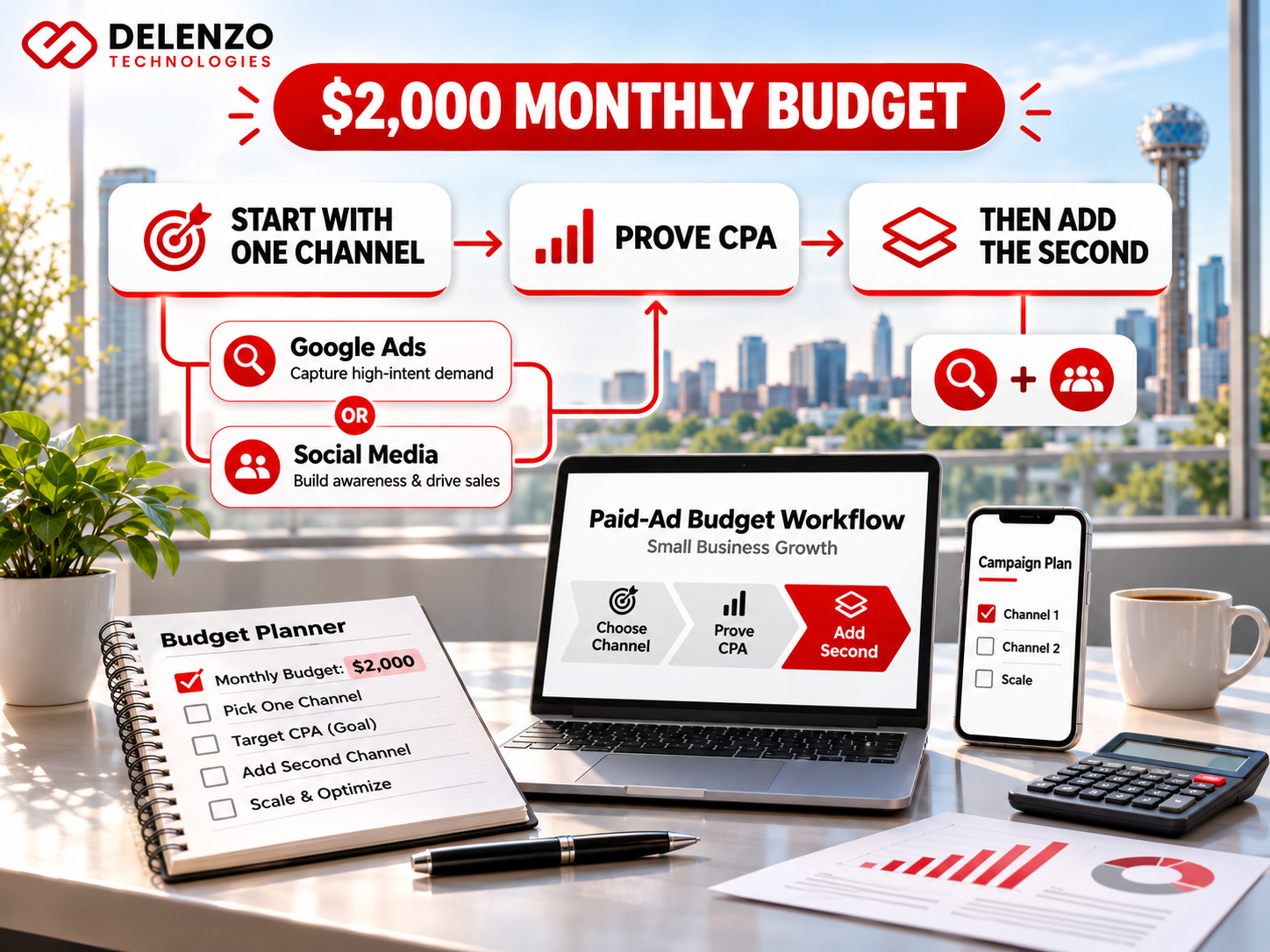
One of the most damaging mistakes small businesses make is spreading a small budget across too many channels. Here’s a simple guide:
| Monthly Budget | Recommendation |
|---|---|
| Under $1,000 | Pick ONE channel only — don’t split |
| $1,000–$3,000 | Master one channel; establish stable CPA before adding a second |
| $3,000–$8,000 | 70/30 split toward your proven channel + test the second |
| $8,000–$20,000 | 60/40 split with separate conversion tracking per channel |
| $20,000+ | Flexible — manage on blended ROAS across both |
“Spreading $2,000 across three platforms means none of them gets enough data to optimize. You’ll spend 90 days learning nothing.” — MetricNexus 2026
Both Google and Facebook’s algorithms need data to work. Google Search needs enough clicks to identify which keywords convert. Meta’s algorithm needs roughly 50 conversion events per week to exit the learning phase and start optimizing delivery. If your budget is too thin to feed either algorithm, results will be unpredictable.
Pick one platform. Run it properly. Then scale.
Can You Run Both? (The Smart Combo Strategy)
Yes — and eventually, most growing businesses should. But the word “eventually” is doing a lot of work in that sentence.
The 2-Phase Approach for Small Businesses
Phase 1 (Month 1–3): One channel only
- Choose the platform that best fits your business model (use the signs above)
- Set up conversion tracking properly before spending a dollar
- Run for at least 60–90 days
- Establish a stable, repeatable CPA or ROAS baseline
- Document what works: which audiences, creatives, keywords, landing pages
Phase 2 (Month 4+): Add the second channel
- Allocate 30% of total budget to the new channel
- Run the new channel with the same CPA target as your proven one
- At 60 days, compare CPA across channels
- Shift budget toward the channel with lower CPA; don’t split equally just for the sake of it
How to Split Budget When Running Both
| Business Type | ||
|---|---|---|
| E-commerce | 55–65% (Shopping/PMax) | 35–45% (prospecting + retargeting) |
| Local service business | 70% (Search) | 30% (retargeting) |
| B2B / Agency | 60% (Search) | 40% (LinkedIn or Meta) |
First-Party Tracking Is Non-Negotiable
Before you spend a dollar on either platform in 2026, set up proper tracking. This isn’t optional.
- Google: Enable Enhanced Conversions in Google Ads + connect Google Analytics 4
- Facebook/Meta: Implement the Meta Conversions API (server-side) in addition to the pixel
Without these, you’ll lose 20–40% of your conversion data due to iOS restrictions, ad blockers, and browser privacy changes. That means your campaign optimization is running on incomplete information — like driving with a foggy windshield.
You can’t optimize what you can’t measure.
Real-World Example — What $2,000/Month Looks Like on Each Platform
Let’s make this concrete. Imagine a home renovation company based in Dallas running $2,000/month on each platform separately.
Google Ads — $2,000/month
- Avg CPC for home services: $3.33
- Estimated clicks: ~600
- Avg conversion rate (service inquiry): 5%
- Estimated leads: ~30 leads/month
- Cost per lead: ~$67
Facebook Ads — $2,000/month
- Avg CPC for home services: $0.95
- Estimated clicks: ~2,100
- Avg conversion rate (service inquiry): 1%
- Estimated leads: ~21 leads/month
- Cost per lead: ~$95
Winner for this scenario: Google Ads
The reason is simple — people search for home renovation services when they’re ready to hire. That existing search demand means higher intent, higher conversion rates, and a lower cost per lead despite the higher CPC.
If this same company sold a home décor product online, the math would likely flip in Facebook’s favor. That’s why the question isn’t “which platform is better?” — it’s “which platform fits this specific business?”
Google Ads vs Facebook Ads — Quick Decision Guide
Ask yourself these three questions before choosing your starting platform:
1. Do people actively search for my product or service on Google? → Yes = Start with Google Ads
2. Is my product visual, lifestyle-driven, or not widely known yet? → Yes = Start with Facebook Ads
3. Can I commit $1,500 or more per month to ONE channel? → No = Save up before starting. Underfunding either platform produces unreliable results.
If your answers point to both platforms equally, default to Google first if you need leads fast, and Facebook first if you’re building a brand or launching a new product.
Frequently Asked Questions
Is Google Ads better than Facebook Ads?
Neither is universally better. Google Ads wins for high-intent, search-driven businesses where customers are actively looking for a solution. Facebook Ads wins for visual brands, e-commerce, and businesses that need to build awareness before demand exists. The right answer depends on your product, your audience, and your budget.
Which is cheaper — Google Ads or Facebook Ads?
Facebook Ads has a lower average CPC ($0.83 vs $2.69 for Google), but cheaper clicks don’t always mean a cheaper cost per acquisition. Google’s higher purchase intent often produces conversion rates 3–4x higher than Facebook’s for service businesses, which can offset the higher CPC. Always compare platforms on CPA, not CPC.
Can I run Google Ads and Facebook Ads at the same time?
Yes — but only after you’ve mastered one platform first. Start with the channel that best fits your business model. Run it for 60–90 days, establish a stable CPA, then add the second channel with roughly 30% of your total budget. Splitting a small budget between both platforms from day one usually means neither gets enough data to optimize.
How much should a small business spend on Google Ads?
The minimum effective budget for Google Ads is around $1,500/month. Below that, the algorithm doesn’t get enough click data to optimize bidding and targeting. If your budget is under $1,000/month, consider starting with Facebook Ads instead — the lower CPC means your budget goes further while you’re still in the learning phase.
Which is better for local businesses — Google or Facebook?
Google Ads generally outperforms Facebook for local service businesses — plumbers, dentists, lawyers, contractors, and similar services — because customers are actively searching for them. Facebook works better for local retail, restaurants, and event-based businesses where visual content and time-sensitive offers drive foot traffic and local awareness.
What is the average ROI for Google Ads vs Facebook Ads?
Based on 2026 benchmarks, Google Ads averages 3.8x ROAS and Facebook Ads averages 3.2x ROAS across industries. These numbers vary significantly by industry, campaign structure, landing page quality, and how well the campaigns are managed. The best ROI comes from the platform that fits your business model, not the one with the higher average.
Conclusion
Google Ads and Facebook Ads are not competitors — they’re tools built for different jobs.
Google captures demand from people who are already looking for what you sell. Facebook creates demand by reaching the right people before they know they need you. Both produce results when matched to the right business model and funded properly.
If people search for your product or service on Google, start there. If your product is visual, new to market, or relies on impulse and awareness, start with Facebook. Once you’ve established a stable CPA on your first channel, add the second — not before.
The biggest mistake isn’t choosing the wrong platform. It’s splitting a small budget between both and wondering why neither works.
Not Sure Where Your Advertising Budget Should Go?
Delenzo Technologies helps US small businesses choose the right mix of Google Ads and Facebook Ads. We can review your current setup, identify wasted spend and show you the highest-priority opportunities for stronger leads and better returns.
Sources:
- WordStream Industry Benchmarks 2025 — stackmatix.com/blog/google-ads-vs-facebook-ads-2026
- AdsGo Small Business Ads Guide — adsgo.ai/blog/google-ads-vs-facebook-ads-small-business/
- MetricNexus 2026 Benchmark Report — metricnexus.ai/blog/google-ads-vs-facebook-ads-vs-tiktok-benchmarks