

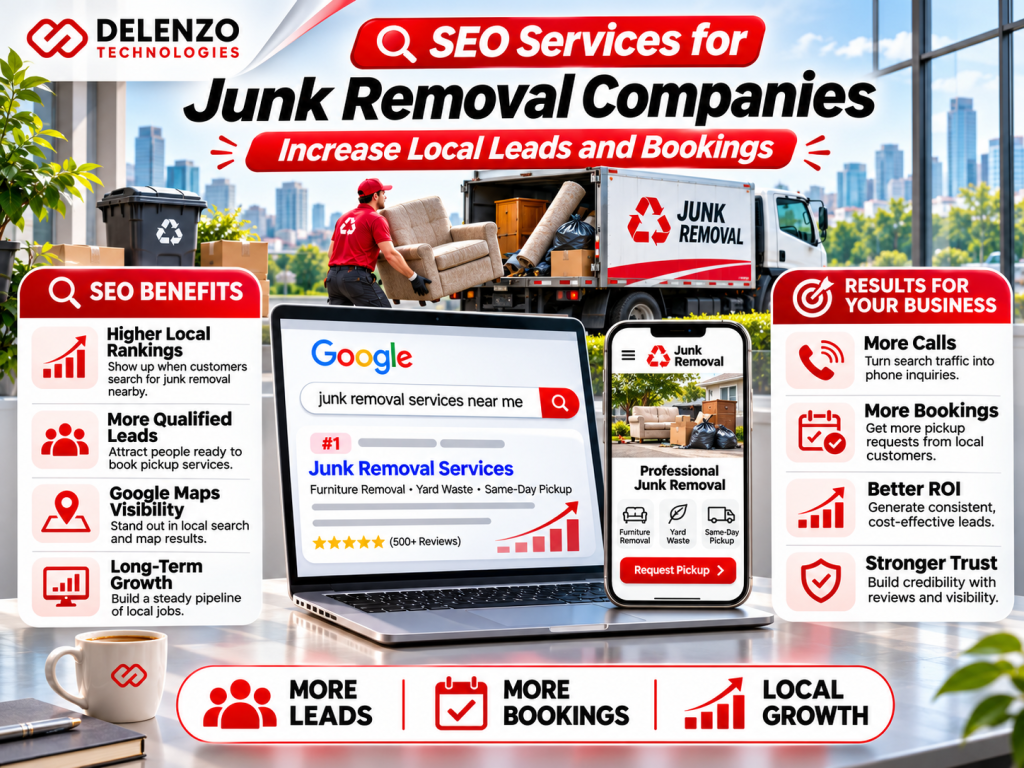
SEO for junk removal companies gets your business into the top Google Maps and search results when nearby people need junk picked up, so more of those searches become junk removal leads.
But which parts of SEO actually bring in jobs for a junk hauler? Most advice out there is written for restaurants and dentists, not hauling companies that work from a truck and get booked the same day. Rankings alone don’t pay the bills. Calls do, and calls come from strong local visibility.
In this guide, we’ll show you what junk removal SEO services include, what they cost, how long they take, and how to turn more searches into booked pickups.
What Are SEO Services for Junk Removal Companies?
SEO services for junk removal companies are the work that gets a hauling business to show up on Google Maps and in regular search results when nearby people look for pickup, cleanout, or debris removal. The goal isn’t traffic for its own sake. It’s phone calls and quote requests from people inside your service area.
Good junk removal SEO services usually cover four areas:
- Google Business Profile work: categories, service areas, photos, reviews
- Website pages: one page per service, written for the way customers search
- Technical fixes: speed, mobile layout, and making sure Google can read every page
- Local trust: listings, links, and reviews that prove you’re a real, active business
Think of SEO for junk removal services as a sales system. Each piece either helps you get found or helps the person who found you pick up the phone. That’s what separates hauling business SEO from a generic “rank my website” package.
How Is Junk Removal SEO Different from General Small Business SEO?
Junk removal is a service-area business, so you go to the customer instead of the customer coming to you. That one fact changes a lot of the SEO work.
Here’s what makes service-area business SEO for haulers its own thing:
- No storefront. Many owners run from a home address or a truck yard, so the address should be hidden on Google and replaced with a service area.
- Urgency. A large share of urgent removal searches happen on a phone, from people who want a truck today or tomorrow.
- Price questions come first. Customers want a ballpark before they call, since pricing depends on truck volume.
- Calls beat clicks. Local lead generation for junk removal is measured in calls and photo quotes, not page views.
A bakery can win with a nice website and a few blog posts. A junk hauler needs to win the map, answer price questions fast, and make calling dead simple.
Why Do Junk Removal Companies Need SEO to Grow?
They need it because most local customers pick a hauler straight from Google, and the top three map results take most of those calls. Without Google Maps visibility, you depend on referrals, paid ads, or shared lead sites to fill the schedule.
SEO builds a steady stream of junk removal bookings that you don’t pay for per click. Once your pages and profile rank, they keep bringing in calls while you’re out on jobs. That’s the real value of organic lead generation: the cost stays fairly flat while the lead count grows.
Appear in High-Intent Searches from Nearby Customers
People searching for junk removal are rarely “just browsing.” Someone typing junk removal near me or same-day junk pickup has a pile of stuff and wants it gone.
Those local hauling searches convert well because the need is real and the timeline is short. A homeowner who finds you at 8 a.m. may book a 2 p.m. pickup. SEO puts you in front of that person at the exact moment they’re ready to pay.
Compete with Franchises and Reduce Dependence on Paid Leads
National brands like 1-800-GOT-JUNK? and College Hunks Hauling Junk have big budgets, but they don’t own local search. Google weighs distance and local reviews heavily, so an independent hauler with a strong profile can outrank a franchise location across town.
Your other local competitors are often small operators with thin websites. That’s good news. A few well-built service pages and steady reviews can move you past them.
SEO also cuts reliance on lead marketplaces, where you pay per lead and the same homeowner may get calls from several haulers. Stronger organic visibility lowers your customer acquisition costs over time, because you stop renting leads and start owning the channel. Our guide on how to generate high-quality leads covers this shift in more detail.
What Do Professional Junk Removal SEO Services Include?
A professional campaign includes local SEO, on-page SEO, technical SEO, and an SEO content strategy built around the jobs you actually want. Here’s how the pieces fit:
| Service area | What gets done | Why it matters |
| Local SEO | Google Business Profile setup, reviews, citations | Gets you into the map pack |
| On-page SEO | Service pages, title tags, internal links | Tells Google what you do and where |
| Technical SEO | Speed, mobile fixes, indexing | Lets Google and mobile users load your site fast |
| Content and links | Guides, FAQs, project photos, local links | Builds trust with customers and Google |
Keyword Research Based on Removal Services and Customer Intent
Keyword research finds the exact phrases customers type and matches each one to the right page. A person searching appliance removal wants something different from someone searching estate cleanout, so they shouldn’t land on the same generic homepage.
This matching step is called keyword mapping. A simple map for a Dallas hauler might look like:
- Homepage: junk removal Dallas
- Furniture page: furniture hauling, couch removal, mattress pickup
- Appliance page: refrigerator removal, washer and dryer haul away
- Estate page: estate cleanout, hoarder cleanup, whole-house cleanout
Tools like Google Keyword Planner, Ahrefs, or Semrush show search volume, but your call log is just as useful. Write down the exact words customers use on the phone. Those are often the phrases worth ranking for.
On-Page SEO for Service-Specific Junk Removal Pages
On-page SEO means building one strong page for each service and making sure Google can tell what it’s about. A single “Services” page listing ten items won’t rank for much.
A solid furniture removal page includes:
- Which items you take (sofas, sectionals, recliners, bed frames)
- Price ranges or how pricing works
- Areas you serve and typical response time
- Real job photos and a short FAQ
- A call button near the top
The same goes for a construction debris removal page, which should mention drywall, lumber, tile, and roofing scraps, plus whether you handle contractor accounts.
Title tags matter here too. Compare “Services | ABC Hauling” with “Furniture Removal in Dallas | Same-Day Pickup | ABC Hauling.” The second tells both Google and the searcher exactly what they’ll get.
Finally, use internal linking to connect related pages. Your estate cleanout page can link to furniture and appliance pages, which helps Google understand your site and keeps visitors moving toward a quote.
Technical SEO for Mobile Speed, Indexing, and User Experience
Technical SEO makes sure your site loads fast on phones and that Google can find and read every page. Since Google uses mobile-first indexing, a mobile-first website is the baseline, not a bonus.
Key checks include:
- Core Web Vitals: Google’s speed and stability scores. Aim for the main content loading in 2.5 seconds or less.
- Crawlability: no broken links, blocked pages, or missing sitemaps
- Site structure: a clear menu where every service page sits one or two clicks from the homepage
- Image size: compressed job photos, since large uploads from a phone camera are a common cause of slow pages
If you’re planning a rebuild, read our guide on website redesign and SEO first. Rankings are easy to lose during a careless redesign. After launch, regular website maintenance keeps plugins updated and pages loading fast.
Useful Content and Relevant Links That Build Local Trust
Content that answers real customer questions earns rankings and calls. Skip generic “5 benefits of decluttering” posts. Write what your customers actually ask. Clear question-and-answer content also gets picked up by AI Overviews and chatbots, which our guide to AI SEO strategies explains.
Strong content ideas for haulers:
- Cleanout guides like “What to do with furniture after a parent moves to assisted living”
- Project examples with before-and-after photos, the city, and the truck load size
- Helpful FAQs about pricing, what you can’t take (paint, chemicals), and donation options
Links matter as well. Local backlinks from the chamber of commerce, real estate agents, property managers, and charity partners show Google you’re a known part of the community. One link from a local realtor’s “trusted vendors” page is worth more than dozens from random directories.
How Does Local SEO Help Junk Removal Companies Rank on Google Maps?
Local SEO helps you rank on Google Maps by improving the three things Google says it uses for local results: relevance, distance, and prominence. You can’t move your truck yard, but you can control how relevant and well-known your business looks.
That’s the job of local SEO services for junk removal companies. Google Maps SEO focuses on your Business Profile, your reviews, and how consistently your business shows up across the web. For most haulers, this is where the fastest gains come from, and it’s why junk removal local SEO services usually start here before touching the blog.
Optimize Google Business Profile for Accurate Service Areas
Your Google Business Profile is often the first thing a customer sees, sometimes before your website. Getting it right is the quickest win in local SEO.
A checklist that works:
- Google Business Profile categories: set “Junk removal service” as primary and add related secondary ones that truly fit, such as “Demolition contractor” only if you do that work
- Service areas: list the cities and ZIP codes you actually serve (Google allows up to 20)
- Hours: keep them accurate, including weekends and holidays
- Photos: upload real trucks, crew members, and loaded jobs every month
- Services and products: add each service with a short description and price range
Want a quick check of your own profile? Try our free GMB Profile Optimizer.
Create Helpful City and Neighborhood Pages Without Duplicate Content
City pages help you rank in each town you serve, but only if each page has something unique to say. Copying one page and swapping “Frisco” for “McKinney” rarely works and can drag your whole site down.
Useful city landing pages include location-specific proof:
- Photos of jobs done in that city
- Local details, such as HOA rules on curbside piles or nearby transfer stations
- Reviews from customers in that area
- Common job types there (apartment move-outs near a university, estate cleanouts in older neighborhoods)
Strong service-area SEO means fewer, better city pages. Five solid pages beat thirty thin ones.
Earn Genuine Reviews and Maintain Consistent Local Listings
Reviews are one of the biggest signals of local prominence, and they also decide who gets the call. Most people compare star ratings and recent comments before they phone anyone.
To earn more customer reviews:
- Ask right after the job, while the driveway is still clear and the customer is happy
- Text a direct review link instead of saying “find us on Google”
- Reply to every review, good and bad, within a few days
- Never pay for reviews or offer discounts in exchange, since Google’s review policy bans incentivized reviews
Next, check your local citations, the listings on Yelp, Bing Places, Apple Maps, Angi, and the BBB. NAP consistency means your name, address (or service area), and phone number match everywhere. Mismatched phone numbers from an old tracking line are a common problem worth fixing early.
Which Junk Removal Keywords Bring Qualified Local Leads?
The best keywords combine a service, a location, or an urgency word. These buyer-intent keywords come from people ready to book, while broad terms like “junk” attract people who aren’t.
| Keyword type | Examples | Lead quality |
| Near me searches | junk removal near me, couch pickup near me | High |
| Service + city | appliance removal Dallas, hot tub removal Garland | High |
| Urgency | same-day junk removal, junk pickup today | Very high |
| Commercial | office cleanout Dallas, construction debris hauling | High value |
| Info only | how to get rid of a mattress, free junk pickup | Low to mixed |
Words like “same-day,” “near me,” “cost,” and a city name are service modifiers. Adding them to your pages and titles helps you catch the searches most likely to turn into jobs.
Target Same-Day Pickup, Furniture Removal, and Appliance Hauling
These are the bread-and-butter residential jobs, and they convert fast. Someone searching same-day junk removal often books within minutes.
If you offer a quick turnaround, say so clearly on your homepage and Business Profile. Mention your cutoff time (“Call by noon for same-day pickup”) so customers know what to expect.
Appliance pickup pages should list common items like refrigerators, washers, dryers, and water heaters, along with whether you handle Freon disposal. For urgent cleanup jobs, like a move-out deadline or a burst-pipe cleanup, a fast call button matters more than long text.
Reach Commercial Cleanouts, Estate Jobs, and Debris Removal Customers
Commercial and estate jobs are bigger tickets and often lead to repeat work. A single property manager can send you a dozen apartment cleanouts a year.
Estate cleanout SEO works best with a dedicated page that speaks to families and executors. Mention sorting, donation drop-offs, and working with realtors on tight closing dates.
For office junk removal, target phrases like “office furniture removal” and “cubicle removal” and mention after-hours scheduling. A construction debris removal page should speak to contractors, remodelers, and roofers who need fast haul-offs between project phases.
Avoid Unqualified Searches for Free Pickup or Dump Hours
Not every search is worth chasing. People searching free junk removal usually want a charity or city bulk pickup, not a paid crew. The same goes for “landfill hours” or “dump near me.”
Donation pickup searches can go either way. Some people only want free charity pickup, while others will pay a hauler to take items to donation for them. A short FAQ explaining your donation process can catch the second group.
This is search intent filtering: choosing which searches to rank for based on who’s likely to pay. Ranking for the wrong terms fills your phone with calls that waste time.
How Can Junk Removal SEO Turn Website Traffic into Booked Jobs?
SEO turns traffic into jobs when your site makes calling or requesting a quote fast and easy. Rankings bring visitors in. Conversion rate optimization turns those visitors into customers.
Most junk removal customers want local calls or quick online bookings, not long forms. Small changes, like a sticky call button or a photo upload field, often lift leads without any extra traffic.
Use Click-to-Call Buttons, Fast Mobile Pages, and Clear Service Information
On a phone, every extra tap loses customers. Strong mobile call conversion comes from a few simple setups:
- A click-to-call button pinned to the top or bottom of every mobile page
- Your phone number in plain text, not inside an image
- Clear service coverage listing cities and ZIP codes
- Trust signals near the call button: star rating, “licensed and insured,” years in business, and real crew photos
A customer should be able to answer three questions within five seconds: Do you serve my area? Do you take my stuff? How do I reach you?
Improve Quote Forms, Scheduling, and Call-to-Booking Tracking
Some customers would rather send a photo than talk. A photo estimate form lets them upload a picture of the pile and get a price by text, which suits people at work or with a noisy house.
Keep appointment requests short: name, phone, ZIP, a photo, and preferred date. Anything more and people drop off.
Tracking is where many haulers fall short. Set up GA4 to record form submissions and calls. Add call tracking with a tool like CallRail so you know which calls came from Google Maps versus your website. Then connect those calls to booked jobs in your scheduling software, such as Jobber or Housecall Pro. Without that last step, you only know how many people called, not how much money SEO made.
How Much Do SEO Services for Junk Removal Companies Cost?
Most junk removal SEO campaigns in the US cost between $500 and $3,000 per month, depending on how many cities you target and how competitive they are. Your SEO budget for junk removal should match your service area and growth goals.
Typical local SEO pricing ranges look like this:
| Business size | Typical monthly cost | What it usually covers |
| Single truck, one city | $500 to $1,200 | GBP setup, reviews plan, a few service pages |
| Multi-truck, several suburbs | $1,200 to $2,500 | City pages, content, link building, call tracking |
| Metro-wide or multi-location | $2,500 to $5,000+ | Full content plan, technical work, several locations |
Many agency packages also charge a one-time setup fee for audits and fixes. For a wider look at what drives pricing and ROI, see our breakdown of SEO services cost.
What Affects the Price of a Junk Removal SEO Campaign?
Four things move the price the most:
- Market competition: ranking in Dallas or Houston takes more work than in a small town
- Service areas: each extra city usually means another unique page and more citation work
- Technical fixes: a slow or broken site needs repair before content can perform
- Content volume: two service pages a month costs less than eight
Be wary of anyone quoting $99 a month. At that price, there’s little room for real pages, reviews work, or reporting.
What Should a Practical Junk Removal SEO Package Include?
A practical package covers the basics that bring calls, and it shows you the results each month. At minimum, expect:
- GBP optimization with monthly photo and post updates
- A keyword plan mapped to your services and cities
- New or improved service pages each month
- Review generation process and response help
- Citation cleanup and local link building
- Call and form tracking setup
- Monthly reporting showing calls, quote requests, and rankings
If a package lists “blog posts” and “rankings” but nothing about calls or your Business Profile, it isn’t built for a hauler.
Junk Removal SEO vs Google Ads: Which Generates Better Leads?
Google Ads gets you calls this week, while SEO brings cheaper leads over the long run. Neither one wins every time. The right choice depends on how fast you need jobs and how long you plan to stay in your market.
| Factor | Local organic search (SEO) | PPC leads (Google Ads) |
| Speed | 3 to 6 months for steady results | Same day once ads go live |
| Cost model | Monthly fee, no per-click charge | Pay for every click |
| Cost over time | Drops per lead as rankings grow | Stays the same or rises |
| When you stop paying | Rankings fade slowly | Leads stop right away |
| Trust | Many users trust map and organic results more | Some users skip ads |
In the paid search vs SEO debate, the cost per lead is what matters. SEO usually wins after the first six months, while ads win when you need jobs right now. Our Google Ads vs Facebook Ads guide explains how paid channels compare for small businesses.
When Should Businesses Combine SEO with Google Ads?
Combine them when you have immediate lead demand but also want long-term visibility. A new hauler with an empty schedule can’t wait four months for SEO alone.
A common plan looks like this:
- Months 1 to 4: run Google Ads or Local Services Ads to fill the schedule while SEO builds
- Months 5 to 8: shift some ad budget to SEO as organic calls grow
- Ongoing: keep ads running only on high-value terms like estate or commercial cleanouts
Good lead attribution makes this work. With call tracking, you can see which channel brought which job and move money to the winner. Delenzo’s paid advertising team runs both channels together for this reason.
How Do You Choose the Right Junk Removal SEO Agency?
Pick an agency that tracks booked jobs, gives you ownership of your accounts, and explains its work in plain terms. A good junk removal SEO company talks about calls and revenue, not just rankings. Our list of the best SEO companies for small businesses shows what strong agencies have in common.
Look for SEO specialists for hauling businesses who understand service-area rules, seasonal demand (spring cleaning and summer moves are busy), and how pricing by truck volume affects your pages.
Check Industry Experience, Clear Deliverables, and Real Lead Reporting
Before you sign, ask these questions:
- Can you show results for a home service business? Real SEO agency case studies should show calls or leads, not just traffic graphs.
- What exactly will you do each month? Get a list of deliverables in writing.
- How will you report? Transparent SEO reporting shows calls, form leads, and map rankings in a simple monthly summary.
- Who owns the accounts? Insist on owned accounts: your Google Business Profile, website, GA4, and Search Console should stay in your name.
Walk away from guaranteed “#1 rankings,” long contracts with no exit, or anyone who wants to own your Business Profile.
How Long Does Junk Removal SEO Take to Show Results?
Most junk removal businesses see early map improvements in 1 to 3 months and steady lead growth in 4 to 6 months. The full local SEO timeline depends on your competition, your starting point, and how many reviews you collect.
| Timeframe | What usually happens |
| Month 1 | Audit, GBP fixes, tracking setup, technical repairs |
| Months 2 to 3 | First ranking progress on the map, new service pages go live |
| Months 4 to 6 | More calls from Google, reviews start adding up |
| Months 6 to 12 | Steady organic lead growth, wins in nearby cities |
A new website in a crowded market like Dallas may take longer. An older business with good reviews but a weak profile can see faster gains.
Measure Rankings, Qualified Calls, Quotes, and Completed Bookings
Track four layers, from visibility down to money:
| What to track | Where to find it |
| Search clicks and keywords | Google Search Console |
| Calls, direction requests, profile views | Google Business Profile performance report |
| Calls and quote forms by source | GA4 and call tracking |
| Completed jobs and revenue | Your CRM or scheduling software |
That last row is where booked job ROI becomes clear. Say your average job is $350 and SEO costs $1,200 a month. Four extra booked jobs a month covers the fee. Anything past that is profit.
Final Takeaway: Turn Local Search Visibility into More Junk Removal Bookings
Customers who need junk gone pick from the first few names Google shows them. Strong Google Maps visibility, clear service pages, and steady reviews put you on that list. From there, a fast mobile site and simple quote options turn local leads into job bookings.
Start with your Business Profile and call tracking. Then add service pages for the jobs you want most. Track booked jobs, not just rankings, and you’ll know exactly what SEO is worth to your business.
Frequently Asked Questions About Junk Removal SEO Services
Do Junk Removal Companies Need a Website for Local SEO?
Yes. A Business Profile can show you on the map, but a Google Business Profile and website together rank higher and convert better, improving local search visibility. Our small business web design team builds call-focused sites.
Can Junk Removal SEO Help Generate Same-Day Pickup Bookings?
Yes. Urgent local searches like “junk pickup today” come from people ready to book now. Same-day messaging, click-to-call buttons, and online bookings help turn those searches into paid jobs within hours.
Should Junk Removal Companies Create Separate Pages for Each City?
Only for cities where you have real jobs and something unique to say. City pages with unique local content, such as local photos and reviews, rank well. Copied service-area landing pages usually don’t.
What Is the Difference Between Junk Removal SEO and Google Ads?
SEO earns map and organic rankings over time, while Google Ads buys placement per click. In organic traffic vs paid leads, SEO wins on acquisition cost and ads win on speed. Both need ongoing investment.
How Can a Junk Removal Business Measure SEO Return on Investment?
Count tracked calls and forms from Google, then note how many became qualified leads and booked jobs. Multiply booked jobs by your average ticket for revenue attribution, then compare it to your monthly SEO fee.
Explore Junk Removal SEO Services with Delenzo Technologies
Delenzo Technologies is a Dallas-based digital marketing agency that helps local service businesses get found and get booked. Our team builds a junk removal marketing strategy around your trucks, your cities, and the jobs you want more of, then tracks results down to booked jobs.
Book a free local SEO consultation and we’ll review your Google Business Profile, website, and top competitors, then show you where the quickest gains are. See our SEO, GEO and AEO services or contact our Dallas team to get started.