



Most people looking for a lawyer start on a phone, compare several firms, and decide within minutes. Slow pages, buried phone numbers, and thin attorney bios lose those prospective clients quietly. In 2026, a legal website should work as an intake tool first and a brochure second.
Strong law firm website design turns search visibility into qualified consultations. This guide explains the essential features, realistic cost ranges, platform choices, practice-area requirements, and compliance considerations attorneys should evaluate before a redesign or rebuild.
Quick answer
A professional law firm website commonly costs $2,000 to $75,000+, depending on content, design, integrations, and complexity. Most firms need mobile-first intake, individual practice-area pages, detailed attorney profiles, secure forms, fast performance, accessibility, and clear ownership of the domain, content, and code.
What Makes Law Firm Website Design Different?
Legal sites are organized around practice areas, attorney credentials, and consultation intake. Standard business sites are usually organized around products, packages, and a general contact page. That structural difference affects nearly every design and development decision.
| Element | Standard business website | Law firm website |
|---|---|---|
| Site architecture | General service pages | Dedicated page for each matter type |
| Primary conversion | Contact form or purchase | Consultation intake with case details |
| Trust signals | Reviews and client logos | Bar admissions, attorney credentials, publications, and permitted case results |
| Content depth | Short marketing copy | Guidance that answers real client questions |
| Compliance | Standard privacy requirements | Accessibility plus state advertising and disclaimer rules |
| Urgency | Low to moderate | Often high for injury, criminal, and family matters |
A prospective client is often stressed, rushed, and unfamiliar with the legal process. Good legal website design removes friction, answers the concern that brought the visitor to the page, and makes the next action obvious. Effective attorney website design places relevant credentials, case focus, and contact options where visitors can find them quickly.
Essential Features Every Modern Law Firm Website Needs

Mobile-first design and tap-to-call
Mobile-first means designing the phone experience before expanding the layout for larger screens. For urgent legal searches, a phone call is often the primary conversion rather than an afterthought.
- Use a persistent tap-to-call action on mobile.
- Make the header phone number clickable on every page.
- Keep tap targets at least 44 by 44 pixels.
- Use short forms that fit one thumb and require minimal typing.
Practice-area architecture
Each practice area should have a dedicated page rather than appearing only in a shared list. A scalable structure might use /practice-areas/, /practice-areas/personal-injury/, and then a focused subtopic such as /practice-areas/personal-injury/truck-accidents/.
Each page should explain the matter type, the legal process in plain language, who the firm helps, and the next step. Deep, useful guidance gives search engines and prospective clients more context than a thin template page.
Attorney profiles that build credibility
Attorney bios are among the most important trust pages on a legal site. Use a professional photograph, bar admissions and jurisdictions, education, relevant experience, representative matter types, publications where applicable, and a direct path to contact or schedule. Every factual claim should be accurate and kept current.
Secure consultation and intake forms
Capture enough detail to route an inquiry without overwhelming the visitor. For many firms, name, phone, email, matter type, and a short description are sufficient for the first contact. Send submissions to a monitored inbox or CRM, confirm receipt immediately, and make clear that submitting a form does not automatically create an attorney-client relationship.
Speed and Core Web Vitals
Visitors feel performance problems immediately, and Google recommends strong Core Web Vitals for search success and user experience. Treat speed as a build requirement, not a repair after launch.
| Metric | Good target | What it measures |
|---|---|---|
| Largest Contentful Paint (LCP) | 2.5 seconds or less | Loading speed of the main content |
| Interaction to Next Paint (INP) | 200 milliseconds or less | Responsiveness to taps and clicks |
| Cumulative Layout Shift (CLS) | 0.1 or less | Visual stability while a page loads |
Compressed images, limited third-party scripts, quality hosting, caching, and routine website maintenance resolve many common performance issues.
How Much Does a Law Firm Website Cost in 2026?

A professional legal website may cost anywhere from $2,000 to $75,000+ in 2026. Page count, original content, custom design, accessibility work, integrations, migration, and review cycles determine the actual investment.
| Project tier | Illustrative cost | Often suitable for |
|---|---|---|
| Template or builder site | $2,000–$6,000 | Solo practitioners and new firms |
| Custom WordPress build | $8,000–$25,000 | Growing firms with multiple practice areas |
| Design-led or Webflow build | $12,000–$30,000 | Firms prioritizing brand differentiation |
| Fully custom development | $25,000–$75,000+ | Multi-office firms with complex workflows |
Hosting, security, and maintenance may add roughly $150 to $500 per month. Content and search programs can add $1,500 to $6,000 per month. The largest cost drivers are usually the number of practice and location pages, custom design, content production, integrations, and migration requirements. See our broader guide to custom website development costs for additional planning considerations.
Which Website Platform Is Best for a Law Firm?

There is no universal best platform for every law firm. The right choice depends on publishing volume, design ambition, budget, internal skills, and integration needs.
| Platform | Best for | Strengths | Trade-offs |
|---|---|---|---|
| WordPress | Content- and SEO-led firms | Flexible publishing, broad ecosystem, technical control | Requires updates, backups, and security management |
| Webflow | Design-led firms | Precise visual control and managed hosting | Smaller extension ecosystem and a steeper learning curve |
| Website builder | Solo and small firms | Quick launch and simple editing | Limited scalability and technical control |
| Custom development | Complex or multi-office firms | Bespoke intake, integrations, and full flexibility | Highest cost and longest timeline |
Heavy content programs often favor WordPress, distinctive design systems may favor Webflow, and complex intake workflows may justify custom development. Migration can be expensive, so select a platform that fits the next three years—not only the launch date. Our website design and development services are platform-aware and built around the firm’s operational needs.
How Website Requirements Change by Practice Area

| Practice area | Primary website priority | Useful features |
|---|---|---|
| Personal injury | Immediate contact | Sticky call action, clear consultation CTA, detailed case-type pages |
| Criminal defense | Urgency and discretion | After-hours contact, concise forms, prominent attorney experience |
| Family law | Empathy and clarity | Process explainers, private inquiry path, calm visual tone |
| Corporate and business | Expertise depth | Industry pages, attorney credentials, thought leadership |
| Estate planning | Education | Guides, checklists, seminars, appointment scheduling |
| Immigration | Accessibility | Multilingual content, visa-type navigation, document checklists |
Personal injury visitors may be researching within days of an accident, so speed and immediate contact matter. Criminal and family law prospects often need discreet, after-hours communication. Corporate, estate planning, and immigration prospects usually spend longer evaluating expertise and educational content. Thoughtful lawyer website development adapts the experience instead of forcing every practice into the same template.
How Law Firm Website Design Supports SEO and Intake
Site structure affects both rankings and consultations. Build one useful page per practice area and, where the firm has genuine offices, one accurate location page per office. Keep the firm’s name, address, and phone details consistent, connect blog posts to relevant service pages, and follow the fundamentals in Google’s Search Essentials.
- Create original pages around specific legal services and client questions.
- Use Attorney, Person, Organization, and LegalService structured data only where accurate.
- Strengthen topical relationships with descriptive internal links.
- Track qualified calls, form completions, booked consultations, and intake drop-off—not traffic alone.
- Request reviews ethically and respond without disclosing confidential information.
A structured build and an ongoing Dallas web design strategy should support each other. Rankings cannot compensate for a broken intake experience, and a beautiful site cannot convert traffic it never earns.
Legal Website Accessibility, Security, and Advertising
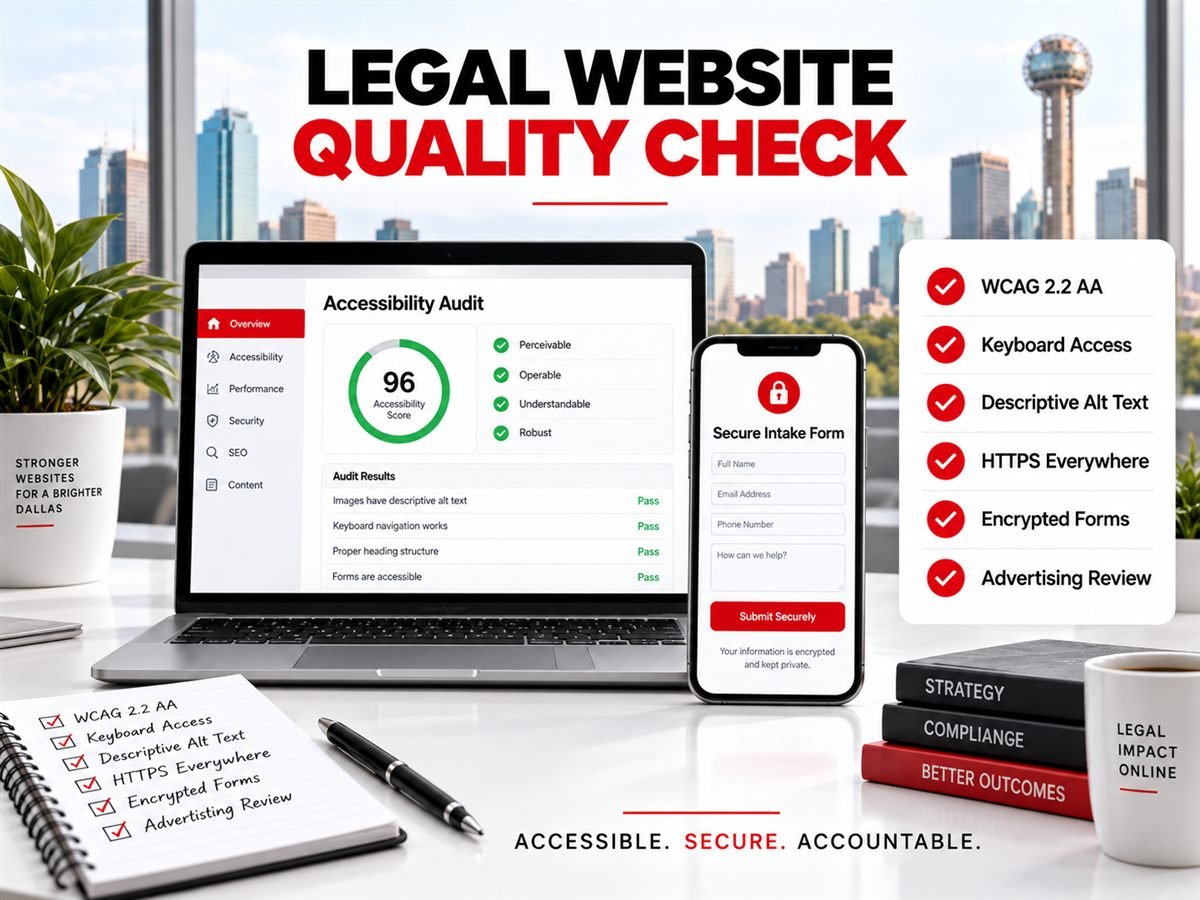
Accessibility and security belong in the project scope from the start. Use the WCAG 2.2 standard as a technical reference, with keyboard operability, visible focus states, descriptive text alternatives, logical headings, form labels, and sufficient contrast. WCAG Level AA calls for at least a 4.5:1 contrast ratio for normal text and 3:1 for large text.
Security basics include sitewide HTTPS, encrypted transmission, controlled access to form submissions, tested backups, software updates, spam protection, and a clear retention policy. Avoid asking for highly sensitive case details before the firm has a secure process for receiving them.
Texas firms should have counsel review website copy against the Texas Disciplinary Rules of Professional Conduct, including advertising statements, responsibility disclosures, past-results language, and specialization claims. Technical accessibility work is not legal advice, and final advertising compliance decisions belong to qualified legal counsel.
Dallas Law Firm Website Design Considerations
Dallas–Fort Worth is a competitive legal market. Firms across Dallas, Fort Worth, Plano, and Irving compete for many of the same high-value searches. Generic templates rarely create meaningful differentiation on their own.
- Depth: publish genuinely helpful practice-area guidance competitors have not covered well.
- Proximity: build accurate location pages only for real, staffed locations.
- Reputation: develop a steady, ethical review process.
- Accessibility: consider bilingual journeys where they reflect the firm’s actual service capabilities.
Delenzo Technologies is based in Dallas and works with businesses across the USA. We connect professional website design, content production, and search optimization in one engagement, with clear deliverables and client-controlled assets.
Should Your Law Firm Redesign or Rebuild?
Redesign when the foundation is sound but the presentation or conversion path is dated. Rebuild when the platform, architecture, integrations, or ownership model blocks growth.
| Current situation | Recommended path |
|---|---|
| Recent, fast, mobile-friendly site | Keep the foundation and improve content and conversion paths |
| Dated visuals, weak mobile UX, declining inquiries | Redesign on the current platform if its structure remains sound |
| Agency owns or licenses the site to the firm | Rebuild on assets the firm controls |
| Practice areas share one URL or integrations are impossible | Rebuild with a scalable architecture |
| Multiple offices and complex intake workflows | Consider a custom build |
Ownership deserves close attention. Confirm control of the domain, hosting account, analytics, content, design files, source code, and backups in writing before signing. If search visibility already exists, follow a careful website redesign and SEO migration plan so valuable URLs, content, and signals are preserved.
Frequently Asked Questions
How much does a law firm website cost in 2026?
Most projects fall between $2,000 and $75,000+, with custom WordPress builds often ranging from $8,000 to $25,000. Page count, original content, design depth, integrations, accessibility, and migration requirements determine the final quote.
Is WordPress a good platform for law firm websites?
Yes. WordPress is a strong option for firms that publish regularly and need flexible technical SEO controls. It requires ongoing updates, backups, security monitoring, and disciplined plugin management.
How long does a law firm website take to build?
Many projects take 6 to 14 weeks. A small template site may launch in 3 to 6 weeks, while a custom build with content, accessibility work, migration, and integrations can take 12 to 20 weeks or longer. Content review and attorney bio approvals are common schedule dependencies.
Should every practice area have a separate page?
Usually, yes. A dedicated page can address the specific legal issue, process, audience, questions, and consultation path more clearly than a combined services list. Avoid creating near-duplicate pages with little original value.
Can a Dallas agency build law firm websites nationwide?
Yes. Strategy, design, development, content, and review can be handled remotely. Local knowledge is most valuable when it affects market positioning, search targeting, and state-specific advertising review.
Ready to Build a Law Firm Website That Converts?
Delenzo Technologies is a creative and digital agency based in Dallas, serving firms across the USA. Our custom website development services can connect design, practice-area content, intake setup, performance, and search optimization in one engagement.
