


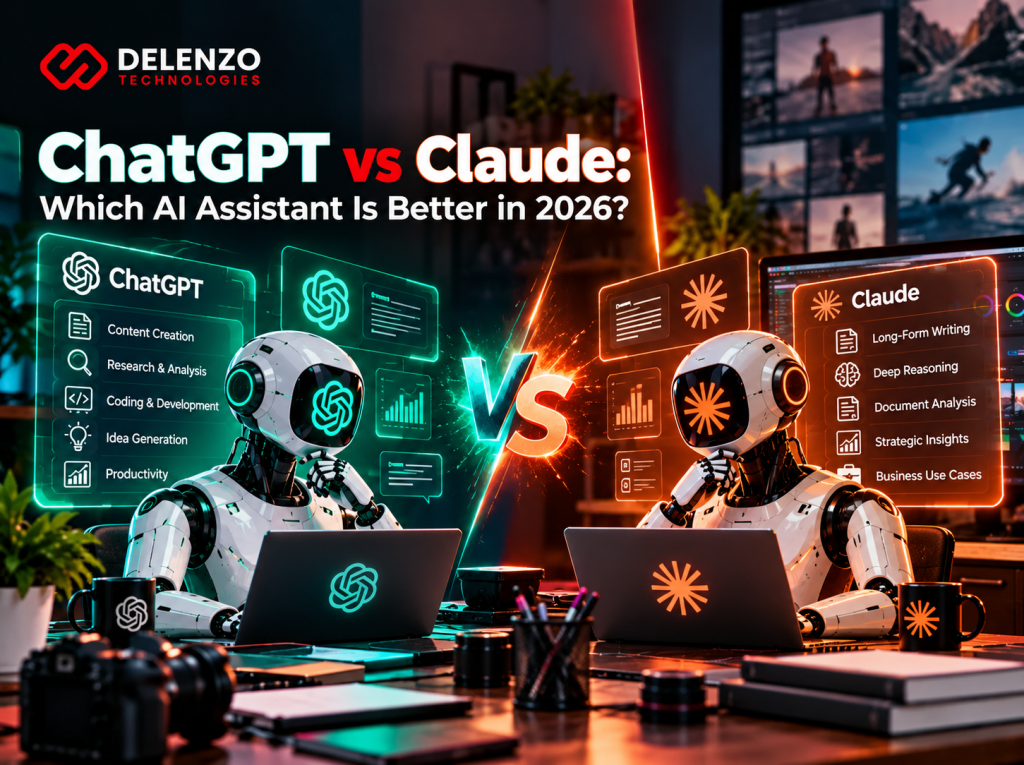
Choosing between ChatGPT vs Claude in 2026 is no longer simply a question of which AI chatbot gives better answers. Both platforms have evolved into comprehensive AI assistants capable of writing, research, coding, document analysis, web search, file handling, reasoning, and professional productivity.
ChatGPT, developed by OpenAI, offers a broad ecosystem that combines advanced AI models with web search, deep research, image generation, file analysis, coding, data analysis, memory, and connected tools.
Claude, developed by Anthropic, has developed its own strong ecosystem around professional writing, coding, large-document analysis, extended reasoning, Claude Code, Research, Projects, memory, connectors, and productivity tools.
So, is Claude better than ChatGPT?
Not universally.
The better AI assistant depends on what you need it to do. Claude can be particularly useful for long-form documents, detailed writing, coding workflows, and context-heavy analysis. ChatGPT provides a broader all-in-one environment for users who regularly switch between research, coding, data, images, files, writing, and general productivity.
ChatGPT vs Claude: Quick Verdict for Different Users
For most people, the decision comes down to workflow rather than simply comparing benchmark scores.
ChatGPT is generally the stronger choice if you want a versatile AI platform capable of handling many different types of work in one environment.
Claude is particularly compelling if your daily work revolves around large amounts of text, software development, structured analysis, research, or complex document workflows.
ChatGPT vs. Claude in 2026
ChatGPT is better suited to users who want an all-in-one AI assistant for research, image generation, coding, files, web search, data analysis, and everyday productivity. Claude is particularly strong for long documents, structured writing, coding workflows, and context-heavy analysis.
Businesses should also look beyond isolated prompts and consider how these platforms fit into a broader AI digital marketing strategy, especially as AI becomes integrated into research, content creation, search, customer journeys, and automation.
ChatGPT vs Claude at a Glance
| Feature | ChatGPT | Claude |
|---|---|---|
| General AI assistance | Excellent | Excellent |
| Complex reasoning | Excellent | Excellent |
| Long-form writing | Excellent | Excellent |
| Coding | Excellent | Excellent |
| Web search | Yes | Yes |
| Deep research | Yes | Yes |
| File analysis | Yes | Yes |
| Data analysis | Strong | Strong |
| Image understanding | Yes | Yes |
| Native image generation | Yes | Limited compared with ChatGPT |
| Memory | Yes | Yes |
| Connected tools | Yes | Yes |
| Long-document workflows | Strong | Particularly strong |
| Individual premium plan | $20/month for Plus | $20/month for Pro |
ChatGPT currently supports tools for web search, deep research, images, uploaded files, data analysis, memory, Projects, and other workflows depending on the user’s subscription and settings.
Claude similarly supports web search, memory, code execution, files, connectors, Artifacts, extended thinking, Projects, and additional professional tools depending on plan.
What Is ChatGPT?
ChatGPT is OpenAI’s general-purpose AI assistant designed for tasks ranging from everyday questions to complex professional workflows.
Users can use ChatGPT to write and rewrite content, brainstorm ideas, explain concepts, solve problems, code, research information, analyze documents and spreadsheets, interpret images, generate visual content, and work with structured data.
Its biggest advantage is the breadth of capabilities available within the same environment.
For example, a marketer could research competitors, analyze a CSV file, develop campaign ideas, write landing-page copy, create an image, and summarize performance data without needing a completely different AI platform for every stage.
OpenAI also provides Deep Research, which can investigate complex questions across multiple online sources and produce structured reports with citations.
What Is Claude?
Claude is Anthropic’s AI assistant and is designed for writing, analysis, reasoning, software development, research, and professional knowledge work.
Claude can generate and edit content, analyze documents, write code, search the web, execute code, work with connected applications, maintain memory across conversations, and organize work through Projects.
Its paid ecosystem also includes tools such as Claude Code and Research. Anthropic’s current Claude Pro plan includes more usage, Claude Code, Projects, additional models, and other professional capabilities.
Claude has become especially attractive to developers, researchers, writers, and professionals who regularly work with substantial amounts of text or context.
ChatGPT vs Claude: Key Differences
The most important difference between Claude and ChatGPT is no longer whether one can write paragraphs or answer questions.
Both can.
The real comparison involves their broader tools, workflows, integrations, model capabilities, and the type of tasks each platform makes easier.
ChatGPT vs Claude for Reasoning & Complex Tasks
Both ChatGPT and Claude can solve multi-step problems, interpret complex instructions, create plans, evaluate alternatives, and reason through technical or business questions.
Neither platform should automatically be considered the “smartest” for every problem.
Performance can change depending on:
- the model selected;
- the prompt;
- the subject;
- available tools;
- context provided;
- whether current web information is required;
- and the complexity of the task.
For serious decisions, users should evaluate the reasoning and supporting evidence rather than assuming one AI provider is automatically more accurate.
Claude vs ChatGPT for Writing & Content Creation
Claude is particularly strong for long-form writing.
It can work well for:
- articles;
- reports;
- documentation;
- editing;
- rewriting;
- brand copy;
- summaries;
- and large structured documents.
Its ability to preserve tone and structure across extended content makes Claude appealing to professional writers and editors.
ChatGPT is also highly capable for writing but has an advantage when content creation is part of a broader workflow.
A marketer might use ChatGPT to research a subject, analyze search intent, create an outline, write content, inspect files, generate supporting images, and refine the finished piece.
Is Claude or ChatGPT Better for Writing?
Claude is particularly strong for long-form writing, editing, document refinement, and maintaining consistency across lengthy content. ChatGPT is also highly capable for writing but offers a broader workflow when content creation also requires web research, image generation, file analysis, SEO planning, data work, or other supporting tasks.
For SEO professionals, either assistant can also be combined with specialized platforms covered in resources such as the 17 Best AI SEO Tools in 2026 to build a more comprehensive optimization workflow.
ChatGPT vs Claude for Coding
Coding has become one of the most competitive areas in the Claude vs ChatGPT comparison.
Both assistants can help developers:
- generate code;
- explain unfamiliar code;
- troubleshoot errors;
- refactor functions;
- plan software architecture;
- create tests;
- review logic;
- and document projects.
Claude has a particularly strong developer proposition through Claude Code, which is included with Claude Pro and higher plans.
ChatGPT also provides sophisticated coding capabilities and can combine programming work with research, data, visual analysis, and broader productivity tasks.
Is ChatGPT or Claude Better for Coding?
Both ChatGPT and Claude are strong coding assistants. Claude is particularly useful for development-focused workflows and Claude Code, while ChatGPT performs strongly for debugging, code explanation, development planning, reasoning, and projects that combine programming with research or other AI tools. The better option depends on your development environment and project complexity.
Therefore, developers should test both platforms against the type of repositories, languages, frameworks, and debugging work they actually perform.
ChatGPT vs Claude for Research
Both platforms now provide capabilities that go significantly beyond ordinary chatbot answers.
ChatGPT offers web search for current information as well as Deep Research for more complex investigations. Deep Research can use web sources, uploaded files, and supported connected applications to produce structured research reports.
Claude also provides web search and a dedicated Research capability.
Anthropic explains that Claude Research performs multiple searches, builds upon what it discovers, investigates different angles, and can use connected tools where available.
For straightforward current-information questions, either platform can perform well.
For complex market research, competitor analysis, literature reviews, or strategic investigations, the best approach is to compare their outputs using the same research question.
As AI assistants increasingly influence how people discover companies and products, businesses should also consider AI Search Optimization alongside conventional SEO.
ChatGPT vs Claude for Long Documents
Claude has historically been particularly attractive for large-context work.
Long documents can include:
- research papers;
- business reports;
- contracts;
- technical documentation;
- extensive notes;
- large codebases;
- and multi-document research.
Claude’s document-oriented workflows make it especially useful when a task depends on maintaining context across substantial quantities of information.
ChatGPT can also work with long documents and uploaded files, but exact file, context, and processing limits can vary according to the selected model, feature, subscription, and account configuration.
For ordinary document analysis, either assistant may be sufficient.
For very large text-heavy projects, Claude deserves particularly strong consideration.
ChatGPT vs Claude for File Analysis
Both platforms support file-based work.
ChatGPT can work with documents, spreadsheets, presentations, PDFs, images, text files, and other supported formats. It can also analyze structured data and create tables or charts from uploaded datasets.
Claude can similarly create files, execute code, analyze uploaded content, and work with external information through supported connectors.
ChatGPT may have an advantage for people whose file workflows frequently involve structured datasets, visualization, spreadsheets, images, and mixed media.
Claude is particularly compelling for text-heavy document analysis.
ChatGPT vs Claude for Image Generation
This is one area where the distinction is clearer.
ChatGPT provides built-in image generation and editing capabilities. Users can generate new visuals from text prompts or upload existing images and request changes using natural language.
That makes ChatGPT useful for:
- social media creatives;
- concept images;
- marketing visuals;
- mockups;
- blog graphics;
- illustration ideas;
- and creative experimentation.
Claude can interpret images and generate certain visual or coded outputs, but it does not provide the same native photo-and-illustration generation workflow as ChatGPT.
Winner: ChatGPT for native AI image generation.
ChatGPT vs Claude for Web Search
Both ChatGPT and Claude can access current web information.
ChatGPT Search can retrieve recent information from the web and provide source links and citations.
Claude’s web search similarly retrieves current information, processes multiple web sources, and includes citations that users can inspect.
For quick factual research, there is no obvious universal winner.
The quality of either system depends partly on what sources it finds and how accurately it interprets them.
ChatGPT vs Claude Memory & Personalization
Memory has become increasingly important because users want AI assistants that understand their preferences and previous work rather than starting from zero every time.
ChatGPT includes memory capabilities that can use relevant stored context to personalize future interactions.
Claude also supports memory across conversations and can search previous conversations on supported paid plans. Anthropic’s current system can maintain remembered topics and use previous context in future conversations.
Both platforms are therefore moving toward persistent AI assistants rather than isolated question-and-answer tools.
ChatGPT vs Claude Integrations
The AI assistant that connects most effectively with a user’s existing workflow can often provide more value than whichever model wins a benchmark.
Both platforms now support broader tool and integration ecosystems.
Claude offers connections with applications and services including supported Google Workspace and Slack workflows, as well as connector-based integrations.
ChatGPT can similarly work with files, connected tools, apps, web research, Projects, and other supported integrations.
Businesses interested in connecting multiple applications should therefore think beyond individual chatbot prompts and explore broader AI workflow automation strategies.
ChatGPT vs Claude for Students
Both assistants can be valuable learning tools when used correctly.
ChatGPT is particularly useful for interactive learning because students can use it to:
- explain difficult concepts;
- solve practice questions;
- summarize notes;
- analyze images;
- review uploaded documents;
- research topics;
- create study plans;
- and ask follow-up questions.
Claude may be particularly useful when students have large research papers, lecture notes, readings, or other lengthy materials to analyze.
ChatGPT may therefore suit students wanting broad multimodal assistance, while Claude can be particularly useful for document-intensive academic work.
Neither tool should be treated as an unquestionable source. Students should verify important factual claims and follow their institution’s rules on AI-assisted work.
ChatGPT vs Claude for Professionals
For professional users, workflow matters even more.
ChatGPT can be especially useful for marketers, managers, analysts, content creators, researchers, consultants, entrepreneurs, and other multidisciplinary professionals who regularly move between different tasks.
Claude can be particularly attractive to software developers, writers, researchers, analysts, and professionals working with large quantities of text.
Businesses should also monitor how these AI platforms influence discovery. As customers increasingly ask AI systems for product and company recommendations, techniques such as tracking and monitoring brand mentions in ChatGPT may become increasingly relevant to digital marketing strategy.
ChatGPT vs Claude Pricing
For individual users, the main paid subscriptions are priced very similarly.
OpenAI currently lists ChatGPT Plus at $20 per month. It provides expanded model and tool access compared with the Free plan, including capabilities such as image generation, files, and Deep Research where available.
Anthropic currently lists Claude Pro at $20 per month when billed monthly. An annual subscription is listed at $200 upfront, equivalent to approximately $17 per month.
How Much Do ChatGPT and Claude Cost?
ChatGPT Plus and Claude Pro both cost $20 per month for individual users in the United States. Claude also offers discounted annual billing. Both companies provide free plans and higher-tier options, while exact usage limits, models, features, taxes, and regional pricing can differ and may change over time.
Both companies also offer higher-usage subscriptions, so users should compare the current plan limits rather than selecting a service based exclusively on the headline monthly price.
Is Claude Better Than ChatGPT?
The answer is sometimes—but not for everything.
Claude may be the stronger option when your priorities include:
- long-form documents;
- extensive text analysis;
- structured writing;
- development workflows;
- Claude Code;
- and context-heavy projects.
ChatGPT may be the stronger option when your work includes:
- native image generation;
- multimodal tasks;
- data analysis;
- broad research;
- mixed file types;
- creative work;
- general productivity;
- and varied day-to-day tasks.
Is Claude Better Than ChatGPT?
Claude is not universally better than ChatGPT. Claude can be a better choice for long-form writing, document analysis, coding, and context-heavy tasks, while ChatGPT is generally more versatile for image generation, multimodal work, data analysis, research, files, personalization, and broader everyday AI assistance.
The right answer therefore depends on what “better” means for a particular user.
Who Should Choose ChatGPT?
Choose ChatGPT if you want one AI assistant capable of supporting many different types of work.
It is particularly compelling for:
- marketers;
- students;
- content creators;
- entrepreneurs;
- analysts;
- researchers;
- multidisciplinary professionals;
- visual creators;
- and users who regularly work with different file types.
ChatGPT is also the stronger choice between these two platforms if native AI image generation and editing are essential to your workflow.
Who Should Choose Claude?
Claude deserves serious consideration if your workflow revolves around:
- long-form writing;
- software development;
- documentation;
- large amounts of text;
- complex research;
- detailed analysis;
- and long-running projects.
Developers may particularly appreciate Claude Code, while writers and researchers may value Claude’s document-oriented workflows and ability to maintain substantial context.
ChatGPT vs Claude: Final Verdict
The ChatGPT vs Claude debate does not have one universal winner in 2026.
ChatGPT is arguably the stronger all-round AI platform for users who regularly combine research, writing, images, files, data, coding, web search, and general productivity.
Claude is an exceptionally strong alternative for users whose work is centered on writing, coding, long documents, research, and context-heavy professional tasks.
If your workday can move from analyzing a spreadsheet to researching competitors, writing an article, generating an image, troubleshooting code, and reviewing documents, ChatGPT’s broader toolset may make it the more practical choice.
If you spend most of your time working deeply with code, documents, research, or sophisticated written material, Claude may fit your workflow better.
Rather than asking only:
“Which AI is smarter?”
Ask:
“Which AI removes more friction from the work I perform every day?”
That is ultimately the most useful way to decide between Claude and ChatGPT.
Frequently Asked Questions About ChatGPT vs Claude
Claude is particularly effective for long-form writing, editing, and document-heavy content. ChatGPT is also a powerful writing assistant and may be more useful when the writing workflow requires research, images, data, files, SEO planning, or other tools.
Both platforms are strong for programming. Claude offers Claude Code and is particularly attractive for development-focused workflows, while ChatGPT performs strongly across debugging, code generation, explanations, architecture, research, and broader technical problem-solving.
Neither platform is always more accurate. Accuracy depends on the model, prompt, subject, tools used, available sources, and whether the question requires current information. Users should verify important factual, financial, legal, medical, or business-critical information against authoritative sources.
Their main individual monthly subscriptions currently have the same U.S. headline price: ChatGPT Plus costs $20 per month and Claude Pro costs $20 per month when billed monthly. Claude also currently offers discounted annual billing.