


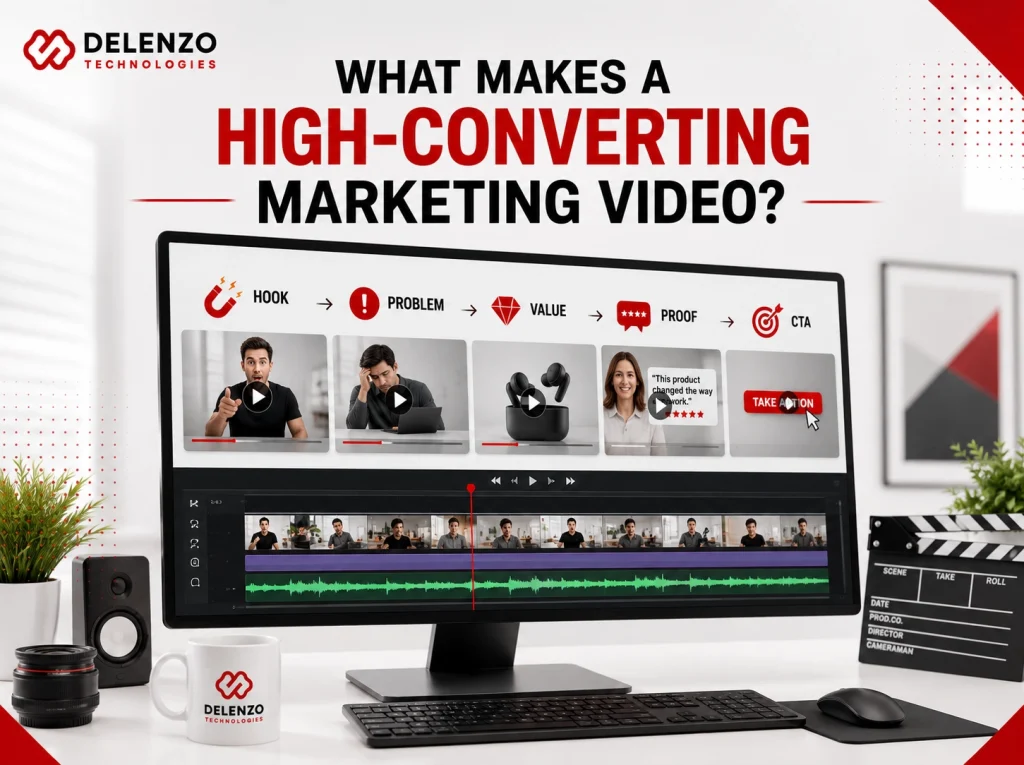
Most marketing videos get views but fail to drive action. A brand can post a polished video, watch the view count climb, and still see zero clicks or sales. The gap comes down to specific editing and structural choices, not luck or budget. Working with a skilled video editing agency can help brands refine these elements for stronger results. This blog post breaks down the hook design, narrative structure, pacing, and CTA placement that separate a high-converting marketing video from one that just looks good.
Why Most Marketing Videos Fail to Convert
Most marketing videos fail to convert because they optimize for attention instead of action. A video can hold a viewer for the full runtime and still never prompt them to click, sign up, or buy.
This disconnect happens because production quality and conversion strategy are separate skills. A beautifully shot video with no clear structure or CTA will underperform a rougher video that guides the viewer toward one specific action. Brands often invest in cameras, lighting, and talent, then treat the edit as an afterthought. The edit is where conversion actually gets built.
View Count vs Actual Conversion Rate
View count measures reach, not results. Consider two videos: one with 500,000 views but a 0.2 percent click-through rate, and another with just 5,000 views at 4 percent. The second is the stronger performer.
Views are a vanity metric because platforms count a view after just a few seconds of watch time. That threshold has nothing to do with whether the viewer understood the offer or took action. Marketing video conversion depends on retention past the hook, clarity of the message, and how directly the video asks for the next step. Tracking click-through rate, landing page visits, and completed actions gives a far more honest picture of performance than view count alone.
The First 3 Seconds: Why the Hook Decides Everything
The hook decides everything because early drop-off happens fast. Wistia’s video engagement research has found viewer retention drops sharply within the opening seconds, and social platforms reward videos that hold attention past that point.
Algorithms on Instagram, TikTok, and YouTube Shorts reward early retention. A weak hook signals low interest to the platform, which then limits how many people see the video at all. Even a strong offer buried behind a slow, generic opening will underperform.

What Makes a Strong Visual Hook
A strong visual hook uses bold motion, contrast, or an unexpected image to interrupt the scroll. The goal is a pattern interrupt that feels different from the content around it in the feed.
Fast zooms, sudden cuts, on-screen text that appears mid-sentence, or an unusual camera angle all work well. Static talking-head openings rarely perform unless the speaker says something surprising in the first line.
- Open on movement, not a static frame
- Use an unexpected object, color, or angle to break the pattern
- Avoid slow fades or logo animations before the first line of content
These small choices add up. A viewer decides whether to keep watching before they consciously register why.
Silent-Viewing Hooks and Text-First Storytelling
Most viewers watch marketing videos on mute, so the hook has to work without sound. Text-first storytelling puts the core message on screen before audio even matters.
Captions and bold on-screen text should carry the opening line, not just repeat what is being said. This matters most on social feeds, where autoplay defaults to silent. A hook that depends entirely on audio will lose most of its audience before the sound is ever turned on.
Testing a video with sound off is a simple way to check this. If the message still lands without audio, the hook is doing its job.
Structure That Converts: The Problem-Value-Proof-Action Framework
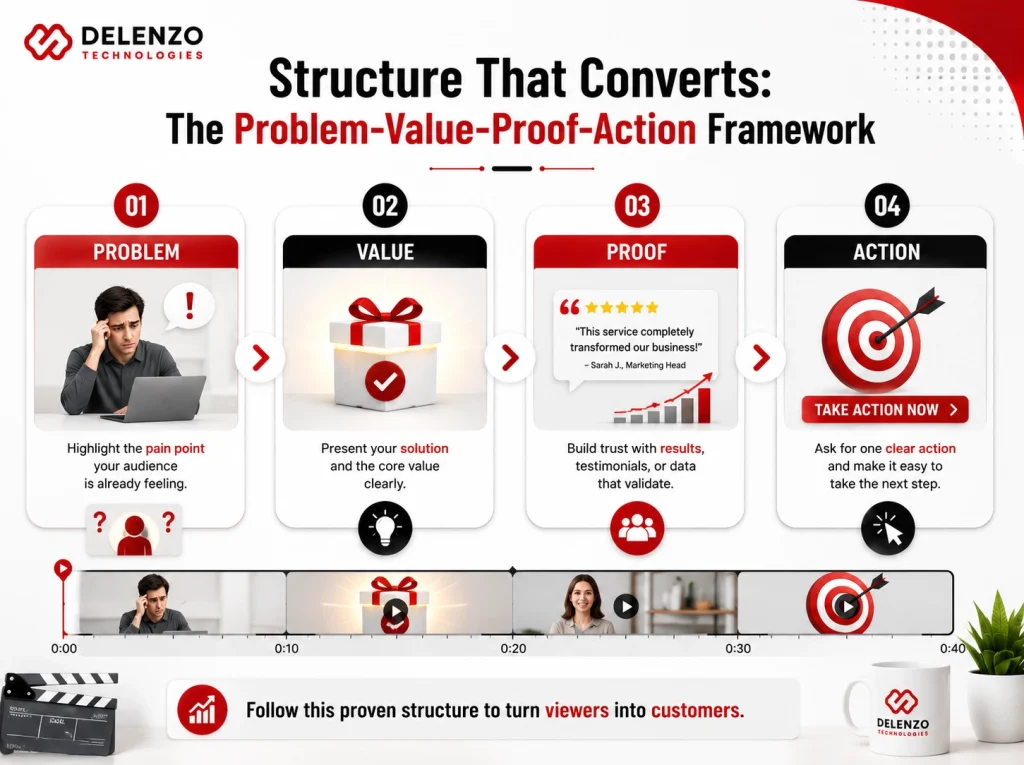
A proven structure for a high-converting marketing video follows four beats: problem, value, proof, and action. This framework mirrors how people naturally make buying decisions.
Instead of opening with a brand introduction, the video opens with a pain point the viewer already recognizes. From there, it introduces the value proposition, backs it up with proof, and closes with a clear next step. This structure works across industries because it follows a decision-making pattern people already trust.
Problem and Value Proposition
The strongest openings name a relatable pain point in the first line, then follow with a clear value statement. This tells the viewer immediately that the video is relevant to them.
Vague openings that talk about the brand before the problem lose attention fast. A viewer needs to see themselves in the video before they care about the solution. Once the problem is named, the value proposition should answer it directly, in plain language, without jargon or exaggerated claims.
Proof and Social Validation
Proof turns a claim into a credible statement. Testimonials, statistics, or a short product demo all work to build trust quickly within a video.
A quick customer quote, a specific result, or a side-by-side demo gives viewers a reason to believe the value proposition. Even five seconds of a real customer speaking adds more credibility than another line of brand messaging.
Proof works best when it is specific rather than general. A number, a named result, or a real customer face outperforms a vague claim like “trusted by thousands.”
The Call-to-Action Placement
CTAs should not only sit at the end of a video. Placing a soft CTA mid-video, alongside a strong one at the close, captures viewers who drop off early.
Many editors treat the CTA as a single closing frame, which misses viewers who never make it that far. A brief on-screen prompt after the proof section, paired with a stronger CTA at the end, covers more of the audience. This layered approach is one of the simplest ways to improve marketing video conversion without changing the creative concept at all.
| Funnel Stage | Recommended Structure | Ideal Length | CTA Style |
| Awareness | Hook, problem, brief value statement | 15 to 30 seconds | Soft, curiosity-driven (“Learn more”) |
| Consideration | Problem, value, proof, light CTA | 30 to 60 seconds | Mid and end CTA, informational |
| Decision | Value, proof, strong direct CTA | 60 to 90 seconds | Direct action (“Book now,” “Buy today”) |
Editing Techniques That Directly Impact Conversion
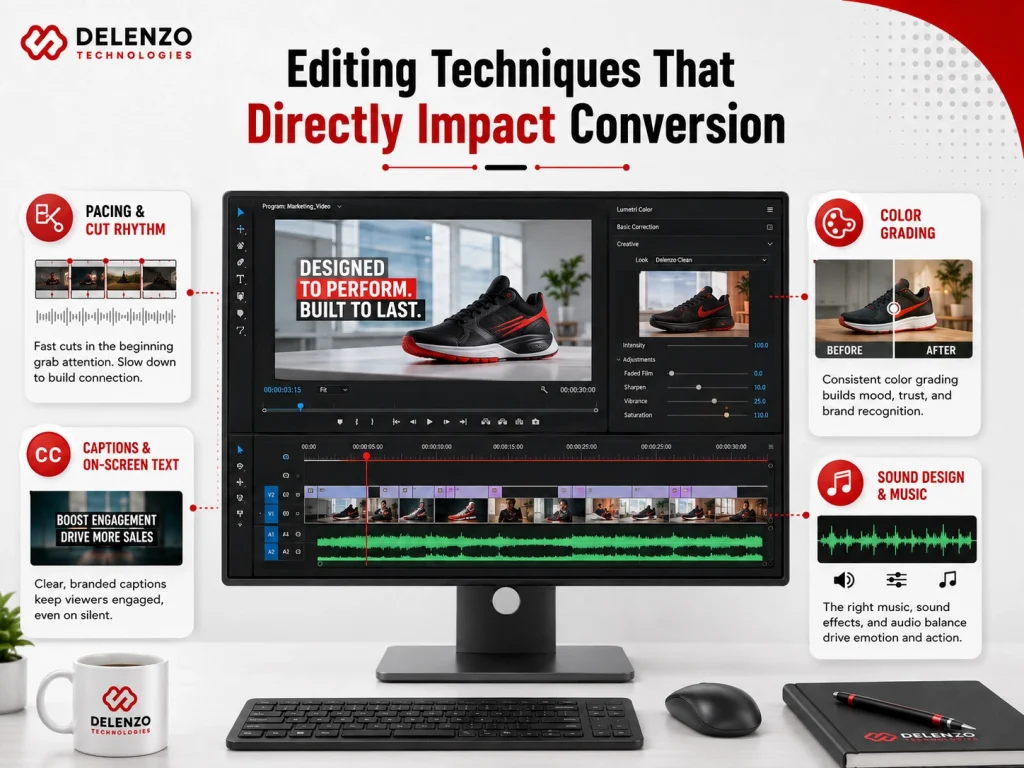
Editing decisions, not just concepts, determine whether a video holds attention long enough to convert. Pacing, captions, color, and sound all shape how a viewer experiences the message.
These technical choices are often overlooked because they feel secondary to the script or the offer. In practice, a well-written script with poor pacing or unreadable captions will still underperform. Professional video editing services exist largely to handle these details with consistency across every video a brand produces.
Pacing and Cut Rhythm
Cut frequency directly affects how long viewers stay engaged. Faster cuts in the first few seconds help retention, while slower pacing works once trust is established.
A video that holds one shot too long early on gives viewers a natural exit point. As the video moves into the proof and value sections, pacing can relax slightly, since the viewer is already invested.
Captions and On-Screen Text Design
Branded, readable captions keep viewers engaged and reinforce recall. Generic subtitle styles, by contrast, can make a video feel unpolished and hurt viewer trust.
Captions should use the brand’s fonts and colors, sized large enough to read on a small screen. Text that lags behind speech or disappears too quickly breaks the flow. This is a detail that a skilled video editing agency handles as a standard part of post-production.
Color Grading and Brand Consistency
Consistent color grading builds recognition and trust across every video a brand releases.
Mismatched color between clips, or footage that looks different from previous videos, creates a subtle sense of inconsistency. A consistent grading approach, applied across a video editing company’s full catalog, protects brand perception over time.
Sound Design and Music Selection
Audio pacing supports the emotional rhythm of a video and keeps viewers engaged through transitions. Music that builds at the right moments reinforces the structure of the edit.
The wrong music choice can undercut an otherwise strong edit. A high-energy track behind a calm testimonial feels mismatched, while a flat track behind an exciting reveal falls short.
Video Length and Format by Platform
Length and aspect ratio decisions directly affect how well a video performs on a given channel. What works on TikTok will often underperform on a landing page.
Each platform has different viewer expectations and technical requirements. Matching format to platform is a simple but frequently overlooked step in video strategy.
Short-Form (Reels, TikTok, Shorts) Best Practices
Short-form platforms reward videos between 6 and 15 seconds, framed vertically at a 9:16 ratio. Anything longer risks losing viewers before the message lands.
Vertical framing fills the screen on mobile, which is where most short-form content is consumed. Captions are essential here, since sound-off viewing is common. Keeping the message tight and front-loaded matters more on these platforms than almost anywhere else.
YouTube and Landing Page Video Length
Owned platforms like YouTube and landing pages allow for longer structure, typically 60 to 90 seconds for a high-converting marketing video. Viewers on these channels have already shown intent, so a slightly longer format works.
Because the audience arrived with more context, the full problem-value-proof-action structure can play out with more detail. Landing page videos in particular benefit from a stronger proof section, since the viewer is closer to a purchase decision.
| Platform | Recommended Length | Aspect Ratio | Caption Style |
| TikTok/Reels/Shorts | 6 to 15 seconds | 9:16 vertical | Bold, animated, brand-colored |
| Instagram Feed | 15 to 30 seconds | 4:5 or 1:1 | Clean, brand font, mid-size |
| YouTube | 60 to 90 seconds | 16:9 horizontal | Standard readable captions |
| Landing Page | 45 to 90 seconds | 16:9 horizontal | Optional, brand-styled |
A/B Testing and Editing Variations for Higher Conversion
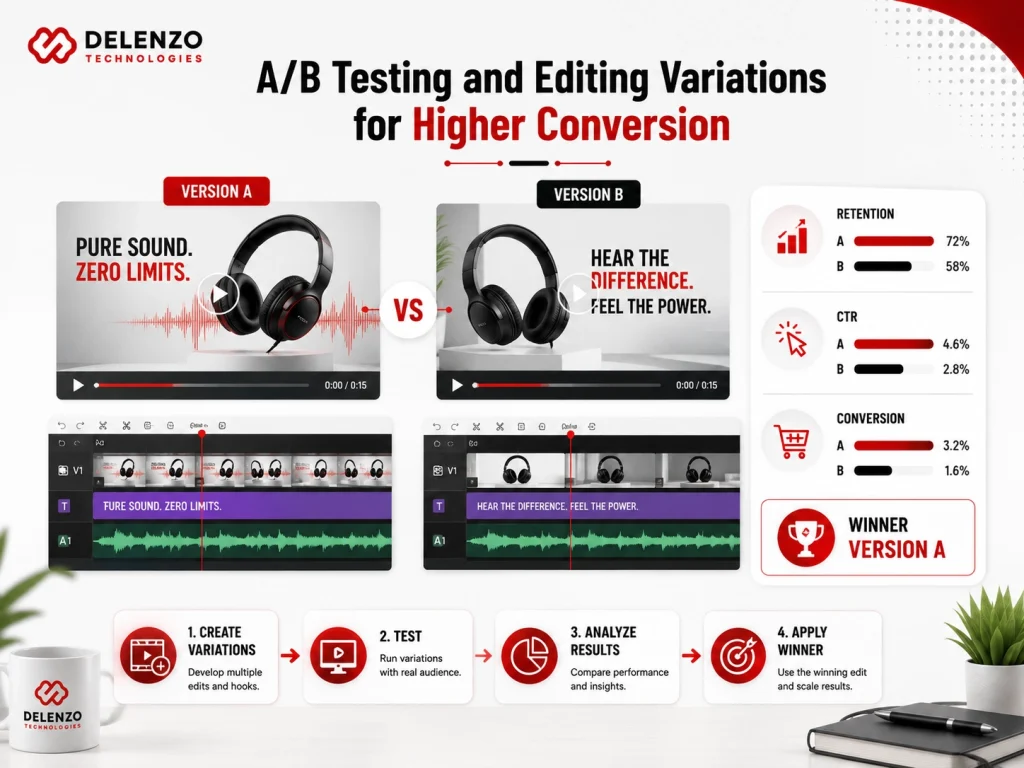
A/B testing edited variations is one of the most reliable ways to improve performance over time. Small changes to a hook or CTA can shift conversion rates significantly.
Testing removes guesswork from the editing process. Instead of assuming which version will perform better, running both versions with real audience data settles the question.
Testing Different Hooks and CTAs
Testing two or three hook variations against the same core video isolates what actually drives retention. The same applies to CTA wording.
A simple test might swap a text-based hook for a spoken one, or move the CTA earlier in the video. Running these variations for one to two weeks, then comparing click-through rate, gives a clear answer.
- Test one variable at a time, such as the hook or the CTA
- Run each version long enough to gather reliable data
- Apply the winning version as the new baseline before testing again
Common Mistakes That Kill Video Conversion
Several recurring editing mistakes quietly reduce conversion rates, even in videos with strong concepts. Fixing these issues is often faster and cheaper than reshooting.
Most of these problems are structural or technical, which means they can be corrected in the edit without new footage.
Videos That Run Too Long
Extended runtime causes drop-off before the viewer ever reaches the CTA. A video that could make its point in 30 seconds but runs for 90 loses viewers.
Every additional second past the necessary length is a chance for the viewer to leave. Trimming a video down to its essential beats keeps runtime tight and purposeful.
Missing or Buried Call-to-Action
A missing or buried CTA is one of the most common reasons a well-made video fails to convert. Viewers rarely take action without a clear, direct prompt.
A CTA that appears only in the final second, or one that is vague, gives viewers no clear path forward.
A strong CTA names the exact action, such as “book a call” or “shop now,” rather than a generic phrase like “learn more.” Specific language consistently outperforms vague language in driving clicks.
Inconsistent Branding Across Cuts
Mismatched colors, fonts, or pacing between cuts undermines viewer trust in the brand.
This mistake often happens when multiple editors work on the same campaign without a shared style guide. A documented set of brand standards for color, font, and pacing keeps every video consistent, regardless of who edits it.
How Delenzo Technologies Edits Marketing Videos to Convert
Delenzo Technologies builds every marketing video around the structure and editing principles covered in this guide. Our process treats the hook, pacing, and CTA as core creative decisions.
As a Dallas-based video editing agency, we work with businesses across the USA who need videos built for measurable results, not just polish. Our team handles promotional video editing, short-form social content, and longer landing page videos with the same attention to structure. Clients searching for video editing services near me in Dallas get the same conversion-focused process applied to every project.
Every project starts with a short discovery step: identifying the platform, the funnel stage, and the one action the video needs to drive. That single detail shapes the hook style, pacing, and CTA placement before editing begins.
Our Approach to Hooks, Pacing, and CTAs
Every project starts by matching hook style to platform, a bold visual interrupt for social feeds, a stronger opening line for landing pages, since viewer intent differs by channel.
Our editors apply consistent captioning, color grading, and layered CTA placement across every video, so brand consistency carries through an entire campaign. This approach is why we position ourselves among the best video editing services for brands that need their video editing services to directly support growth goals, not just brand awareness.
Final Thoughts
A high-converting marketing video is built through deliberate editing decisions, not luck or a bigger budget.
Applying even a few of these principles, like layered CTAs or platform-specific length, can noticeably improve performance. For brands ready to apply this structure at scale, working with an experienced video editing company removes the guesswork and speeds up results.
Frequently Asked Questions
What makes a marketing video convert better?
Conversion comes from structure, not polish alone. Videos that open with a real viewer problem, prove their claim quickly, and ask for one clear action outperform videos built only for visual quality.
How long should a high-converting marketing video be?
Length depends on the platform. Short-form videos on TikTok or Reels work best at 6 to 15 seconds, while YouTube and landing page videos can run 60 to 90 seconds for stronger conversion.
Why is the first few seconds of a video so important for conversions?
Most platforms lose over half of viewers within the first three seconds. A strong hook using bold visuals, movement, or text-first storytelling stops the scroll and keeps viewers watching longer.
Does video editing really affect conversion rates?
Yes, often more than the script itself. Two videos with identical footage can perform very differently based purely on cut pacing, caption readability, and audio choices made in post-production.
Where should the call-to-action go in a marketing video?
A CTA should not sit only at the end. Placing a soft CTA mid-video after the proof section, plus a strong CTA at the close, captures more viewers and improves marketing video conversion.