

Most small businesses don’t have a client problem. They have a visibility and trust problem. People either can’t find them, or they find them and still pick someone else.
The short answer on how to get more clients: show up where buyers search (Google, Maps and AI tools), give them proof that you’re good at what you do, and follow up with every lead quickly. This guide walks through each piece with real costs, timelines and examples you can copy.
Quick answer: Build visibility, earn trust and follow up fast. Start with a conversion-ready website and Google Business Profile, then add local SEO, reviews, referrals and one paid channel you can measure consistently.
You’ll get 12 strategies, a cost comparison table, budget numbers and a simple way to track what’s working.
Why Is It Hard for Small Businesses to Get New Clients?
Small businesses struggle to get new clients mainly because buyers decide quickly and choose from a very short list. If you’re not on that list when they search, you lose the job before you knew it existed.
BrightLocal’s 2026 consumer research found that 75% of consumers choose a local business in under 30 minutes, and 72% look at three or fewer businesses before deciding. That’s a small window.
Most owners run into the same roadblocks:
- The business doesn’t appear on page one or in the Google Map Pack.
- There are only a handful of reviews, no photos and no proof of past work.
- The website is slow, hides the phone number and has a ten-field contact form.
- Leads come in, then go cold because nobody calls back for two days.
- Marketing is random: a Facebook post here, a flyer there, with no plan tying it together.
Every one of these can be fixed. Solid small business marketing strategies don’t need a big team. They need focus and a few habits you repeat every week.
How to Get More Clients for Your Small Business: 12 Proven Strategies
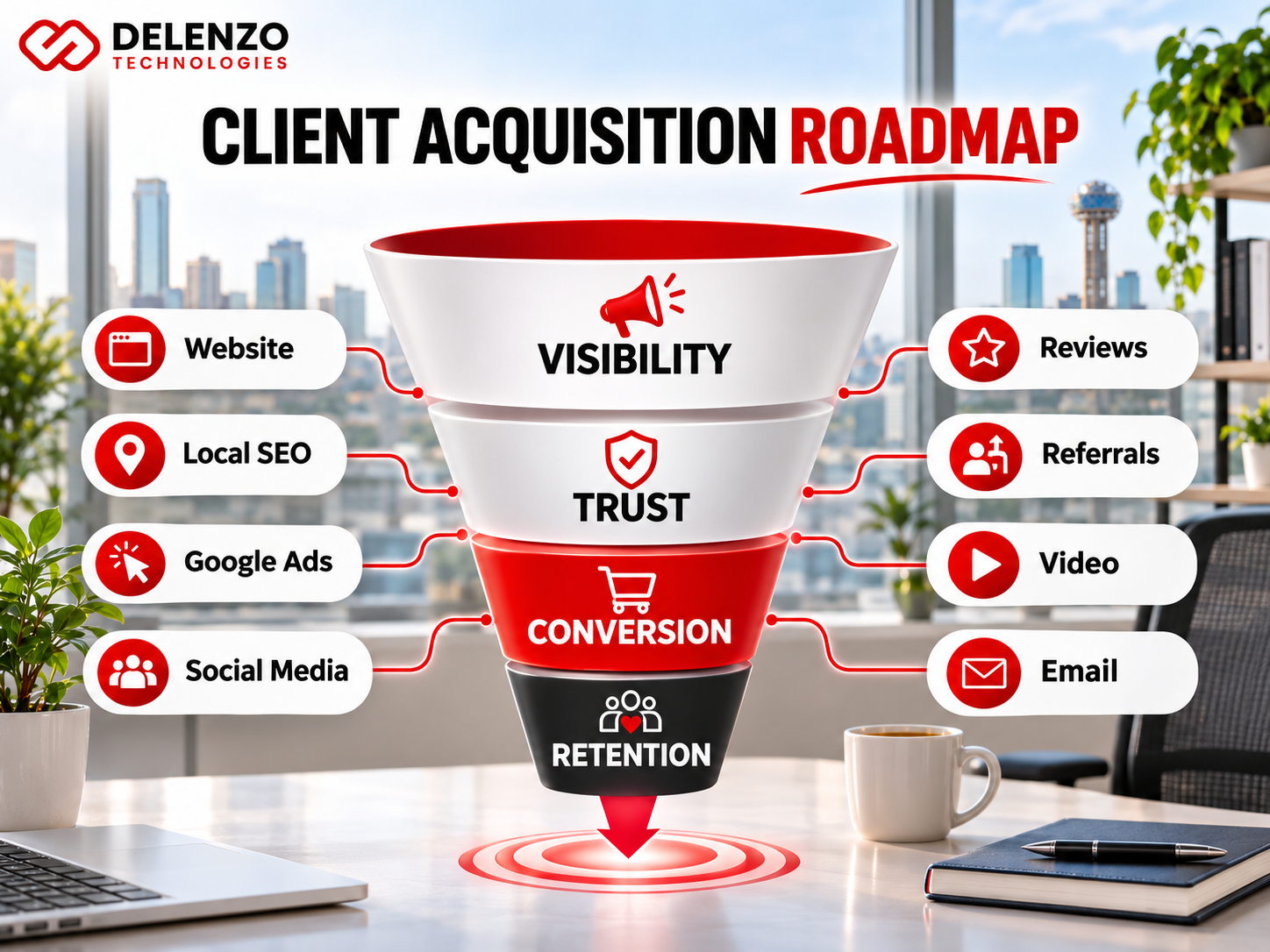
The 12 client acquisition strategies below are ordered the way most small businesses should roll them out: foundations first, then traffic, then trust, then follow-up. You don’t need all 12 at once. Start with the first three, then add one new channel each month.
1. Define Your Ideal Client and Target Market
Your ideal client is the customer who pays well, needs what you sell most and is easy to work with. Write that person down before you spend a dollar on ads, because every other strategy depends on it.
Take a Dallas plumber. Targeting “homeowners in houses built before 1990 who need repiping” works far better than targeting “anyone with a leak.” That one choice changes the keywords, the ad copy and even the photos on the website.
To build your profile, write down:
- Your five best current clients and what they have in common
- The problem each one was trying to solve when they found you
- Where they spend time online (Google, Instagram, LinkedIn, Facebook groups)
- What almost stopped them from hiring you (price, trust, timing)
- The exact words they use to describe the problem
Hand those notes to whoever writes your ads or website copy. Generic messages attract generic leads.
2. Build a Website That Turns Visitors Into Clients
A website brings in clients when it loads quickly, says what you do in one line and makes contacting you take seconds. If people land on your site and leave without calling or filling out a form, the site is the leak.
This is where conversion rate optimization (CRO) comes in. It means making small changes so more visitors take action. BrightLocal reports that 73% of local searches start on a phone, so test every change on mobile first.
Fixes that usually help:
- Put your phone number and a “Get a Quote” button at the top of every page.
- Write a headline that says what you do and where, like “Roof Repair in Dallas, Same-Week Service.”
- Cut your contact form down to name, phone, email and one message box.
- Place reviews, client logos or before-and-after photos next to every call to action.
- Compress images so pages load in under three seconds.
- Create one page per service instead of one page that lists everything.
- Change one thing at a time, then watch calls and form fills for two to four weeks before you judge it.
3. Optimize Your Google Business Profile to Get Local Customers
Your Google Business Profile is the free listing that appears in Google Maps and the local Map Pack. For many service businesses, it’s the first thing a buyer sees, so it deserves an hour of work every month.
Google Business Profile optimization comes down to completing every field and keeping the listing active:
- Choose the most accurate primary category, then add secondary ones (for example, “HVAC contractor” plus “Air conditioning repair service”).
- Make your business name, address and phone number match your website exactly.
- List your services with short descriptions, and add prices if you can.
- Upload real photos of your team, your work and your location every month. Skip stock images.
- Publish an update, offer or event once a week.
- Turn on messaging and reply within a few hours.
- Respond to every review, good or bad.
4. Use Local SEO to Get Found in “Near Me” Searches
Local SEO is how you rank when someone nearby searches for your service, like “dentist near me” or “bakery in Plano.” BrightLocal found that 46% of consumers always or often add “near me” to local searches, which means many buyers tell Google exactly where they want to buy.
Good local SEO for small business goes beyond your Google listing:
- Build a separate page for each city or area you serve, with real local details such as neighborhoods and past projects.
- List your business on Yelp, Bing Places, Apple Business Connect, the BBB and industry directories, using the same name, address and phone everywhere.
- Earn links from local sources like the chamber of commerce, teams you sponsor, local news and partner businesses.
- Add LocalBusiness schema markup so search engines read your details correctly.
- Put your city and service together in page titles, like “Kitchen Remodeling in Dallas, TX.”
Expect real movement in three to six months. Local SEO is slow to start, but the leads keep coming without a per-click cost.
5. Rank on Google and AI Search With SEO, GEO and AEO
SEO gets your pages ranked on Google. GEO (generative engine optimization) and AEO (answer engine optimization) get your business quoted and recommended inside AI answers from ChatGPT, Google AI Overviews, Perplexity and Gemini. You need all three now, because buyers use both kinds of search.
The shift is happening quickly. BrightLocal’s 2026 Local Consumer Review Survey shows that use of ChatGPT and other AI tools for local business recommendations rose from 6% in 2025 to 45% in 2026.
To show up in both:
- Open each page and section with a direct one- or two-sentence answer, then explain.
- Add an FAQ section built from the exact questions clients ask you on calls.
- Use clear headings, short paragraphs, lists and tables that AI tools can pull from.
- Add FAQ, Organization and LocalBusiness schema.
- Get your business mentioned on trusted sites, local news and review platforms. AI tools rely heavily on those mentions.
- Publish details only you have: your prices, timelines, project photos and real numbers from your work.
A page that answers one question clearly beats a long page that answers nothing.
6. Run Google Ads to Get Clients Fast
Google Ads put your business at the top of search results today, in front of people already searching for what you sell. It’s the quickest paid route to leads, but you pay for every click, so setup matters.
PPC for small business isn’t cheap anymore. WordStream and LocalIQ’s 2025 benchmarks put the average cost per click at $5.26 and the average cost per lead at $70.11 across industries. Auto repair averaged $28.50 per lead, while legal services hit $131.63.
Set up campaigns so you don’t waste budget:
- Target only the cities or ZIP codes you serve.
- Start with exact and phrase match keywords that show buying intent (“emergency plumber Dallas,” not “plumbing tips”).
- Add negative keywords like “free,” “jobs,” “DIY” and “salary.”
- Use call ads or call assets so mobile users can tap to call.
- Send clicks to a dedicated landing page, not your homepage.
- Set up conversion tracking for calls and form fills before you spend anything.
- Schedule ads for the hours someone can answer the phone.
A first-month test budget of $1,000 to $1,500 buys roughly 190 to 285 clicks at the average CPC. That’s enough data to see which keywords bring real leads in one service area.
7. Use Facebook and Instagram Ads to Attract New Customers
Facebook and Instagram ads reach people before they start searching, by targeting location, age, interests and behavior. They work well for offers, events, visual products and retargeting people who already visited your site.
People on Meta aren’t looking for you yet, so your ad has to stop the scroll. A few rules that help:
- Use Lead Ads with an instant form so people can request a quote without leaving the app.
- Retarget website visitors and video viewers from the last 30 to 90 days. They already know you.
- Test three to five creatives at once: a short video, a customer photo, a before-and-after and a simple offer graphic.
- Lead with a specific offer (“Free AC check with any repair this month”) instead of “We’re the best.”
- Start around $10 to $20 a day, then put more behind the ad sets that bring leads at your target cost.
- Call or text new leads within minutes. Social leads cool off quickly.
8. Get Clients From Social Media Without Paying for Ads
Organic social media brings in clients by building familiarity over time, so people think of you first when they need your service. It costs nothing but consistency.
The biggest mistake with social media marketing for small business is trying to be everywhere. Pick one or two platforms where your clients already hang out. A B2B consultant probably belongs on LinkedIn. A salon or restaurant belongs on Instagram and TikTok. Home service companies often do well in Facebook community groups and on Nextdoor.
What to post:
- Quick tips that answer common client questions
- Behind-the-scenes clips of your team at work
- Client results and finished projects (with permission)
- Short explainers on pricing, timelines or what to expect
- Local content, such as events you attend and businesses you partner with
Aim for three to five posts a week, and spend 15 minutes a day replying to comments and DMs. Conversations turn followers into clients much more often than posts alone.
9. Use Video Marketing to Build Trust and Win Clients
Video wins clients because people can see you, hear you and decide whether they trust you before they call. A 60-second clip often does what a full page of text can’t.
Video marketing for small business doesn’t need a studio. A recent smartphone, a $20 clip-on mic and window light are enough to start.
Videos that bring in work:
- FAQ answers, one question per video, under 60 seconds
- Client testimonials filmed on-site right after a job
- Before-and-after walkthroughs of your work
- An owner or team intro for your homepage and Google profile
- Process videos showing what happens after someone hires you
Post each clip to Instagram Reels, TikTok, YouTube Shorts and your Google Business Profile. Embed longer versions on your service pages, where visitors are deciding.
10. Ask for Online Reviews and Client Testimonials
Reviews are often what decides between you and a competitor, so ask every happy client for one. BrightLocal’s 2026 survey found that 97% of consumers read online reviews and 41% always read them when choosing a business.
Strong online reviews and testimonials come from a simple routine:
- Ask in person at the moment the client is happiest, like when the job is done or the order arrives.
- Follow up the same day by text or email with a direct link to your Google review page.
- Keep the request short so leaving a review takes one tap.
- Reply to every review within 48 hours. Thank people by name, and answer bad reviews calmly with a fix.
- Turn your best reviews into testimonials on your website, ads and social posts.
Never buy reviews, write fake ones or offer rewards for positive ratings. Google’s policies ban it, and the FTC’s 2024 rule on fake reviews allows fines for it.
11. Create a Referral Program to Get Clients by Word of Mouth
A referral program rewards current clients for sending you new ones, which turns happy customers into your sales team. Referred clients trust you before the first call, so they usually close faster.
A simple referral program that works:
- Reward both sides, like $50 off for the referrer and $50 off for the new client.
- Match the reward to your price point. A $25 gift card fits a cleaning service, while a $250 credit fits a $10,000 remodel.
- Ask right after a strong result or a five-star review.
- Give clients something easy to share: a link, a code or a card they can hand to a friend.
- Track referrals with unique codes so you know who to thank.
Partners count too. Realtors refer movers and home inspectors. Accountants refer bookkeepers and lawyers. Coffee with three businesses that serve the same clients as you can turn into a steady lead source.
12. Use Email Marketing to Follow Up and Convert Leads
Email marketing turns leads who aren’t ready yet into paying clients by staying in touch until they are. Most people don’t buy on their first visit, and the business that follows up usually gets the job.
Ads and SEO handle lead generation for small businesses. Email marketing for small businesses closes the gap between a lead and a sale. Free plans from tools like Mailchimp, MailerLite or Brevo are enough when you’re starting out.
Emails to set up first:
- A welcome email, sent right after someone joins your list, with one helpful tip
- A quote follow-up two to three days after you send a quote, with a client review attached
- A four-week nurture series with one useful email a week (a tip, a case study, an FAQ, an offer)
- A win-back email to past clients after 6 to 12 months, with a reason to come back
- A short monthly newsletter: one tip, one project, one offer
Grow your list with a lead magnet, such as a price guide, a checklist or a free consultation that people get in exchange for their email.
How to Get Clients Fast: Best Strategies for Quick Results
The quickest ways to get clients are reaching out to past clients, asking for referrals, running Google Search ads and running Meta Lead Ads. These can bring leads within days, while SEO and content take months.
If you need work this week, use these customer acquisition strategies in this order:
- Email or text every past client with a check-in or a limited-time offer. They already trust you.
- Ask your five happiest clients for one referral each.
- Launch a Google Search campaign on high-intent keywords in your area.
- Run a Facebook or Instagram Lead Ad with a clear offer.
- Post on your Google Business Profile, local Facebook groups and Nextdoor (follow each group’s rules).
- Call back every open quote from the last 90 days.
Short-term tactics fill the calendar now. Keep building the slower channels alongside them so you aren’t paying for every single lead forever.
How to Get More Clients Without Spending Money
You can win clients for free by spending time instead of budget: a complete Google Business Profile, reviews, referrals, organic social posts, partnerships and helpful content. These cost nothing and keep working long after you set them up.
If you’re working out how to attract new customers on a zero budget, start here:
- Complete your Google Business Profile and post on it weekly.
- Ask every happy client for a review.
- Set up a basic referral offer. A discount on the next job costs you little.
- Answer questions in local Facebook groups, Reddit threads and industry forums without spamming.
- Swap referrals with businesses that serve the same clients you do.
- Write one blog post a month that answers a real client question.
- Offer to speak at a local meetup, chamber event or webinar.
- Reconnect with your LinkedIn network and tell people what you do now.
Pick two of these and do them every week for 90 days. That beats trying all eight for two weeks.
How to Get Local Customers for Your Small Business
To get local customers, show up in local search, get involved in your community and make it easy for nearby people to find and recommend you. Local buyers trust businesses they see often, online and in person.
There are plenty of ways to attract new customers close to home:
- Rank in the Google Map Pack with a complete profile and a steady flow of reviews.
- Sponsor a youth sports team, school event or charity run.
- Join your chamber of commerce or a BNI chapter.
- Set up a booth at farmers markets, home shows or community fairs.
- Run ads that target a 5 to 10 mile radius around your location.
- Team up with neighboring businesses on shared offers.
- Get featured in local news, local blogs and “best of” lists.
For businesses in the Dallas-Fort Worth area, plan neighborhood by neighborhood. Someone in Uptown Dallas may search and buy differently than someone in Plano or Frisco. Build pages and ads around the areas you actually serve, and mention local details buyers recognize.
Client Acquisition Strategies Compared: Cost, Speed and Results
The right mix depends on how quickly you need clients and how much you can spend. Paid ads bring the fastest leads, while SEO, reviews and referrals bring cheaper leads over time.
Use this table to compare your client acquisition options side by side:
| Strategy | Monthly cost | First results |
|---|---|---|
| Google Business Profile | Free | 2 to 8 weeks |
| Local SEO | Free DIY, more with an agency | 3 to 6 months |
| SEO, GEO and AEO | Free DIY, more with an agency | 4 to 12 months |
| Google Ads | $1,000+ | 1 to 7 days |
| Facebook and Instagram Ads | $300 to $600 | 1 to 14 days |
| Organic social media | Free | 2 to 6 months |
| Video marketing | Free to $300 | 1 to 3 months |
| Reviews and testimonials | Free | Ongoing |
| Referral program | Cost of rewards | 2 to 8 weeks |
| Email marketing | Free to start | 1 to 4 weeks |
Timelines are typical ranges. Your industry, location and competition will move them.
How Much Should a Small Business Spend on Marketing to Get Clients?
Most small businesses should spend about 7% to 8% of gross revenue on marketing. That’s the long-standing U.S. Small Business Administration guideline for businesses earning under $5 million a year with net margins of 10% to 12%.
| Annual revenue | Yearly budget (7% to 8%) | Monthly budget |
|---|---|---|
| $250,000 | $17,500 to $20,000 | $1,458 to $1,667 |
| $500,000 | $35,000 to $40,000 | $2,917 to $3,333 |
| $1,000,000 | $70,000 to $80,000 | $5,833 to $6,667 |
New businesses and companies in crowded markets often spend more in their first years to get established.
The number to watch closely is your customer acquisition cost (CAC), which is what you spend to win one new client:
Total marketing and sales spend
CAC = _________________________
Number of new clients
Spend $3,000 in a month and win 20 clients, and your CAC is $150. If an average client is worth $1,200 to you over time, that’s a healthy return. If they’re worth $200, you need a cheaper channel.
Common Mistakes That Stop Small Businesses From Getting Clients
The most common mistakes are trying every channel at once, following up too slowly and not tracking results. Each one wastes money and makes good strategies look like they failed.
Watch out for these:
- Spreading a small budget across five platforms instead of doing one or two well
- Sending ad traffic to a homepage instead of a focused landing page
- Waiting hours or days to call back new leads
- Ignoring Google reviews, especially negative ones
- Writing about yourself instead of the client’s problem
- Copying a competitor’s pricing and messaging so nothing sets you apart
- Quitting SEO after two months because rankings haven’t moved yet
- Never asking happy clients for referrals
- Running ads without conversion tracking
How to Track Which Marketing Channel Brings You the Most Clients
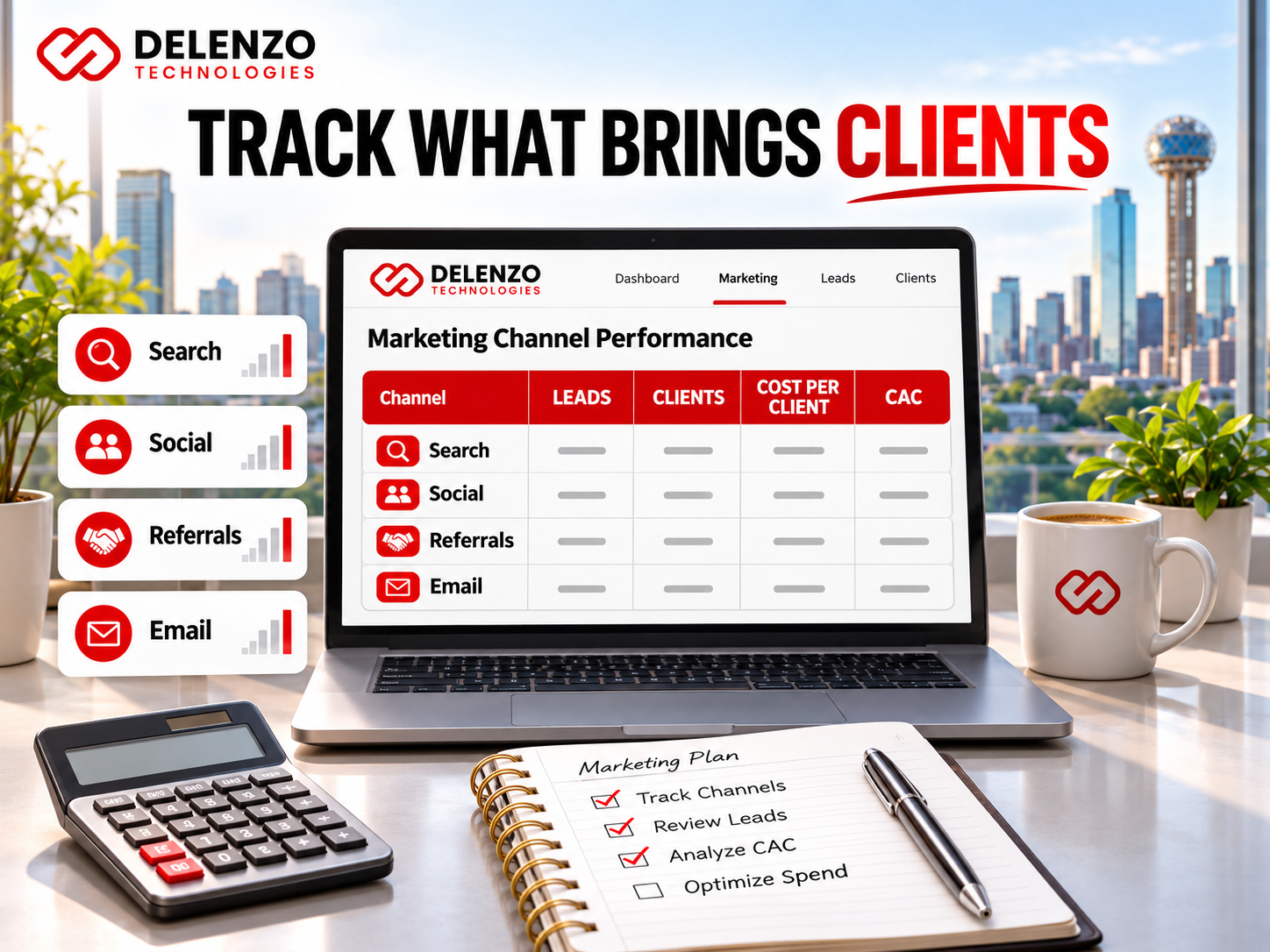
To track which channel brings clients, tag every link, track every call and form, and ask every new client how they found you. Then compare channels by cost per lead and cost per client, not by clicks or likes.
A simple tracking setup:
- Add UTM tags to the links in your ads, emails and social posts.
- Set up Google Analytics 4 key events for form fills, calls and bookings.
- Use a separate call tracking number for each major channel (CallRail is one common option).
- Add a “How did you hear about us?” field to your forms and intake calls.
- Log every lead and its source in a spreadsheet or CRM.
- Review the numbers once a month. A sample month looks like this:
| Channel (spend, leads, clients) | Cost per lead | Cost per client |
|---|---|---|
| Google Ads ($1,500, 25 leads, 6 clients) | $60 | $250 |
| Facebook Ads ($600, 20 leads, 3 clients) | $30 | $200 |
| Referrals ($300, 8 leads, 5 clients) | $38 | $60 |
Facebook brings the cheapest lead here, but referrals bring the cheapest client. That’s why you track all the way to the sale.
Get More Clients With Delenzo Technologies
If you’d rather spend your time running the business, Delenzo Technologies can build and run your client acquisition system for you. We’re a Dallas-based digital marketing agency working with small businesses, startups and e-commerce brands across the USA.
Our team handles:
- SEO, GEO and AEO, so you rank on Google and appear in AI answers
- Paid advertising on Google, Facebook and Instagram
- Social media marketing and content marketing
- Website development built to turn visitors into leads
- Graphic design and video editing for ads, reels and your website
Book a call with Delenzo Technologies and we’ll look at where your leads come from today and which channels are worth your budget.
Ready to Build a Reliable Client Pipeline?
Get a clear view of the channels most likely to grow your business. Delenzo Technologies can review your current visibility, website and lead flow, then recommend the highest-priority next steps.
Frequently Asked Questions
What Is the Fastest Way to Get More Clients for a Small Business?
The fastest way to get more clients is to contact past clients, ask for referrals and run Google Search ads on high-intent local keywords. Past clients and referrals often turn into work within a week.
How Do I Attract New Customers to My Small Business?
To attract new customers, show up where buyers search (Google, Maps and AI tools), earn trust with reviews, and reply to every lead within an hour. 97% of consumers read online reviews.
How Can I Get Clients for My Business for Free?
You can get clients for free through a complete Google Business Profile, online reviews, referrals, organic social media and local partnerships. These cost time instead of money and build on each other.
Is SEO or Google Ads Better for Getting New Clients?
Google Ads is better for quick leads, and SEO is better for steady, lower-cost leads long term. Google Ads leads averaged $70.11 in 2025, while ranked SEO pages bring leads without per-click costs.
How Do Small Businesses Find Their First Clients?
Most small businesses land their first clients through their personal network, referrals, local networking and a Google Business Profile. Tell people what you offer, and ask each early client for a review and a referral.