

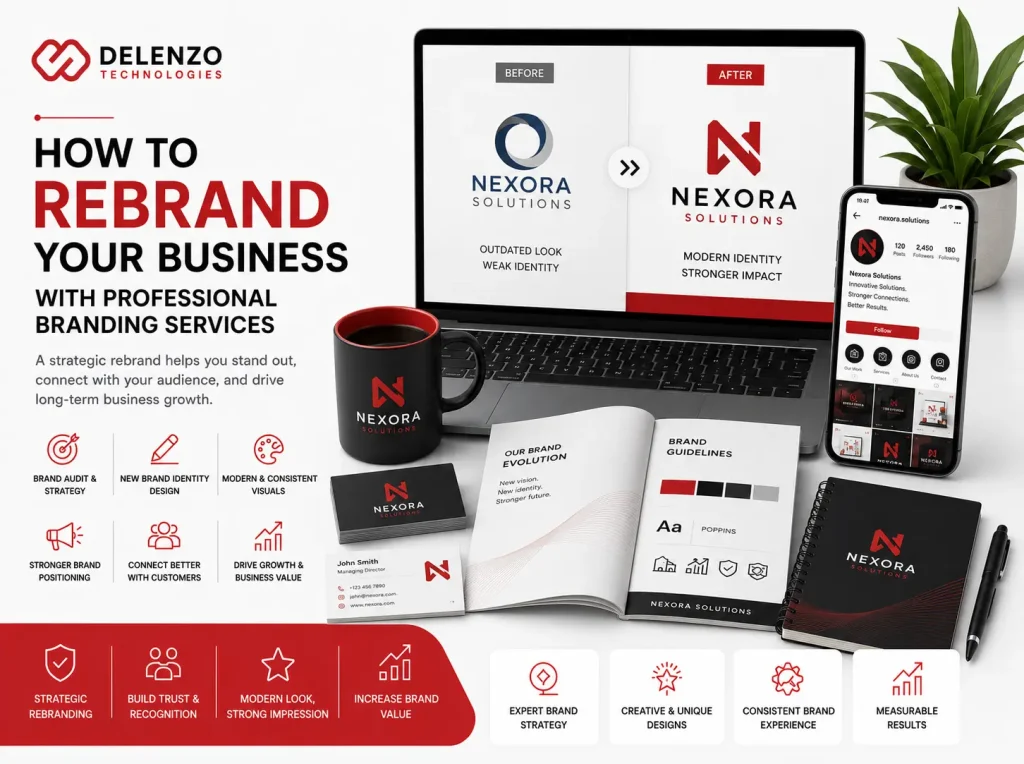
Rebranding your business is not about picking a new logo you like better. It is a strategic reset that changes how customers see you, trust you, and choose you over competitors. Get it wrong and you confuse loyal customers. Get it right and you unlock growth you could not reach under your old identity.
Think about a local Dallas landscaping company that started small, mowing lawns for neighbors. Five years later, it manages full commercial property contracts. Its old logo, a cartoon lawnmower, no longer matches the work it does. Commercial clients see that logo and assume the company is too small for their contracts. This is exactly the gap a rebrand is meant to close.
This guide walks through what a real rebrand involves, when it makes sense, what it costs, and how to avoid the mistakes that waste both time and budget.
What rebranding actually means (and what it is not)
A rebrand is a deliberate shift in how your business looks, sounds, and positions itself in the market. It touches strategy, messaging, and visual identity together. It is not a cosmetic swap you do because you are bored with your colors.
Real rebranding starts with clarity about your business, not with design preferences. It means identifying exactly who you serve now and checking whether your current identity communicates that clearly. When the answer is unclear, strategy needs to come before any visual work begins. Businesses that skip this step often end up redoing the work within a year.
Full rebrand vs. brand refresh
A full rebrand rebuilds your positioning, name, and identity from the ground up. It usually happens after a merger, a major pivot, or years of positioning that no longer fits. A brand refresh is lighter. It updates visuals and messaging while keeping your core positioning intact. Most businesses need a brand refresh, not a full rebrand. Choosing the wrong scope wastes money and confuses your audience unnecessarily.
Logo update vs. identity overhaul
A logo update changes one asset. An identity overhaul rebuilds your entire visual identity design system, including typography, color palette, imagery style, and brand voice. A new logo alone rarely fixes a positioning problem. If customers misunderstand what you do, a logo swap will not solve that. The confusion usually lives in messaging, not in the shape of an icon.
When should you rebrand? 5 real triggers that justify the investment
Not every business needs a rebrand. Timing matters as much as execution. A rebrand done too early wastes money, and one done too late costs missed customers. Here are five real signals worth acting on.
Your brand no longer reflects what your business does
A bakery that now offers full event catering looks mismatched with a logo built for cupcakes. When your services evolve past your original identity, customers notice the gap. New prospects form judgments within seconds of landing on your site or storefront. This is one of the clearest signs it is time for rebranding your business.
You are entering a new market or audience
A brand built for local homeowners will not automatically resonate with commercial clients. Entering a new market often means adjusting tone, visuals, and messaging to match new buyer expectations. Skipping this step slows adoption in the new segment.
A merger, acquisition, or leadership change
Combining two companies under one identity requires more than picking a favorite logo. It requires a strategy that respects both customer bases. Leadership changes often bring new vision too, which naturally pushes brand evolution forward. A new owner who inherits an outdated identity often finds it easier to invest early rather than patch problems later.
Your visual identity is genuinely dated or confusing
Faded colors, outdated fonts, and inconsistent logos across platforms signal neglect to customers. A dated identity can quietly cost you credibility, especially against newer competitors with sharper design. Small business owners often underestimate how much a tired logo affects first impressions online.
You outgrew your original positioning
A business that started as a budget option but now competes on quality needs messaging that reflects that shift. Staying quiet about growth keeps you boxed into an old perception customers already have. Positioning should evolve at the same pace your business does, not years behind it.
What professional branding services include in a rebrand
Professional branding services cover far more than design work. A real rebrand moves through several connected stages, each building on the last. Understanding each stage helps you evaluate whether a design partner is offering a complete process or just a logo package.
Brand audit
Every serious business rebranding process starts with an honest audit. This reviews your current messaging, visuals, customer perception, and competitive standing before any new work begins. A good audit often surfaces problems the business owner already sensed but never named clearly.
Market and competitive research
Understanding what competitors do well, and where they fall short, shapes smarter positioning decisions. Skipping research often leads to a brand that blends in instead of standing out. Research also reveals gaps competitors have left open, which a new brand can claim directly.
Brand strategy and positioning
This is the foundation. Brand strategy defines who you serve, what you promise, and why you are different. Every design decision afterward should trace back to this strategy directly. Without it, even beautiful design ends up saying nothing memorable about the business.
Visual identity redesign
This stage covers logo systems, color palettes, typography, and imagery guidelines. Strong visual identity design translates strategy into something customers instantly recognize and remember. A consistent system also makes future marketing materials faster and cheaper to produce.
Verbal identity and messaging
Your brand voice, taglines, and core messaging need to match your new visual identity. Mismatched tone and visuals confuse audiences even when both look polished individually. A playful logo paired with stiff corporate copy sends conflicting signals to customers.
Brand guidelines
A finished brand needs documented rules covering logo usage, color codes, spacing, and tone. These guidelines keep your branding and identity design consistent across every team and vendor you work with. Without them, small inconsistencies creep in within months of launch.
Rollout and implementation support
A rebrand is only useful once it is live everywhere customers interact with you. Implementation support covers website updates, social profiles, signage, packaging, and internal communication. A phased rollout plan reduces confusion and keeps operations running smoothly during transition.
Rebranding checklist: every touchpoint that needs updating
A rebrand touches more assets than most business owners expect going in. Missing even a few touchpoints creates inconsistency that undermines the whole effort. Use this checklist to track what needs updating during your launch.
- Website design, navigation, and metadata
- Logo files across all formats and sizes
- Social media profiles, covers, and templates
- Business cards, letterhead, and print collateral
- Email signatures and marketing templates
- Signage, vehicle wraps, and physical locations
- Packaging and product labeling, if applicable
- Google Business Profile and directory listings
- Internal documents, presentations, and proposal templates
- Legal documents and domain or trademark filings
Assign an owner to each category before launch day. A single point of accountability prevents assets from slipping through unnoticed during a busy transition.
Common rebranding mistakes that waste time and money
Most rebrand failures trace back to a handful of repeated mistakes. Avoiding these protects both your budget and your timeline. Business owners who plan carefully around rebranding your business rarely run into these same problems twice.
- Starting with design before strategy. Jumping straight to logo concepts without defined positioning leads to visuals that look nice but say nothing useful. Teams end up reworking the logo later once real strategy finally surfaces.
- Rebranding in response to short-term performance problems. A slow sales quarter is rarely a branding issue. Fix operational problems before spending on identity work, or the new brand inherits the same underlying issue.
- Changing the domain unnecessarily. A new domain can erase years of search rankings and backlinks. Keep it unless the old one actively hurts your brand or no longer matches your business name.
- Announcing without explaining. Customers feel disoriented when a familiar brand changes overnight with no context. A short explanation builds trust during transition and reduces confused customer service messages.
- Skipping the internal launch. Employees representing your brand daily need to understand the change before customers do. Internal buy-in prevents mixed messaging across sales calls and support conversations.
- Thinking the brand guidelines are the deliverable. Guidelines are a tool, not the finish line. The real deliverable is consistent execution across every touchpoint, month after month.
- Cutting the brand audit to save time. Skipping the audit means building a new strategy on assumptions instead of evidence, which often backfires later and forces a costly second round.
How much does rebranding cost with professional services?
Professional rebranding costs vary enormously by scope and provider. Here is a realistic breakdown for 2026, based on estimates gathered from published industry pricing sources.
| Scope | Investment Range | What is typically included |
| Logo refresh only | $500 to $3,000 | Updated logo, minor color and font adjustments, basic usage guide |
| Brand refresh | $3,000 to $12,000 | Refined visual identity, updated messaging, light strategy work, core templates |
| Full small business rebrand | $8,000 to $25,000 | Brand audit, strategy, full visual identity, guidelines, rollout support |
| Mid-market full rebrand | $25,000 to $75,000 | Deep research, competitive analysis, complete identity system, multi-channel rollout |
| Enterprise rebrand | $75,000 to $250,000+ | Extensive research, multi-market strategy, full asset production, change management |
These figures are illustrative estimates meant to guide budgeting conversations, not fixed quotes. Actual pricing depends on business size, industry, and how many touchpoints need updating.
Small and growing businesses usually fall into the brand refresh or full small business rebrand ranges. Paying for enterprise-level scope when a lighter refresh would work only inflates cost without adding value. A good design partner will recommend the smallest scope that solves your actual problem, not the biggest package available. Ask any provider for a clear breakdown of deliverables before signing, so there are no surprises once work begins.
How Delenzo Technologies supports business rebranding
Delenzo Technologies provides brand identity design services that cover the full scope of what a professional rebrand requires, from discovery and strategy through visual identity design, brand guidelines, and rollout support.
The process starts with understanding why the rebrand is needed and what success looks like, not with opening design software. That foundation shapes every decision: the logo system, the graphic design and branding services applied across channels, the social media design templates, the print design collateral, and the UI/UX design work that brings the rebrand to life on digital surfaces.
Businesses that need a trusted design partner, not just a logo file, find that fit with Delenzo Technologies. The team works closely with small and growing businesses across Dallas and the United States. They translate new strategy into design that holds up across every channel customers use.
Final Thoughts
Rebranding your business is a serious decision, not a quick design refresh. It works best when strategy leads, research informs, and execution stays consistent across every touchpoint. A rebrand done well should feel obvious in hindsight, like the business finally looks like what it actually is.
Whether you need a light brand refresh or a full identity overhaul, getting the sequence right protects your investment and your customer relationships. Delenzo Technologies partners with growing businesses through every stage of that process, so the rebrand actually holds up once it goes live, on the website, on social channels, and everywhere else customers form their first impression.
Let’s Talk About Your Project
Have a project in mind? Get in touch with Delenzo Technologies and let’s discuss your requirements.
Contact UsFrequently Asked Questions
A business should rebrand when its current identity no longer aligns with its vision, audience, or market positioning. Key triggers include major business shifts, mergers, acquisitions, outdated visuals, or a damaged reputation.
A brand refresh updates visual elements like logos, fonts, and colors while keeping your core identity intact. A full rebrand rebuilds your business foundation, changing core identity, target audience, and market positioning.
Professional branding services include a brand audit, competitive research, brand strategy, visual identity design, messaging, brand guidelines, and rollout support across every customer touchpoint your growing business relies on daily.
A full rebrand typically takes two to four months, depending on scope and approval speed. A brand refresh moves faster, often completing within four to six weeks with the right team in place.
How do I protect my SEO when rebranding?
Keep your existing domain if possible, use 301 redirects for changed URLs, update metadata carefully, and preserve backlinks. Announce changes to Google Search Console early to avoid unnecessary ranking drops.