


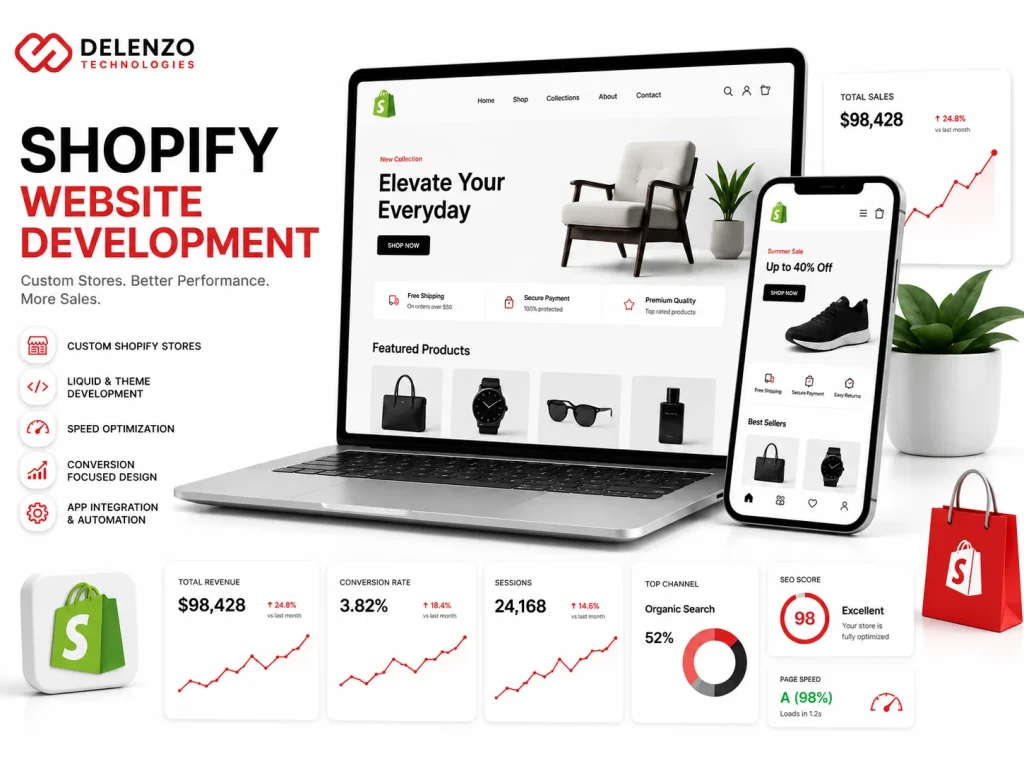
You already chose Shopify. That was the easy part. Turning it into a store that loads in under two seconds, ranks on Google, and converts browsers into buyers is the hard part. That is where professional shopify website development changes the outcome. Maybe you are launching a new storefront. Maybe you are migrating from WooCommerce or Magento, or fixing a slow theme that bleeds sales. Either way, build quality decides your growth ceiling. We work with US businesses that have outgrown templates and need real engineering. The goal is simple: a store that earns more than it costs to run.
This guide breaks down scope, real 2026 costs, safe migration, conversion design, and what actually moves revenue. Read it before you sign a single contract.
What’s Included in Professional Shopify Website Development Services?
Professional Shopify development covers far more than installing a theme. A complete Shopify website development service includes design, configuration, and custom coding that work together as one system.
A full-scope engagement usually includes:
- Custom theme development or deep theme customization
- Product, collection, and variant setup with clean metafields
- Payment gateway and tax configuration for US sellers
- On-page SEO setup, schema markup, and clean URL structure
- Core Web Vitals and full-page speed optimization
- Custom functionality through trusted apps or bespoke code
Scope is what separates a store that sells from a store that simply exists. Cheaper builds skip SEO, speed, and QA, then cost more to fix later. A clear scope also sets expectations on both sides, so nothing important gets cut at the end. Here is how scope typically shifts by build tier.
| Build Component | Standard Setup | Professional Build | Custom Development |
| Theme | Pre-built theme install | Customized theme | Bespoke, coded from design |
| Product setup | Basic catalog | Structured with metafields | Advanced variants and logic |
| SEO | Minimal | Full on-page and schema | Technical SEO and content plan |
| Speed | As-is | Optimized | Engineered for Core Web Vitals |
| Custom features | None | Selected apps | Custom-coded functionality |
The Core Architecture: Online Store 2.0, Liquid Customization & App-Lean Engineering
Shopify Online Store 2.0 is a flexible theme architecture that lets merchants edit page layouts without touching code. With shopify online store 2.0 liquid customization, we build sections and blocks your team can rearrange directly in the theme editor.
JSON templates let every page type carry its own modular layout. Merchants edit content in the theme editor, not the codebase. That independence keeps you off the developer’s calendar for small changes.
We also keep the store app-lean. Every installed app adds scripts, monthly fees, and potential slowdowns. Where an app duplicates what Liquid can do natively, we build it directly into the theme. Metafields and metaobjects let us store custom data without bolting on extra tools. Fewer apps means faster load times and lower ongoing cost. Clean architecture is the difference between a store that scales and one that cracks under traffic.
The Real 2026 Shopify Development Cost: US Pricing Matrix
Shopify website development cost 2026 starts at around $300 for a basic starter store and runs to $10,000+ for a custom build. The final figure depends on scope, design complexity, and integrations. US businesses deserve real numbers, not vague estimates, so here is the breakdown by project type.
| Package | Project Scope | Timeline | Typical US Cost |
| Starter Store | Standard theme, product setup, basic config | 1–2 weeks | $300–$1,500 |
| Growth Build | Custom theme, conversion features, SEO | 3–6 weeks | $1,500–$5,000 |
| Custom Build | Bespoke features, integrations, custom code | 6–16 weeks | $5,000–$10,000+ |
| Migration | Replatform with data and SEO transfer | 3–8 weeks | $2,000–$8,000 |
The lowest tier suits small businesses testing an idea or launching lean. Higher tiers add the SEO, speed, and QA that protect long-term revenue. Every quote should map to a written scope of deliverables. A cheap setup that skips testing rarely stays cheap once you pay to fix it.
SaaS Economics: Transaction Fees, App Stack Costs & Total Cost of Ownership
The build price is only part of ownership. Shopify is SaaS, so you pay monthly to operate the store.
Plans start around $39 per month and scale to Shopify Plus near $2,300 per month. On top of that sit app subscriptions and payment fees. If you do not use Shopify Payments, extra transaction fees stack on every order.
The line item most owners miss is shopify hidden app subscription costs. A store running fifteen apps can quietly spend $300 to $800 monthly before a single ad runs. We audit every app for real return and remove the dead weight.
Total cost of ownership is platform fees, apps, payment processing, and maintenance combined. The smarter long-term play is fewer apps and cleaner code, which lowers monthly overhead. Budget for the full picture, not just the launch invoice.
The Safe Migration Protocol: Moving Products, Customers & SEO Equity to Shopify
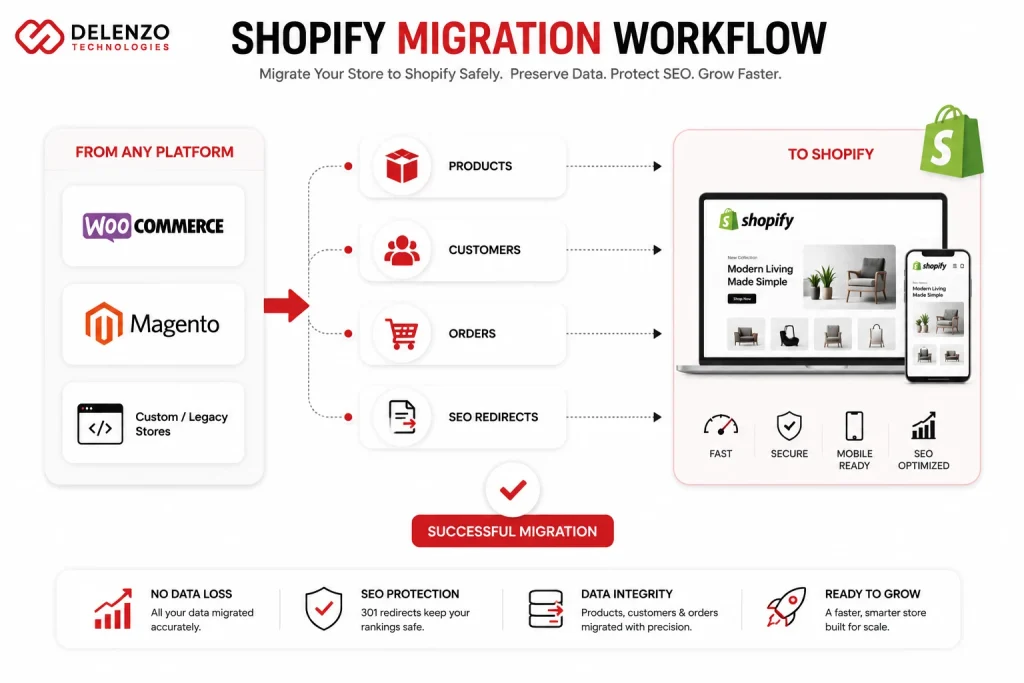
A safe Shopify migration moves your products, customers, and SEO equity without losing rankings. Done wrong, you can erase years of search authority overnight. The protection comes from preserving every URL during the move.
A safe migration follows a strict sequence:
- Export and clean product, customer, and order data first.
- Map every old URL to its new Shopify equivalent with 301 redirects.
- Recreate metadata and validate structured data before launch.
- Keep the old site live until the new store is fully verified.
- Run a post-launch crawl to catch any missed redirect or broken link.
As an experienced shopify product migration agency, we handle each step and test redirects against real URLs before go-live. Customer accounts, passwords, and order history transfer intact, so returning buyers never hit a broken page. Protecting organic traffic through the move is not optional, it is the point.
Checkout Extensibility: Building High-Converting Checkouts Without Code Bloat
Shopify replaced old checkout.liquid edits with a safer, upgrade-proof system. Modern shopify checkout extensibility 2026 uses UI extensions and Shopify Functions instead of fragile custom code.
This lets us add upsells, trust badges, custom fields, and shipping logic without breaking future updates. The checkout stays fast and PCI compliant.
We also handle tracking compliance correctly. Server-side events and the customer events API keep conversion data accurate without heavy scripts. This protects your ad reporting even as browser privacy rules tighten. A cleaner checkout reduces friction at the exact moment buyers decide.
Every extension must earn its place. Baymard Institute finds the average large store can lift conversions by about 35% through better checkout design. Code bloat at checkout costs conversions, so we test each change against real funnel data before it ships.
What Makes a Shopify Store Convert Visitors Into Customers?
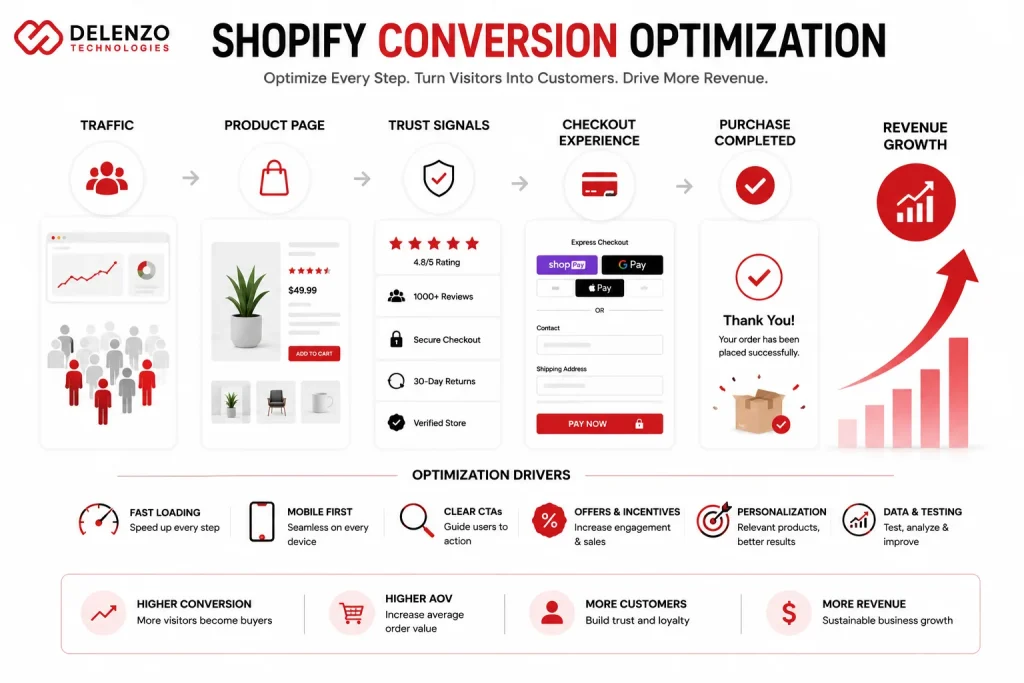
A good-looking store does not automatically sell. Shopify conversion optimization aligns design, speed, trust, and navigation toward one goal: completed purchases.
Most abandoned carts trace back to slow pages, unclear navigation, weak trust, or clumsy mobile flows. According to Baymard Institute, roughly 70% of online carts are abandoned before purchase. Each of these is fixable with the right build. Fixing them lifts revenue without spending more on ads, which improves margins on every order. The next three areas drive the biggest gains.
Product Pages That Increase Conversions
The product page is where the decision happens. Strong shopify product page optimization combines clear images, social proof, and persuasive copy.
We use high-quality images with zoom, multiple angles, and lifestyle context. Reviews and ratings sit near the buy button to build confidence. A short FAQ answers objections before they stall the sale. Trust badges and clear shipping details remove last-minute doubt. Descriptions focus on benefits, not just specs. Every element should earn the click on Add to Cart.
Mobile Commerce & Responsive Design
Most Shopify traffic is mobile, so we design for the phone first. Effective mobile shopify optimization means thumb-friendly buttons, fast images, and a checkout that finishes in seconds.
Responsive layouts adapt cleanly across screen sizes. Navigation stays simple, with search and filters that load instantly. We compress media and lazy-load below the fold to protect speed. Mobile checkout supports Shop Pay, Apple Pay, and Google Pay for one-tap buying. If it frustrates a thumb, it loses a sale.
Trust Elements That Reduce Cart Abandonment
Buyers abandon carts when they feel unsure. Clear shopify trust signals close that gap and recover lost revenue.
Verified reviews show real customers had good experiences. A visible return policy lowers perceived risk. Security badges and SSL signals reassure shoppers at checkout. Transparent shipping costs and delivery dates prevent surprise drop-offs. Baymard Institute reports that unexpected extra costs are the top reason for abandonment, cited by 48% of US shoppers. Easy access to support, through chat or a clear contact page, signals a real business stands behind every order. Even a simple FAQ and a visible phone number can lift checkout completion. Trust is what turns interest into payment.
Why Dallas Businesses Choose Local Shopify Development Agencies
Local partners bring advantages a distant freelancer cannot match. For Dallas and DFW merchants, proximity means real support in your timezone.
We configure Texas sales tax correctly from day one, including local rates and nexus settings. For brands with warehouses or 3PLs across DFW, shopify erp inventory sync dallas keeps stock accurate across systems in real time. No overselling, no manual updates.
Our shopify website development team works your business hours, so urgent fixes do not wait overnight. Same-region collaboration also makes strategy sessions and on-site discovery easier. You meet a team that understands the local market and your customers. When a sale is on the line, local support answers fast.
The Pre-Launch Checklist: Security, Payment Gateway Audits & Live Testing
Launching without a checklist invites costly errors. Our shopify pre launch checklist confirms the store is secure, fast, and ready for real orders.
Before go-live, we verify:
- Payment gateways with real test transactions and refunds
- 301 redirects from every old URL
- Core Web Vitals and full-page speed scores
- Mobile QA across iOS and Android devices
- SSL, security headers, and admin access controls
- Forms, emails, and order confirmations end to end
We also confirm analytics, pixels, and tax settings fire correctly. Every form and automated email is triggered once to prove it works. A store should never collect its first real payment as its first test. Careful launch QA prevents the silent revenue leaks that hide for weeks.
Ongoing Shopify Support: Protecting Speed, Security & Core Web Vitals
Shopify website maintenance cost typically runs $200 to $1,500 per month, based on store size and update frequency. Ongoing support covers Core Web Vitals monitoring, security patches, app performance reviews, and testing new releases before they touch your live store. A store is never finished at launch.
Platforms update, apps change, and performance drifts over time. The right plan scales with your catalog and order volume, so you pay for the coverage you actually need. That cost is small against the revenue a broken or slow store quietly loses.
Proactive maintenance keeps speed, security, and search rankings stable as you grow. It catches small issues before they turn into lost sales. A maintained store quietly compounds value, while a neglected one slowly leaks it.
Build a Shopify Store That Earns Its Keep
Shopify gives you the platform. Execution decides whether it grows. From architecture and migration to checkout, conversions, and ongoing care, the details compound into revenue. Skip the details, and even a great product struggles to sell.
At Delenzo Technologies, our Dallas-based team delivers shopify website development built for speed, search visibility, and conversions. We handle new builds, replatforming, and growth optimization for US businesses ready to scale. If you want a store engineered to perform, not just exist, we are ready to help.
Reach out to Delenzo Technologies today for a build that turns Shopify into your best-performing sales channel.
Frequently Asked Questions
An agency-built Shopify website typically takes 4 to 16 weeks, depending on project complexity. Simple stores launch faster, while custom themes, integrations, and migrations extend the timeline. Scope and content readiness most affect speed.
Hidden monthly Shopify costs include app subscriptions, payment transaction fees, and premium themes. A store running many apps can spend $300 to $800 monthly before advertising. Audit every app for real return.
Standard Shopify works for most small and mid-sized stores. Shopify Plus suits high-volume brands needing advanced checkout control, automation, and dedicated support. If you process heavy traffic or wholesale, Plus earns its cost.
Agencies make the ERP the single source of truth for inventory. The ERP manages actual stock and pushes live availability to Shopify through APIs or middleware. This real-time sync prevents overselling and manual updates.
Shopify developers in Dallas typically charge $50 to $150 per hour, or $300 to $10,000+ per project. Final pricing depends on scope, customization, integrations, and whether you need ongoing maintenance support.