



Digital marketing for ecommerce businesses works best as one connected growth system—not a collection of disconnected campaigns. In 2026, profitable stores match each channel to a specific bottleneck, improve conversion before buying more traffic, and measure contribution margin instead of celebrating revenue alone.
The short answer
Start with the constraint that is limiting revenue. Use SEO and paid search to capture existing demand, Meta and video to create demand, CRO to convert more visitors, and email or SMS to increase repeat purchases. Set the budget from your allowable customer acquisition cost (CAC), then track profit by channel.
Ecommerce is more competitive in 2026. Advertising costs are volatile, search results keep evolving, and buyers compare several stores before placing an order. Raising the ad budget without fixing the economics usually scales waste. This guide explains which channels drive ecommerce sales, how much to budget, how Shopify and WooCommerce affect execution, and what to measure when ROAS does not tell the whole story.
Which digital marketing channels drive ecommerce sales in 2026?
Six channels drive most online-store growth: ecommerce SEO, Google Ads, Meta Ads, email and SMS, conversion rate optimization (CRO), and content marketing. Each solves a different problem, so judging every channel by the same metric creates bad decisions.
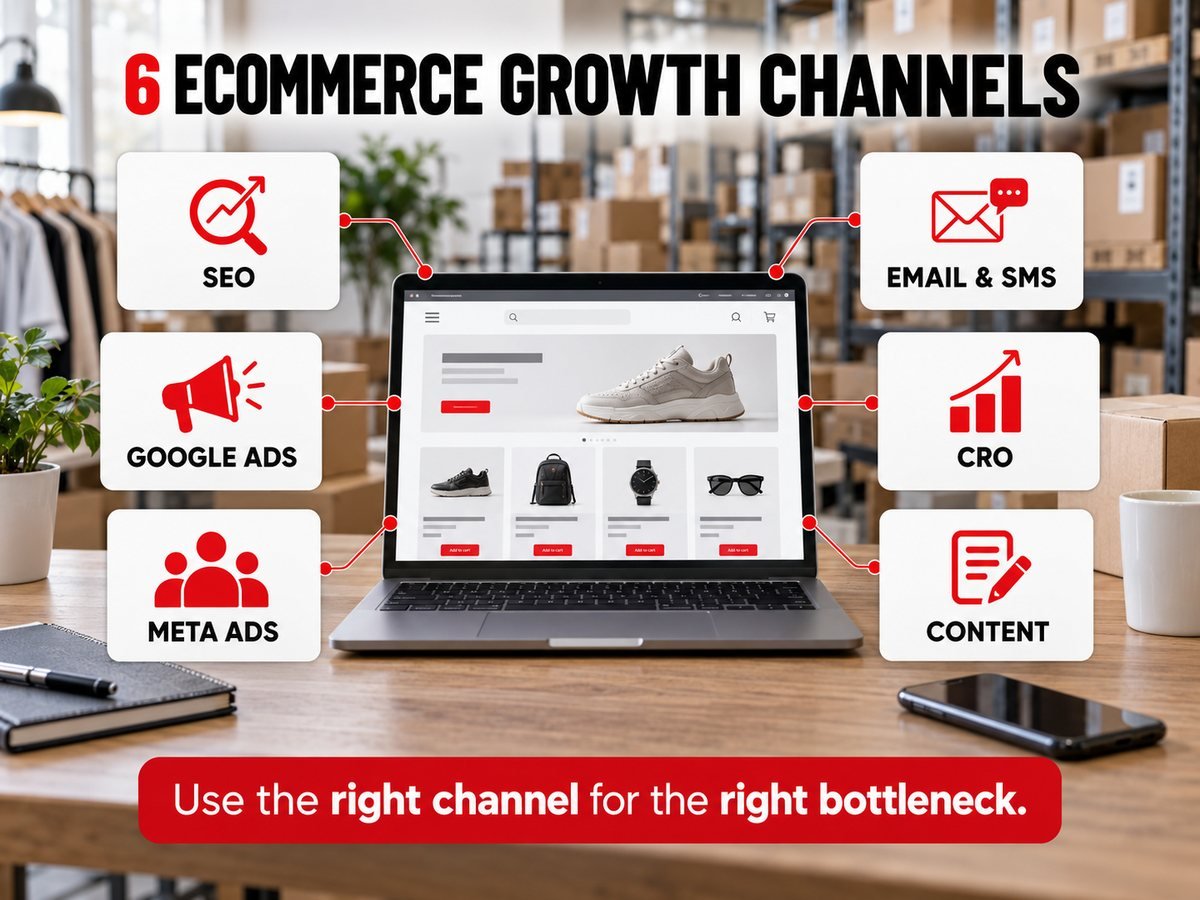
| Channel | Best for | Typical time to useful signal | Primary metric |
|---|---|---|---|
| SEO | Capturing demand that already exists | 3–6 months | Organic revenue |
| Google Ads | Reaching shoppers ready to buy | A few days | Contribution profit / CAC |
| Meta Ads | Discovery and new-customer acquisition | 1–2 weeks | New-customer CAC |
| Email and SMS | Repeat purchases and recovery | A few days | Revenue per subscriber |
| CRO | More sales from current traffic | 4–8 weeks | Conversion rate |
| Content | Trust and research-stage demand | 3–6 months | Assisted revenue |
Speed and cost often move in opposite directions. Paid media buys attention now, while SEO and content compound over time and can reduce blended acquisition cost. Email and CRO frequently produce the least expensive incremental revenue because they improve the value of traffic you already earned or paid for.
Most stores do not need all six channels at once. Two or three properly funded programs usually outperform six underfunded campaigns. If organic discovery is the priority, review Delenzo’s guide to choosing among the best SEO companies for small businesses and compare the reporting standards before hiring.
How to choose the right ecommerce marketing channels
Choose the first channel from your largest bottleneck—not from the platform your competitor appears to use. A simple decision framework gives every marketing dollar a job.
| Your situation | Start here | Why it works |
|---|---|---|
| New store with little data | Meta Ads + strong product pages | Buys traffic and learning quickly |
| People already search for the product | Google Ads + SEO in parallel | Captures existing purchase intent |
| Visual or lifestyle product | Meta Ads + short-form video | Creates demand before shoppers search |
| Customers reorder frequently | Email + SMS automation | The second purchase costs less than the first |
| Healthy traffic but weak sales | CRO + checkout fixes | Repairs the store before adding traffic |
| Rising acquisition cost | Retention + AOV work | Improves economics without chasing volume |
| Loyal customer base | Email, SMS + referrals | Activates an audience you own |
Fix one bottleneck before adding another channel. That focus makes attribution clearer and gives tests enough traffic and budget to reach a useful conclusion.
How much should an ecommerce business spend on digital marketing?
Many growth-stage stores plan roughly 8%–15% of revenue for marketing, but that is only a starting frame. The sustainable number depends on gross margin, average order value, repeat purchases, cash flow, and the speed of growth you want. A realistic 2026 plan separates five cost areas.
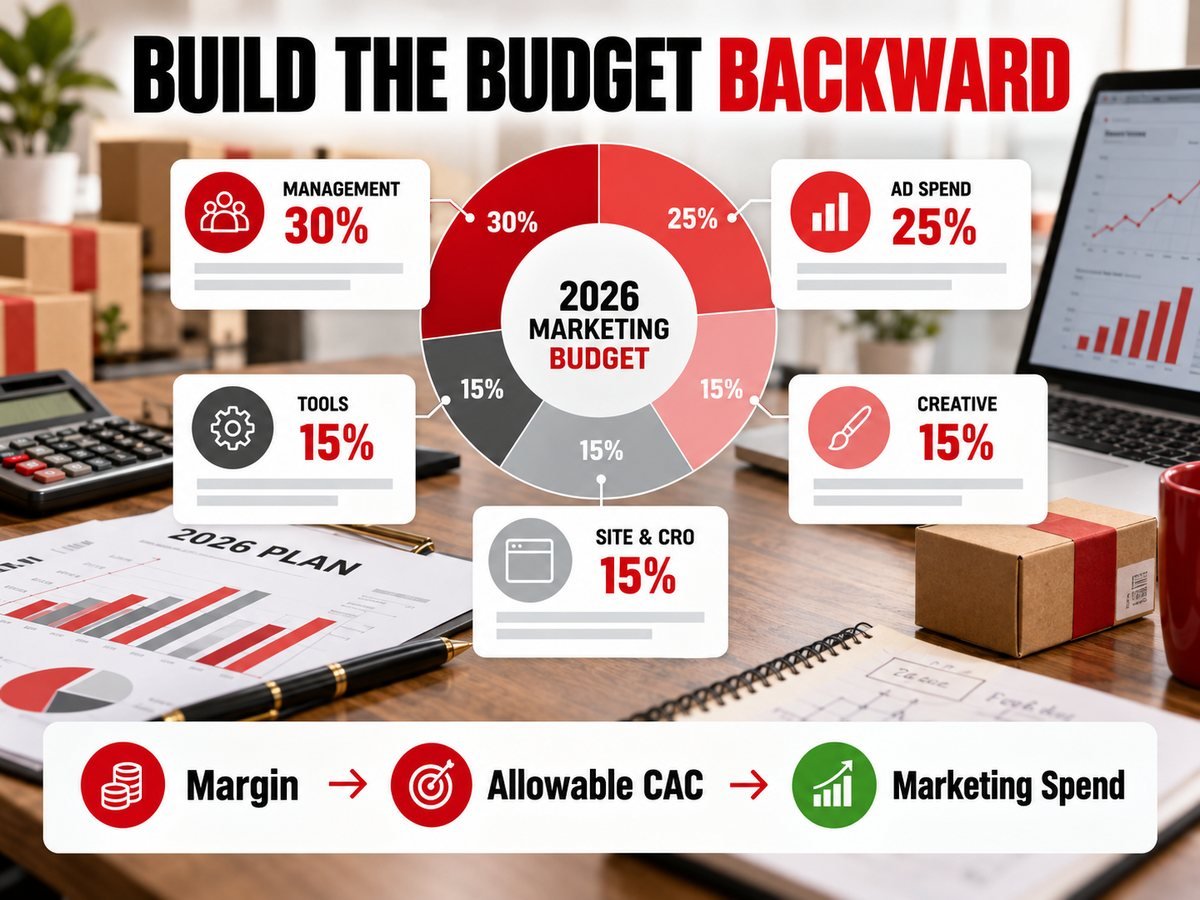
| Cost area | Planning range per month | What changes the number |
|---|---|---|
| Agency or in-house management | $2,000–$8,000 | Channel count and reporting depth |
| Paid media | $3,000–$30,000+ | CAC, AOV and growth target |
| Software and tools | $200–$1,500 | Store size, apps and analytics stack |
| Creative production | $500–$4,000 | Testing volume and video needs |
| Site and development work | $500–$3,000 | CRO tests, speed and feed work |
Margin sets the ceiling. A business with a 60% gross margin can support a higher acquisition cost than one at 25%. Early paid campaigns also buy learning, not only profit, so reserve a defined testing budget before judging the channel.
The safer method is to work backward: calculate contribution margin, choose the portion available for acquiring a customer, then set spend based on that allowable CAC. A budget selected first and justified afterward is how unprofitable campaigns get scaled.
How SEO, paid ads, social media and email work together
Traffic × Conversion Rate × Average Order Value × Purchase Frequency = Revenue
Each discipline changes a different variable. SEO and useful content grow qualified traffic through category pages, comparison pages and buying guides. Paid search sends high-intent shoppers to the most relevant product or collection page. Social creative introduces the product to people who were not yet searching. Site speed, layout and checkout flow improve conversion rate. Bundles and shipping thresholds increase AOV. Email and SMS lift purchase frequency after the first order.
The handoffs matter more than any isolated campaign. Ads that land on a slow product page waste money on every click. A strong website development and digital marketing foundation makes SEO, paid media and retention more efficient together.
How to increase ecommerce sales without increasing ad spend
You can increase revenue by improving conversion rate, order value and retention before purchasing more traffic. Consider a store with 50,000 monthly visitors, a 1.5% conversion rate and an $80 AOV. It produces 750 orders and $60,000 in revenue. Raising conversion to 2.5% produces 1,250 orders and $100,000 from the same traffic.

-
- Checkout: reduce steps, offer preferred wallets and show shipping costs early.
-
- Product pages: use sharp images, clear sizing, helpful reviews and honest delivery dates.
-
- Average order value: test bundles, sensible cross-sells and a profitable free-shipping threshold.
-
- Retention: build welcome, replenishment, post-purchase and win-back flows.
-
- Product feed: maintain accurate titles, attributes, inventory and pricing.
Feed quality is frequently overlooked. Google recommends combining product structured data with a Merchant Center feed to improve its understanding and verification of product information. Its official ecommerce product data guidance explains how the two sources work together.
Ecommerce marketing by business stage
The right strategy changes with revenue, data volume and team capacity. Planning by stage prevents smaller stores from copying tactics designed for brands spending ten times more.
| Monthly revenue | Focus on | Common mistake |
|---|---|---|
| Under $10K | One paid channel, product pages, three essential email flows | Spreading a small budget across five channels |
| $10K–$50K | Scale the winner, add SEO, begin CRO testing | Chasing new platforms before fixing conversion |
| $50K+ | Retention, attribution, incrementality and margin by channel | Judging every channel by last-click reporting |
Below $10,000 per month, breadth is usually the enemy. Choose one acquisition channel, improve the offer and collect permission to follow up. Between $10,000 and $50,000, scale proven campaigns while SEO begins carrying more demand. Above $50,000, measurement quality and profit allocation are often bigger constraints than traffic.
Shopify vs WooCommerce: what changes in the marketing strategy?
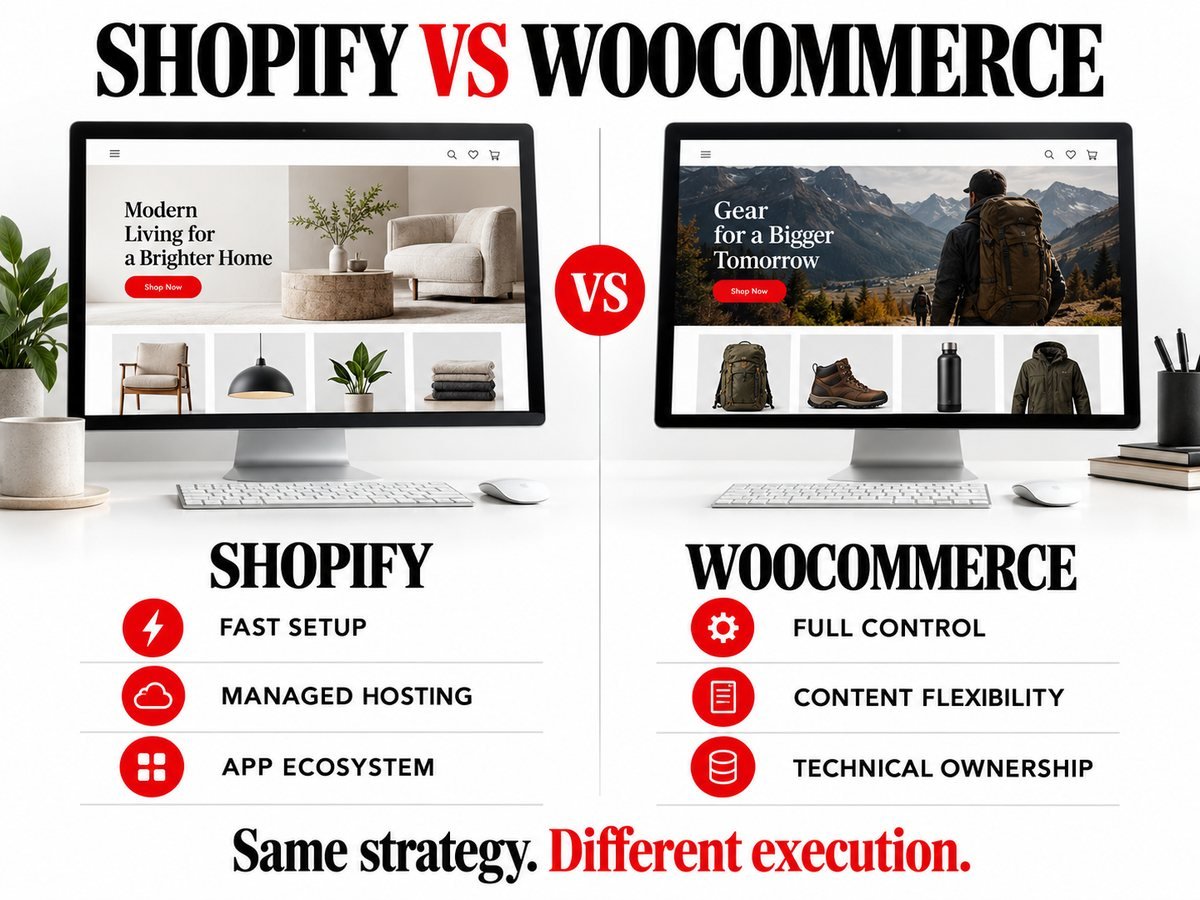
The strategy does not change: both platforms need qualified traffic, persuasive product pages, reliable tracking and retention. Execution changes because the operational friction sits in different places.
Shopify marketing considerations
Shopify manages hosting and much of the checkout infrastructure, allowing teams to focus on product feeds, lifecycle automation, creative testing and merchandising. The tradeoff is less control over some URL and template behavior. For planning costs, apps, migration and conversion architecture, read our 2026 Shopify website development guide.
WooCommerce marketing considerations
WooCommerce offers deeper control over site architecture, content and custom functionality. That flexibility benefits large catalogs and content-led strategies, but the business owns hosting, caching, security, updates and feed reliability. Technical SEO and Core Web Vitals require ongoing attention because slow pages weaken both paid and organic performance.
Neither platform wins for every store. Choose based on catalog complexity, internal skills, integration requirements and the amount of custom control the growth plan needs.
How to measure ecommerce marketing profitability beyond ROAS
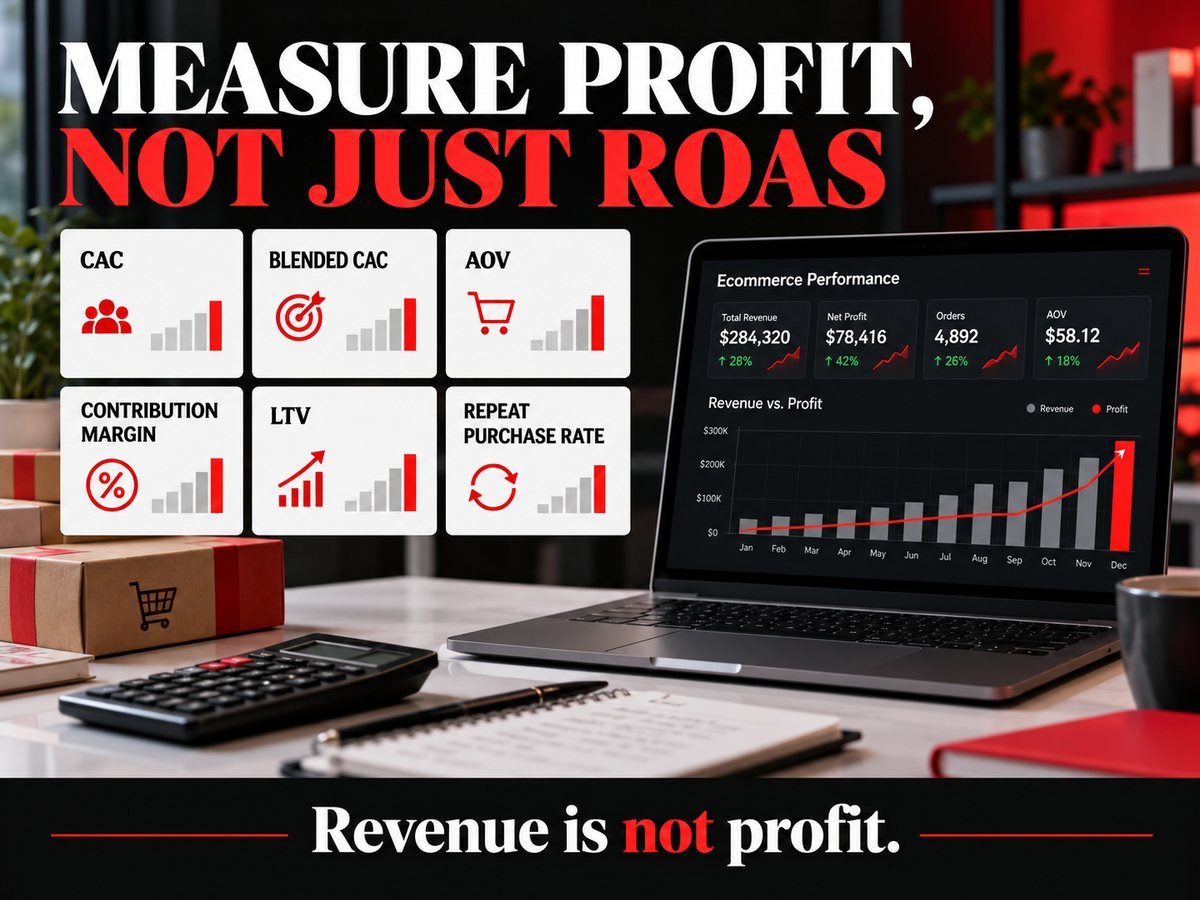
ROAS reports revenue per advertising dollar. It does not account for product cost, fulfillment, payment fees, discounts, returns, overhead or repeat purchases. A useful profitability view combines six metrics.
-
- CAC: total cost to acquire one new customer.
-
- Blended CAC: total marketing spend divided by all new customers.
-
- AOV: average revenue per order.
-
- Contribution margin: revenue remaining after product, fulfillment, payment and other variable costs.
-
- LTV: contribution profit generated by a customer over the relationship.
-
- Repeat purchase rate: the share of customers who buy again.
A 4× ROAS on a $100 order looks strong. But if product cost, fulfillment and fees consume 70%, only $30 remains. With a $25 CAC, the order contributes $5 before salaries, tools or overhead. A lower first-order ROAS may be healthier when margin and repeat purchase behavior are stronger.
Track contribution margin by channel and compare blended CAC with the CAC reported inside ad platforms. A widening gap can mean multiple platforms are claiming credit for the same customer.
A practical 2026 framework for Dallas ecommerce businesses
Online demand continues to expand. The U.S. Census Bureau’s Q2 2026 release estimated seasonally adjusted retail ecommerce sales at $340.2 billion—up 12.2% year over year—and ecommerce represented 17.1% of total retail sales. For Dallas–Fort Worth brands, a strong store can address local intent and national demand through the same system.
-
- Local SEO: build visibility for pickup, showroom and service-area searches across DFW.
-
- Paid search and Shopping: capture national purchase demand with accurate feeds and focused landing pages.
-
- CRO: improve product pages and checkout before materially increasing spend.
-
- Email and SMS: reduce blended CAC through repeat purchases and timely recovery flows.
-
- Profit reporting: use attribution, contribution margin and cohort retention to allocate budget.
Delenzo Technologies supports ecommerce brands from Dallas, TX, and across the USA. The approach starts with a store built to convert, then adds demand through the channels that fit the company’s margin and growth stage. Brands evaluating a broader digital foundation can also review our Dallas web design and development guide.
How to choose an ecommerce digital marketing agency
Judge an agency on economics, ownership and platform depth. Before signing, ask:
-
- How many ecommerce brands have you scaled, and at what revenue stages?
-
- How do you separate qualified sales from raw conversions?
-
- Will we own the ad accounts, pixels, audiences and analytics properties?
-
- Do reports include CAC, LTV and contribution margin?
-
- How do you decide which channels to run—and which to stop?
-
- Who has hands-on experience with Shopify or WooCommerce?
-
- What does the monthly CRO process include?
-
- What are the exit terms and asset-handover requirements?
If an agency only discusses ROAS, keep looking. A capable ecommerce partner connects spend to profit and treats the website, creative, acquisition and retention as one system.
Frequently asked questions
Is SEO worth it for ecommerce businesses in 2026?
Yes. Ecommerce SEO captures existing demand and can reduce blended acquisition cost over time. Meaningful movement often takes three to six months, depending on site health, competition, catalog size and content quality. Google’s ecommerce SEO guidance emphasizes crawlable site structure, product data and useful content.
How much does digital marketing for ecommerce cost in 2026?
Many growth-stage brands use 8%–15% of revenue as an initial planning range. The budget should include management, media, software, creative and website work, then be validated against gross margin and allowable CAC.
Are Google Ads effective for ecommerce businesses?
Yes, especially when shoppers already search for the product. Results can appear quickly, but profitability depends on feed quality, landing-page relevance, conversion rate, margin and repeat purchases.
Does the strategy change between Shopify and WooCommerce?
The revenue strategy stays the same; implementation changes. Shopify simplifies hosting and many operational tasks, while WooCommerce gives greater control and greater technical responsibility.
Can a Dallas ecommerce agency serve businesses across the USA?
Yes. Campaigns, reporting and store optimization operate online, so a Dallas-based team can manage nationwide acquisition and retention while still offering local collaboration.
Ready to grow your ecommerce store in 2026?
Check conversion rate, AOV and repeat purchase rate before increasing the ad budget. If two of the three are weak, more traffic will not solve the problem. Get an ecommerce growth plan built around your margin, platform and stage.