


Searching for a website development company near me in Dallas seems simple—until dozens of agencies make the same promises. The right partner should offer more than a polished portfolio: you need clear pricing, a suitable platform, reliable support, and full ownership of your website.
This guide explains what to look for, realistic Dallas website development cost ranges, platform options, hiring questions, and the ownership details to confirm before you sign. If you are planning the broader project, start with our complete Dallas web design and development guide.
Quick answer: how do you choose?
Shortlist companies with relevant work, a documented process, transparent pricing, measurable performance standards, and a written ownership-transfer clause. Then compare the proposed platform and support plan—not just the initial price.
What Should You Look for in a Dallas Website Development Company?
Review these seven factors before you shortlist a Dallas website development company:
- Portfolio relevance: Look for live websites in your industry, not only attractive mockups. A restaurant portfolio says little about ecommerce capability.
- Technology fit: Ask which platform the team recommends and why. A company that builds everything one way may recommend its preferred tool instead of the best fit.
- Post-launch support: Updates, backups, security patches, monitoring, and small edits should be defined in writing.
- Pricing transparency: A useful proposal separates strategy, design, development, content, testing, and ongoing costs. A single-line quote can hide scope gaps.
- Process clarity: The company should explain each project stage, approval point, and deliverable before you sign.
- Communication structure: Request one named contact and a regular check-in schedule.
- Ownership policy: Your business should control the domain, hosting, CMS, analytics, search tools, and source files.
Ranking well for a local search proves an agency can market itself; it does not prove how it will manage your project. Ask how the team measures mobile usability, conversions, and Core Web Vitals. Google defines these metrics around loading performance, responsiveness, and visual stability.
How Much Does Website Development Cost in Dallas, TX?
As a planning estimate, many Dallas website projects fall between $2,500 and $15,000. A custom application can cost more. The final price depends on scope, platform, integrations, design complexity, content readiness, and timeline.
| Project type | Planning range | What it usually covers |
|---|---|---|
| Basic brochure website | $2,500–$5,000 | 5–10 pages, template-based design, contact forms |
| Custom business website | $5,000–$9,000 | Original design, custom pages, blog, foundational SEO |
| Ecommerce store | $8,000–$15,000 | Product catalog, payments, shipping, inventory setup |
| Custom application or portal | $15,000+ | User accounts, dashboards, databases, integrations |
What affects website development pricing?
- Scope: Page count, content volume, and unique templates directly affect hours.
- Platform: WordPress often costs less than a fully custom build. Shopify is a practical middle ground for many product businesses.
- Design complexity: Template adjustments cost less than original layouts, illustration, motion, and complex interactions.
- Integrations: CRM, booking, payment, inventory, and marketing systems add development and testing.
- Timeline: Rush projects may require overlapping specialists and additional coordination.
- Team structure: A larger agency carries more overhead but may provide dedicated design, development, QA, and project management.
Dallas agency rates vary widely. Ask whether each proposal is fixed-price or hourly, what assumptions it includes, and which changes trigger additional fees. Compare the same scope across vendors.
Which Website Platform Does Your Business Need?
Match the platform to how your business operates. The wrong platform often costs more to replace than it saved at launch.
| Platform | Best fit | Planning range | Typical timeline |
|---|---|---|---|
| WordPress | Service businesses, blogs, content-led sites | $2,500–$9,000 | 4–8 weeks |
| Shopify | Product sellers wanting managed hosting and checkout | $8,000–$13,000 | 5–10 weeks |
| WooCommerce | Stores needing flexible rules or an existing WordPress stack | $8,000–$15,000 | 6–12 weeks |
| Custom development | Portals, workflows, or applications with unusual logic | $15,000+ | 12+ weeks |
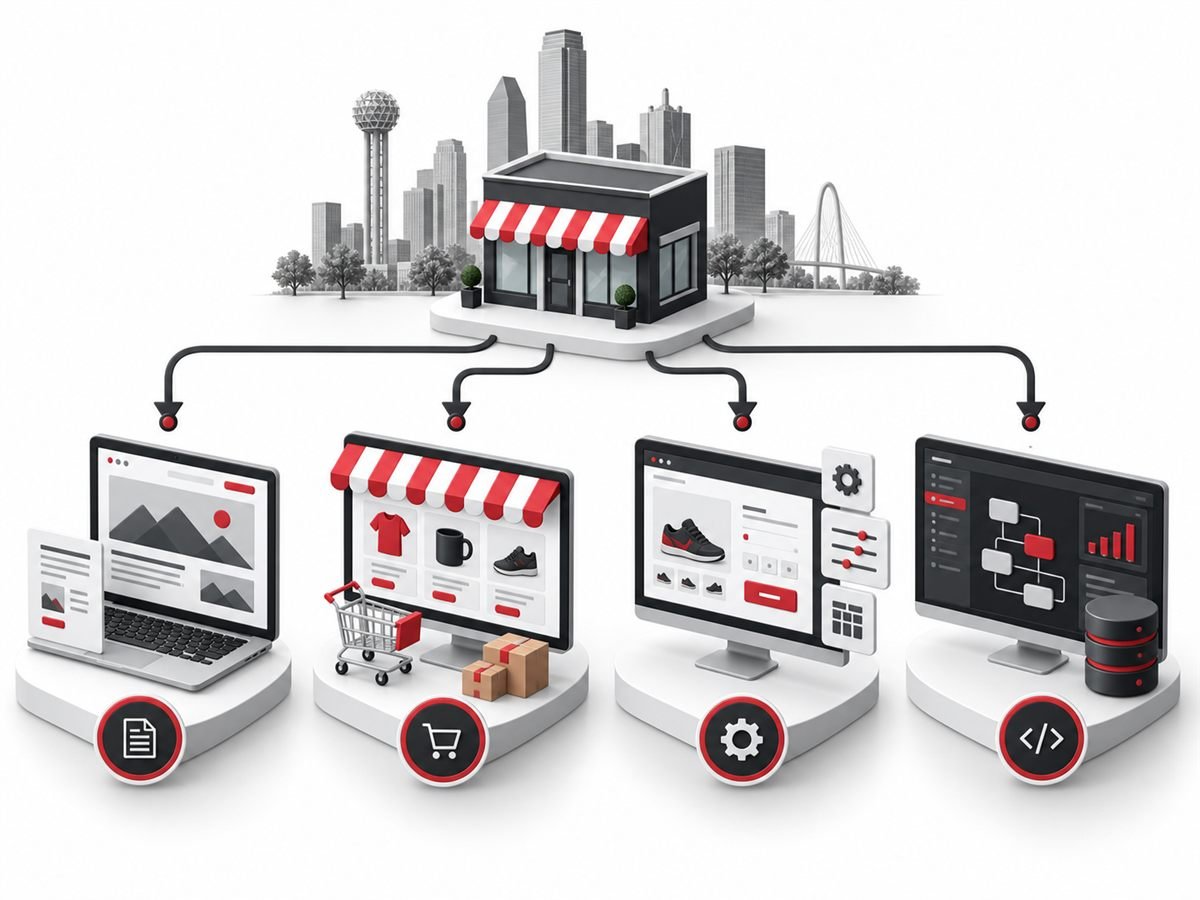
Choose WordPress when content and lead generation drive the business. Choose Shopify when selling products is the main job. Choose WooCommerce when you need greater control over catalog and pricing rules. Choose custom development only when established platforms cannot support your essential workflow. For a deeper comparison, read custom website development cost guide and our Shopify development guide.
Dallas Agency vs. Freelancer vs. Remote Team
There is no universally correct choice. The best model depends on budget, complexity, communication needs, and risk tolerance.

| Aspect | Dallas agency | Freelancer | Remote team |
|---|---|---|---|
| Availability | Same time zone; in-person meetings possible | Flexible, but dependent on one person | Meetings may follow another time zone |
| Cost | Higher; includes management and overhead | Often lowest | Mid-range; varies by region |
| Capacity | Designer, developer, QA, project manager | One person may cover every role | Full team; coordination happens remotely |
| Accountability | Contract, business entity, local reputation | Depends on the individual | May be harder to enforce across borders |
A freelancer can be a strong choice for a focused, simple site. A remote team suits buyers who can manage detailed specifications. A local agency costs more but can provide broader capacity, face-to-face collaboration, and a business reputation tied to the Dallas market.
Website Development for Dallas Small Businesses
Small businesses need focused websites that load quickly, earn trust, and produce leads or sales. Ask for relevant portfolio proof because each industry has requirements that a generic template can miss.
Ecommerce website development
Ecommerce projects need well-structured product data, variants, inventory, shipping zones, taxes, payment setup, and reliable analytics. Checkout speed and usability matter more than decorative homepage effects. Product schema and abandoned-cart recovery should be discussed during scoping. Review our guide to ecommerce website design costs before comparing proposals.
Medical and healthcare websites
Healthcare websites may need appointment booking, secure form handling, clear privacy practices, and accessible content. The W3C accessibility guidance provides a recognized technical standard. Data handling should also be reviewed with qualified legal and compliance professionals: the HHS HIPAA Privacy Rule applies to protected health information handled by covered entities and certain partners. Ask where submissions are stored, how they are transmitted, and who can access them.
Law firm and legal websites
Legal websites rely on trust and local visibility. Practice-area pages, attorney profiles, credentials, permitted case results, and consultation paths should be easy to find. Each major service generally deserves a focused page aligned with how prospective clients search.
Questions to Ask Before Hiring a Website Development Company
- Who owns the domain, hosting account, website, and source files after launch?
- What post-launch support is included, and for how long?
- How are technical SEO, redirects, analytics, and tracking handled during development?
- How many revisions are included, and when do extra fees begin?
- Can you show live work in my industry and explain your contribution?
- What is the payment schedule, and which deliverable is tied to each milestone?
- Who manages the project day to day, and how often will we communicate?
- How are future changes, maintenance, and emergency fixes priced?
Get every answer in the proposal or contract. Clear agencies explain tradeoffs in plain language. Evasive answers about ownership, scope, or support are serious warning signs.
What Does the Website Development Process Include?
- Discovery: Document business goals, audiences, sitemap, content, features, and success measures.
- Design: Review wireframes first, then approve visual designs for key page types.
- Development: Build the approved pages, forms, functionality, and integrations.
- Quality assurance: Test devices, browsers, forms, links, accessibility basics, analytics, and performance.
- Launch: Configure hosting, redirects, analytics, Search Console, security, and backups before announcing the site.
- Support: Continue updates, monitoring, backups, and agreed content changes after launch.
A written stage-by-stage timeline keeps the project aligned. SEO should be part of planning and QA—not an afterthought. If you are replacing an existing site, use a documented migration plan such as the one in our website redesign and SEO guide.
What Should You Own After Your Website Is Built?
Your business should own or control every essential account and asset. Confirm the handover clause before paying a deposit.
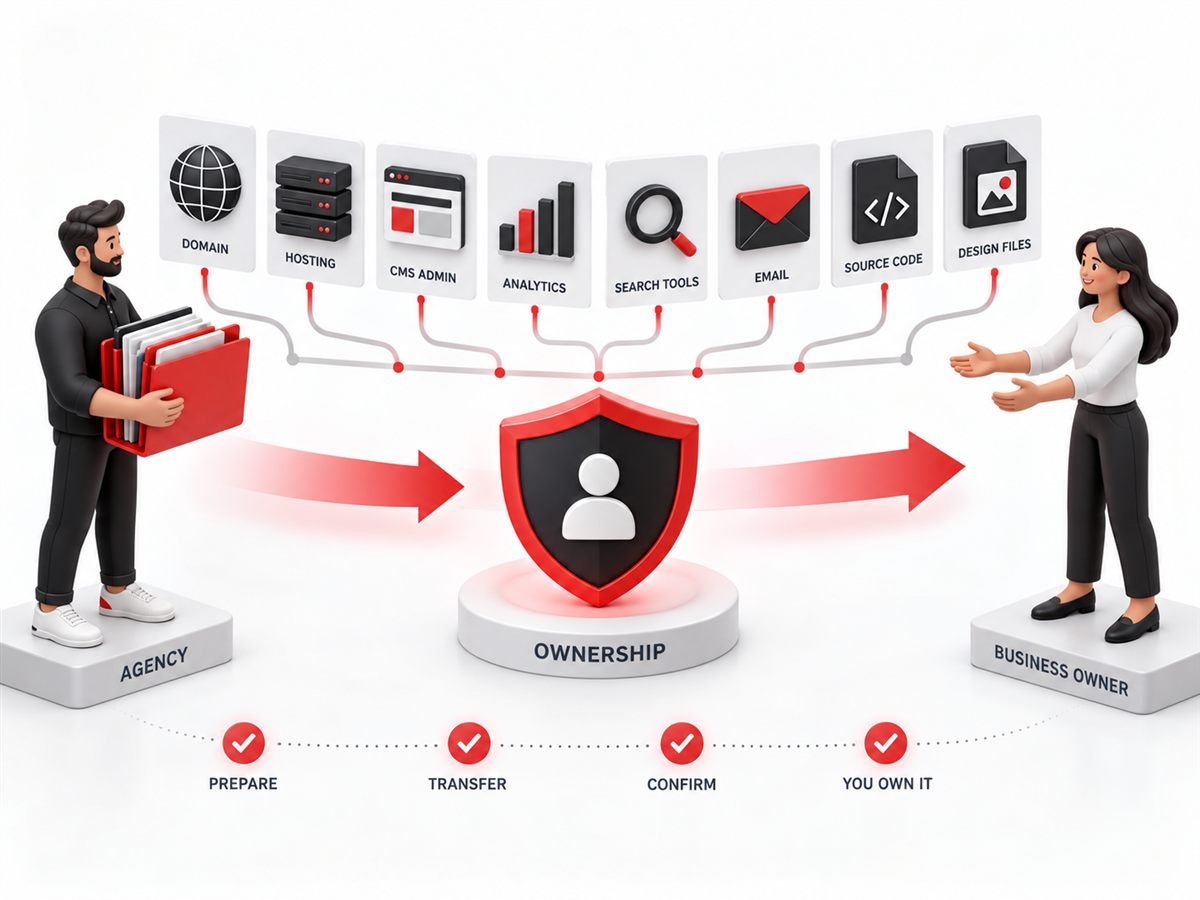
- Domain: Registered in the business name with registrar access controlled by the business.
- Hosting: Transferable on request, with billing and administrative access clearly documented.
- CMS: Full administrator access—not only an editor account.
- Analytics: The property belongs to the business account, with the agency added as a user.
- Google Search Console: Verified under the business account.
- Business email: Controlled through the company’s own workspace.
- Source code and design files: Delivered through a repository or archive at project close.
- Licenses: Ownership, renewal dates, and ongoing fees documented for themes, plugins, fonts, and stock assets.
Bundled hosting can be convenient, but the account and site must be transferable. You should never discover an ownership restriction only when you want to change providers.
How to Avoid Expensive Website Development Mistakes
- No written contract: Email threads are not a complete scope. Use a signed agreement with deliverables, responsibilities, timelines, and acceptance criteria.
- Vague scope: Define page counts, unique templates, integrations, content responsibilities, and revision limits.
- No ownership clause: Make account and asset transfer explicit.
- No support plan: Websites need updates, backups, monitoring, and security maintenance after launch.
- Agency-owned domain: Keep registration in your business name.
- Full payment upfront: Milestone payments give both sides clear delivery checkpoints.
- No content plan: Decide who writes, reviews, and approves copy before design begins.
Ask what happens if you choose to leave. A professional provider can explain export, handover, and transition steps without drama. Ongoing upkeep should also be planned; see why website maintenance matters.
Working With Delenzo Technologies in Dallas
Delenzo Technologies builds WordPress, Shopify, WooCommerce, and custom websites for small businesses in Dallas and across the United States. Our recommendation follows the project’s goals, workflow, budget, and growth plan.
Every project begins with a written scope and milestone plan. Ownership, access, launch responsibilities, and post-launch support are defined before development starts. Explore our digital and website services, or request a website consultation to discuss your requirements.
Pricing and timelines in this article are general planning estimates. Your proposal should reflect the exact scope, content, platform, integrations, and compliance requirements of your project.
Frequently Asked Questions
How much does website development cost in Dallas, TX?
Many Dallas business websites fall between $2,500 and $15,000 as a planning range. Brochure sites sit at the lower end; ecommerce stores, integrations, and custom portals cost more. Scope, platform, content, and timeline determine the final quote.
Is it better to hire a local Dallas web development company?
A local company is useful when you value in-person meetings, same-time-zone communication, and local accountability. Remote teams can cost less. Choose the model that matches your project-management needs and risk tolerance.
How long does website development take in Dallas?
A focused business website often takes four to ten weeks. Ecommerce sites and custom applications may take longer. Content delays, late approvals, and new requirements are common causes of timeline changes.
Who owns my website after an agency builds it?
Your contract should state that your business owns or controls the domain, hosting, CMS access, analytics, Search Console, source code, and design files. Confirm transfer terms before paying a deposit.
Can a Dallas website development company work with clients outside Texas?
Yes. Most agencies can serve clients nationwide through video meetings, shared project tools, staging sites, and documented approvals. Ask about working hours, response times, and the communication schedule.